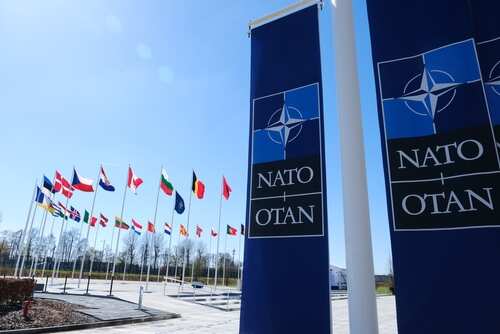
Europe is preparing a major shift in NATO military strategy, emphasizing specialized roles for smaller frontline states while larger allies provide mobile forces. The plan represents a significant departure from decades of standardization and interoperability across NATO.
Story Overview
- Small European states would dismantle current militaries to focus exclusively on prepared defenses and fortifications
- Larger NATO allies would provide mobile offensive capabilities as a second defensive layer
- EU mobilizing over €800 billion for defense transformation as U.S. reduces European presence
- Radical departure from NATO’s traditional standardization approach toward specialized role division
Breaking NATO’s One-Size-Fits-All Strategy
The Modern War Institute at West Point proposes that small frontline European states completely dismantle their current military formations and rebuild them solely for positional defense. This radical concept abandons NATO’s long-standing emphasis on standardization and interoperability, where each ally maintains similar force structures. Instead, Baltic states and other eastern flank nations would focus exclusively on fortifications, obstacles, and sensor networks in likely invasion corridors while relying on Germany, France, and other rear-area allies for mobile offensive capabilities.
EU’s €800 Billion Defense Revolution
The European Union’s Defence Roadmap released in October 2025 sets a path to full defense readiness by 2030, introducing four European Readiness Flagships including the Eastern Flank Watch and European Air Shield. The ReArm Europe Plan mobilizes over €800 billion through tools like the Security Action for Europe loan scheme and national escape clauses allowing up to 1.5% of GDP extra for defense spending. This massive financial commitment enables the infrastructure investments required for large-scale positional defense systems.
America’s Strategic Pivot Forces European Self-Reliance
The 2025 U.S. National Security Strategy signals America’s intent to reduce contributions to European conventional deterrence and shift attention to the Indo-Pacific theater. European allies face pressure to spend up to 5% of GDP by 2035 on defense, nearly double current NATO targets. Congressional debates over the 2026 National Defense Authorization Act include provisions limiting U.S. troop reductions in Europe below 76,000 without approval, reflecting concerns about overly rapid drawdowns while Europe builds capacity.
Historical Precedent Meets Modern Warfare
Russia’s full-scale invasion of Ukraine fundamentally reassessed the likelihood of high-intensity war in Europe, exposing critical deficits in ammunition stocks, artillery, and air defense capabilities. NATO expanded from four to nine Forward Land Forces battlegroups by 2025, while operations Baltic Sentry and Eastern Sentry demonstrate Europe’s growing responsibility for its own security. Unlike historical fixed fortifications such as the Maginot Line, the proposed positional defense emphasizes modern sensor-rich, layered defenses integrated with mobile reinforcement capabilities from allied nations.
Europe’s Positional Defense Opportunity https://t.co/FA2rWeOODe via @WarInstitute
— tankbrigade (@tankbrigade) December 11, 2025
The concept represents a practical response to resource constraints facing small nations asked to dramatically increase defense spending while maximizing deterrence against Russian aggression. This approach allows frontline states to concentrate limited resources on their comparative advantage—prepared defensive positions on home territory—while larger allies provide complex mobile capabilities requiring greater industrial capacity and fiscal resources.
Sources:
Commission and High Representative present new Defence Roadmap to strengthen European defence
Europe’s Role in the 2025 U.S. Security Strategy
A Turning Point Paper on Defence
Europe’s Positional Defense Opportunity
How Europe can strengthen its own defenses and rebalance transatlantic relations
2026 National Defense Authorization Act: What Europeans Need to Know
Renew Europe backs fast-track defence permits to strengthen European security