

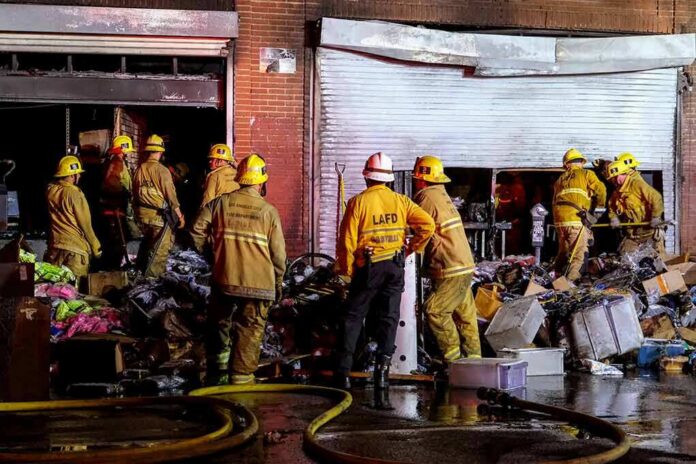
Urban firestorms do not just burn; they chemically recompose the air. The Eaton Fire in Los Angeles proved that with unusual clarity: when homes, vehicles, and electronics ignite alongside brush, the smoke becomes a metal-bearing aerosol fundamentally different from ordinary wildfire haze—and millions downwind can be enveloped in it.
At a Glance
- The Eaton Fire’s smoke plume was highly enriched in toxic metals versus typical wildfire smoke—especially lead, halogens (chlorine, bromine), and arsenic.
- Researchers estimate that during the peak 24-hour period, nearly 7 million people in greater Los Angeles encountered airborne lead concentrations roughly 80 times background levels.
- Post-fire sampling found lead and other metals on indoor and outdoor surfaces, including homes miles from the burn zone.
- The chemistry aligns with what burns in cities—buildings, vehicles, electronics—rather than only vegetation.
What made the Eaton Fire plume different
Not all smoke is the same. The physics of combustion may look similar at a distance, but the feedstock—what actually burns—controls the aerosol chemistry. In wildland-only fires, vegetation dominates the fuel and the particulate mix skews toward organic carbon, black carbon, and a signature of mineral ash. In urban firestorms, the fuel adds layers of complexity: painted and treated wood, polymer-rich furnishings, wiring, batteries, plastics, roofing, vehicle components, and legacy materials such as lead-based paint or solder. In the Caltech-led analysis of the Eaton Fire, the resulting plume showed more than 50-fold enrichment of lead compared with a nearby wildland-fire plume, along with about sevenfold enrichment of halogens (chlorine and bromine) and threefold for arsenic—an unmistakable indicator that structural and vehicular combustion shaped the emissions.
That enrichment is not a mere laboratory curiosity. Lead is a potent neurotoxin; brominated and chlorinated compounds can contribute to corrosive and reactive aerosols; arsenic is a well-established toxicant. The mixture carried by the plume, therefore, implies a qualitatively different exposure profile for communities downwind of urban-interface fires than for communities breathing smoke from a forest fire far from development. The Eaton Fire placed that contrast in sharp relief; it did not invent it.
How researchers traced the plume and sized the exposure
The study’s backbone was time-resolved aerosol chemistry. Researchers leveraged a potassium-to-lead ratio as a tracer to distinguish the Eaton Fire plume from background and from a reference wildland plume, hour by hour, over January 8–13, 2025. With that fingerprint and atmospheric tracking, they mapped the plume’s evolution and derived population counts within the affected air mass, rather than relying on a few stationary monitors alone. The result: an estimate that at the peak on January 9, nearly 7 million residents experienced a 24-hour lead concentration roughly 80 times the typical background level—an exposure-intensity metric, not a claim about individual absorbed dose.
Why this method matters is straightforward. Smoke plumes are dynamic: wind shear, inversion layers, microclimates, and diurnal flows can move a metal-laden layer across basin-scale populations in hours. A chemical tracer gives you a moving map instead of a snapshot. That moving map is what emergency managers and public-health officials need if they aim to warn neighborhoods, guide indoor filtration advisories, and triage where to deploy surface-cleaning resources first.
From air to surfaces: what settled where
Airborne risk often passes with the plume; residue does not. Caltech’s team and collaborators documented that metals transported by the smoke deposited on indoor and outdoor surfaces, including homes several miles from the burn zone. In a campaign drawing more than 300 wipe and dust samples across 52 homes, lead and other metals were detected in settled material, with samples taken near windows showing markedly higher lead than samples from interior locations. The group reported finding lead contamination above EPA limits as far as seven miles from the fire perimeter, underscoring the efficiency with which smoke-borne particles infiltrate buildings and then resettle where occupants touch, clean, eat, and play.
For household risk management, the pathway matters: inhalation dominates during the acute smoke event; ingestion and hand-to-mouth transfer from dust and surfaces may dominate afterward, particularly for children. That helps explain why quick outdoor air improvements can coexist with persistent indoor contamination that requires targeted cleaning and, in some cases, professional remediation. It also explains why window sills and entry floors—interfaces between outdoor and indoor air—often retain the highest post-fire residue loads.
Mechanism and plausibility: where the metals come from
The source attribution is chemically and physically consistent with an urban burn. Lead can originate from old paint, solder, wheel weights, electronics, and legacy plumbing components; bromine and chlorine track with halogenated polymers, flame retardants, and treated materials. Arsenic can appear from pressure-treated wood, electronics, and certain metal alloys. When these materials combust, they produce fine and ultrafine particles that carry metal species and halogen salts; these particles travel efficiently and deposit across wide areas, especially under stable atmospheric conditions that trap smoke layers over the basin. The measured plume chemistry—elevated lead, halogens, arsenic relative to a nearby vegetation-dominated reference—fits that source mix; it does not require an exotic or implausible explanation.
Importantly, the comparative baseline used by researchers was not an abstract model; it was a nearby wildland-exclusive fire plume analyzed with similar instrumentation and methods. That anchor reduces the risk of misattributing background urban metals to the event and strengthens the case that structural combustion drove the observed enrichment.
Smoke from the devastating Los Angeles Eaton Fire last year exposed millions to very high levels of lead and other heavy metals, a new study found.
The research adds to a growing body of evidence that wildfires in urban areas are uniquely toxic. https://t.co/jUjhYXo8kY
— The Washington Post (@washingtonpost) October 29, 2026
Health implications: what we know, what matters operationally
Two realities can be held at once. First, the atmospheric data are unambiguous that the Eaton plume delivered a spike of toxic metals across a large population footprint. Second, an acute concentration spike does not by itself establish long-term health injury for every exposed individual. The former is a matter of measurement; the latter is a matter of dose, duration, and biology, which depends on behavior (indoor vs. outdoor), building filtration, and subsequent contact with contaminated dust. Public-health guidance that follows from both realities is pragmatic: prioritize rapid communication when urban-interface fires are active; recommend indoor sheltering and filtration during peak plume passage; and, once the air clears, pivot to dust hygiene—HEPA vacuuming, wet-wiping high-settle zones, replacing or cleaning HVAC filters—and targeted testing where surface contamination is suspected.
The risk calculus also differs by population. Young children, pregnant people, and those with preexisting cardiovascular or respiratory diseases bear higher vulnerability to even short-term exposure. For lead especially, the absence of a safe threshold in children argues for a low-tolerance approach to post-fire dust in homes and schools. Where practical, clinicians can use blood-lead testing to check for ongoing exposure in concerned households, particularly if surface sampling indicates elevated residue.
Why this changes preparedness for urban-interface fires
The Eaton Fire is a blueprint for improving response. First, treat plume chemistry as an emergency signal, not an academic afterthought: time-resolved aerosol composition—metals and halogens—should be embedded in wildfire and urban-fire monitoring networks so officials can issue metal-specific advisories, not just PM2.5 alerts. Second, plan for a two-phase incident: an acute airborne phase requiring respiratory protection and indoor filtration, followed by a residue phase requiring dust management and, where indicated, remediation. Third, put sampling where people live: wipe and dust sampling of windows, entry paths, and HVAC filters can reveal exposure pathways and help target cleanups efficiently.
Finally, the study’s population-exposure mapping is not just a retrospective statistic; it is a forward-looking tool. If emergency managers can pair real-time chemical tracers with census-weighted population maps, they can concentrate resources—filters, masks, mobile cleaning units—where they will reduce harm the most. The science is already robust enough to make that operational shift. The Eaton Fire did not just teach us what was in the smoke; it showed us how to respond better the next time an urban firestorm blooms over a city.
Sources:
nypost.com, courthousenews.com, mynewsla.com, kshb.com, scienceexchange.caltech.edu