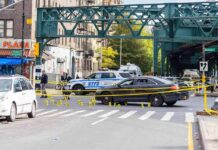


When a homicide scene shows a resident bound and both occupants executed with gunshots to the head, investigators treat it as a targeted double murder until hard evidence proves otherwise; that is exactly what the East Harlem case indicates.
At a Glance
- Police found 66-year-old Elias Severino and his 55-year-old home health aide, Elsa Espina-Espinal, shot in the head inside his East Harlem apartment; Severino was discovered bound.
- No firearm was recovered at the scene, and detectives are investigating it as a double homicide.
- Officers arrived for a welfare check after Espina-Espinal failed to show up for another job; the apartment door was reportedly open or unlocked when first responders entered.
- Robbery has been described by a police source as the apparent starting point, though detectives have not publicly announced a confirmed motive.
What Happened Inside the East Harlem Apartment
Officers responding to a welfare check at a senior housing complex at East 104th Street and Second Avenue discovered a harrowing scene: 66-year-old resident Elias Severino, who was undergoing cancer treatment, and his home health aide, 55-year-old Elsa Espina-Espinal, both dead of gunshot wounds to the head. Severino was found tied up. No gun was recovered in the apartment, and the door was left open or unlocked when police arrived, according to broadcast reporting reviewed after the incident. Those concrete facts — bound victim, execution-style wounds, no firearm recovered — are why detectives are treating the case as a double homicide rather than any other configuration.
The sequence that brought officers to the apartment adds a second layer of clarity. Espina-Espinal failed to appear for another scheduled assignment, prompting a request for a wellness check. Responding officers entered the unit and discovered both victims; they were pronounced dead at the scene. That timeline is consistent across early accounts and explains how a crime behind a closed door surfaced within hours rather than days.
How Investigators Are Framing Motive and Method
From the first pass at the scene, detectives had reasons to consider robbery as a working theory. Restraint of the resident, fatal head wounds to both occupants, and the absence of a recovered firearm all match a pattern seen in in‑home robberies that turn lethal when an unexpected person enters. A police source described the case as one that “began as a robbery” and indicated investigators believe Espina-Espinal may have walked in during the crime — a sequence that would explain why both the resident and the returning aide were killed. At the same time, other outlets reported that detectives had not yet determined motive, signaling that while robbery is a plausible organizing theory for the investigation, it has not been announced as a confirmed conclusion.
Mechanistically, the scene elements are coherent. Binding typically serves control — restraining movement to search, demand valuables, or await access credentials. Gunshot wounds to the head, inflicted on both victims, point to decisive use of lethal force rather than a struggle over the weapon; the unrecovered firearm eliminates a murder‑suicide scenario at a glance. In buildings with partial access control, offenders often exploit tailgating, propped doors, or known visiting rhythms, which is why detectives quickly move to pull camera video, entry logs, and elevator timestamps to reconstruct ingress, movement, and exit.
Why the Timing of Discovery Matters
The apparent discrepancy in reported times — some accounts placing the police response around 8:30 p.m., another citing discovery closer to 10:30 p.m. — likely reflects different reference points: the initial call, first arrival, and the formal on‑scene pronouncement or record entry. What matters operationally is that Espina-Espinal’s missed shift triggered the welfare check that opened the door. In practical investigative terms, that narrows the window of the offense, guides which surveillance segments to prioritize, and tightens the canvass for witnesses and vehicles in the relevant hours.
The building context is also salient. Residents described a nighttime security presence and questioned how an armed assailant gained entry. NYCHA declined to comment in the immediate aftermath, a standard stance during active investigations, leaving the details of access control — fobs, intercom logs, or camera placement — to be established through police review of video and system data.
What Detectives Need to Close a Case Like This
Double homicides inside residences are solved by converging lines of evidence: surveillance showing entry and exit; digital traces such as phone location, rideshare or transit taps; latent prints and touch DNA from bindings or door hardware; ballistic signatures that can match a recovered firearm if one turns up in a later arrest; and property or financial anomalies indicating theft. In New York City, homicide clearance rates tend to outpace those for other major crimes, reflecting both investigative priority and the relative density of evidence violent crimes often generate.
In a scene with binding, extension cords or tape become evidence carriers: they retain skin cells, fingerprints, and tool marks from cutting or tying. The absence of the firearm at the location focuses lab work on shell casings and bullet fragments; those can be entered into the ballistic imaging network to identify links to other shootings if the weapon has a history. Meanwhile, canvassing for witnesses is not limited to people who heard shots; a hallway camera catching a gloved figure at a door can be paired with street-level cameras that spot a vehicle plate, which in turn unlocks a chain of subpoenas for phone pings, toll records, and known associates.
Community Impact and Public Narrative
Crimes inside senior housing resonate because the victims are both personally vulnerable and embedded in a care ecosystem — family, aides, case managers — that depends on predictable, safe access. When a home health aide is killed in the line of care, it punctures the assumption that routine protects. That is why early coverage emphasized Espina-Espinal’s role and Severino’s health status, and why neighbors’ fear centered on access points and camera coverage. It also explains why the investigative focus on surveillance review and security enhancements drew immediate attention from residents and building managers.
At the same time, the broader city backdrop is not one of surging violence. In recent periods, New York has recorded declines in murders and robberies, alongside historically low shooting totals — context that reframes an outlier double homicide as precisely that: an acute, intolerable event demanding resolution, not a signal of systemic unraveling.
🚨 DOUBLE HOMICIDE IN EAST HARLEM
A 55-year-old home health aide and a 66-year-old man were found shot in the head inside an apartment on E. 104th St.
The man was reportedly tied up. No gun was recovered.
💔 The woman was set to retire in December.
Police are investigating. pic.twitter.com/UkFwpKhMts
— UnfiltNY | NYC News (@UNFILTNY1) November 8, 2026
Where the Case Stands
As of the initial reporting window, detectives had made no arrests and had not named suspects. The investigative spine — a bound resident, both victims executed, no weapon recovered, a welfare check triggered by a missed shift — is solid. A police source’s description of a robbery precipitating the violence aligns with the physical scene and with patterns detectives have seen before, even as public statements stopped short of declaring a confirmed motive. Expect the breakthrough, if it comes, to follow the well-worn path: surveillance images matched to a name, lab hits on bindings or casings, or a gun recovered in an unrelated stop that matches the ballistic signature from 2029 Second Avenue.
Sources:
nypost.com, nydailynews.com, bronx.news12.com, newyork.news12.com, abc7ny.com, pix11.com, hudsonvalley.news12.com, nbcnewyork.com, nyc.gov