
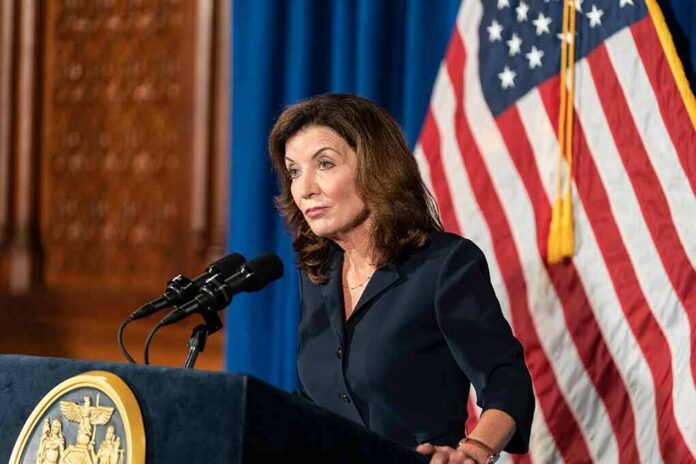
Kathy Hochul secured another term as New York’s governor, defeating Republican Bruce Blakeman in a race that major outlets called early and consistently, reflecting a lopsided vote pattern driven by New York City’s electorate and strong early voting.
At a Glance
- Associated Press and multiple outlets projected Hochul the winner on election night, around 9 p.m. ET.
- Preliminary returns showed a commanding margin for Hochul, not a recount-range contest.
- Independent reporting from City & State, Times Union, and New York Daily News aligned on the outcome.
- Turnout dynamics—especially early voting and New York City’s voter share—explain the scale and speed of the call.
What Happened and Why the Call Came Early
Major decision desks, including the Associated Press, projected Kathy Hochul the winner over Bruce Blakeman at roughly 9:00 p.m. on election night. The call reflected a pattern familiar to close watchers of New York statewide races: once sufficient vote from New York City and its immediate suburbs is in line with historical margins and pre-election polling, the statewide outcome becomes mathematically difficult to reverse. In this case, returns and projection models converged rapidly in Hochul’s favor, producing an early, confident call that was echoed by other outlets the same evening and into the next day.
The preliminary share tallies underscore the point. As of the evening of November 4, the Washington Examiner’s running results showed Hochul leading by a massive spread—77.7% to 22.1%—a margin wholly inconsistent with recount-trigger dynamics and consistent with a decisive statewide victory. While such figures evolve as more ballots are counted and canvasses are certified, the scale of the split explains why decision desks needed little time to project the winner.
The Vote Dynamics That Shape New York Statewide Outcomes
New York City’s electoral weight is the structural fact of statewide politics. Roughly two in five registered New Yorkers live in the five boroughs; when Democratic candidates carry the city by the customary large margins and perform competitively in the suburbs, their statewide position is commanding. Early voting compounded this advantage in 2026: local TV coverage reported early vote participation in the city substantially above 2022’s level, adding both volume and predictability to the early returns feeding projection models.
Campaign strategy followed the math. Hochul emphasized affordability and “kitchen table” concerns—cost of living, taxes, and services—aimed squarely at the state’s dense metro electorate. Blakeman concentrated his efforts on Long Island and exurban turnout, betting on Republican enthusiasm and crossover independents. The result mirrored the structural reality: strong Democratic margins in the city and steady showings upstate and downstate suburbs created a surge-proof lead once the first waves of city vote were reported.
How Projections Work—and What They Do and Don’t Claim
Professional decision desks do not wait for a full hand-tallied canvass. They combine precinct-level returns, historical baselines, demographic and geographic models, and vetted exit or voter analysis to determine when an outstanding vote cannot plausibly reverse the observed trend. In this race, the convergence of early returns with modeled expectations supported an early, decisive projection for Hochul. Media projections, however, are distinct from government certification; counties finalize and transmit official results to the state for a formal canvass in the ensuing days and weeks. That sequence does not contradict an early projection when the margin is insurmountable—it merely reflects how the legal process of election administration operates.
The New York State Board of Elections does not provide rolling statewide totals on election night, a long-standing practice that leaves public-facing live tallies to media aggregators while counties compile unofficial results. The absence of a state-run live ticker neither impairs the legitimacy of independent projections nor substitutes for certification; it simply delineates the roles of media analysis and official canvassing.
Alignment Across Independent Outlets
Confidence in a projected winner is strongest when distinct editorial desks, using different models and sourcing, land on the same call. That occurred here. The Associated Press, City & State New York, the Times Union, and the New York Daily News all reported a Hochul victory on election night or immediately thereafter. None presented this as a hair’s-breadth outcome; the characterization across outlets was of a comfortable reelection, broadly in line with late-campaign polling and early returns.
That cross-outlet alignment matters. In polarized environments, readers sensibly look for convergence signals—whether different institutions reach the same conclusion based on their own judgment. On this race, they did.
🚨 BREAKING: DEMOCRAT KATHY HOCHUL PROJECTED TO WIN REELECTION AS NEW YORK GOVERNOR
Decision Desk HQ projects Democrat Kathy Hochul will win New York's gubernatorial election, securing another term as governor.
The projected victory keeps New York's governor's mansion in…
— LindellTV (@RealLindellTV) November 4, 2026
The Turnout Story Beneath the Headline
Two elements of turnout likely animated the scale and speed of the call. First, New York City’s share of the statewide electorate remained the anchor; high participation among core Democratic constituencies stabilized Hochul’s floor early in the count. Second, early voting—a maturing institution in New York—appeared to accelerate the visibility of that advantage on election night, because more votes were scanned and reportable when polls closed, rather than trickling in through the night as late precincts reported. When a dominant share of early-reporting vote mirrors the modeled outcome, decision desks can call the race earlier and with greater certainty.
What to Watch After Election Night
After projections, the process turns procedural: counties complete their canvasses, reconcile machine tapes and poll books, adjudicate provisional and cured ballots, and transmit certified totals to the state. Those steps can refine margins but rarely reverse landslides. In New York’s 2026 governor’s race, the election-night picture—large, consistent leads confirmed by multiple independent outlets—fit the pattern of a decisive statewide result rather than a contest hinging on late-counted ballots.
Sources:
npr.org, nytimes.com, washingtonexaminer.com, cityandstateny.com, democratandchronicle.com, timesunion.com