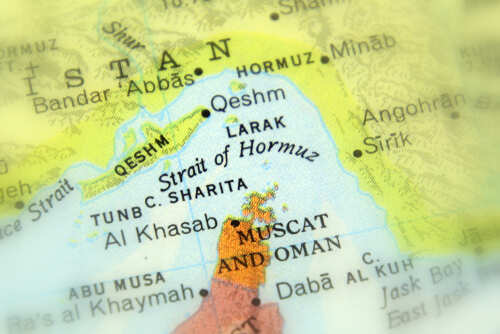
A months-long Strait of Hormuz blockade is testing whether Washington can keep energy flowing without letting inflation and “deep state” inertia do the damage at home.
Quick Take
- The Strait of Hormuz has been blocked since Feb. 28, disrupting a major share of global oil and petrochemicals and keeping Brent crude above $100.
- President Trump has paired ceasefire efforts with a reported “shoot-and-kill” directive for U.S. naval encounters as ship seizures continue.
- Markets are pricing real economic pain: inflation expectations are rising, and the U.S.-global oil spread is widening as Brent stays elevated.
- Claims of a $24B Iraq trade corridor reflect the logical push for overland alternatives, but publicly available sourcing on that specific figure remains thin.
Hormuz Blockade Turns a Regional Clash Into a Global Price Shock
The Strait of Hormuz—one of the world’s most important chokepoints—has been blocked since Feb. 28 after a U.S.-Israeli campaign and subsequent Iranian retaliation, according to the research summary’s cited trackers and market reporting. With roughly 21 million barrels per day of oil flow disrupted and a large slice of petrochemicals affected, Brent crude surged from the low $70s to above $100, closing one recent Friday near $106.
The immediate effect is straightforward: higher energy prices radiate through everything from trucking and air travel to groceries and household utilities. The longer-term effect is political: sustained price spikes revive a familiar argument among conservatives that decades of fragile global supply chains, permissive deterrence, and overreliance on unstable routes leave American families paying for foreign crises. The research also notes non-oil trade disruption, including metals and petrochemicals.
Trump Mixes Deterrence and Diplomacy as Seizures Continue
The latest week in the timeline described in the research includes a U.S. Navy tanker seizure, Iran-linked ship seizures, and an “indefinite ceasefire” extension followed by President Trump’s reported “shoot-and-kill” order. The same reporting also points to indirect talks teed up in Pakistan involving U.S. envoys Steve Witkoff and Jared Kushner. Together, those steps signal a dual-track strategy: raise the cost of interference at sea while pursuing an off-ramp.
That approach will be judged by results, not rhetoric. Conservatives who prioritize national strength and secure trade routes will see hard-edged deterrence as overdue after years of perceived drift. Critics, including many on the left, will worry about escalation and civilian risk. What is clear from the research is that the market is already voting: oil is staying elevated, and uncertainty remains high even when headlines suggest temporary de-escalation.
“$24B Iraq Corridor” Claim Highlights a Real Need, But Verification Is Limited
The research premise circulating online says the Hormuz crisis is “spurring” a $24 billion Iraq-centered land trade corridor to bypass the blocked maritime route. The same research summary also flags a key limitation: no direct source in the provided material confirms the corridor figure or a formal project announcement at that valuation. What can be said with confidence is narrower—when a chokepoint closes, shippers and governments look for alternatives, and Iraq is geographically positioned to matter.
This distinction matters for readers trying to separate hard information from narrative momentum. There is a real strategic logic to rerouting, including pipelines, rail, and highway links that reduce reliance on a single waterway. But the dollar figure and the specific “corridor” branding appear, at least in the supplied research set, to be more inference than documented policy. In an era of constant virality, conservatives and liberals alike have reason to demand receipts before treating numbers as settled fact.
Inflation Pressures Reignite Voter Anger Over Government Competence
Economic spillovers are where the Hormuz crisis collides with domestic politics. The research notes a CPI nowcast near 3.7% and University of Michigan inflation expectations around 4.7%, alongside a sharp Brent premium versus WTI. For households, that kind of expectation shift can become self-fulfilling as businesses price in higher costs. For policymakers, it complicates decisions on rates, spending, and energy strategy—especially with broader trade and tariff debates in motion.
Hormuz crisis spurs $24B Iraq trade corridor as Gulf routes shift https://t.co/2XRMoaOKQp pic.twitter.com/Yl08Ce8VrM
— World News (@Worldnews_Media) April 27, 2026
The deeper frustration, shared across party lines, is that crises keep exposing a federal system that feels reactive rather than prepared. Conservatives see an argument for energy realism—prioritizing abundant supply and resilient infrastructure—over symbolic goals that raise costs. Many liberals will argue for consumer protection and guardrails against inequality. The common ground is the demand for competence: secure routes, credible deterrence, and policies that don’t let everyday Americans absorb the bill for geopolitical miscalculation.
Sources:
Oil prices hold above $100 as Iran seizes ships in Strait of …
Iran Conflict and the Strait of Hormuz: Impacts on Oil, Gas …
Crude oil analysis: Brent could easily top $100 if Hormuz …