

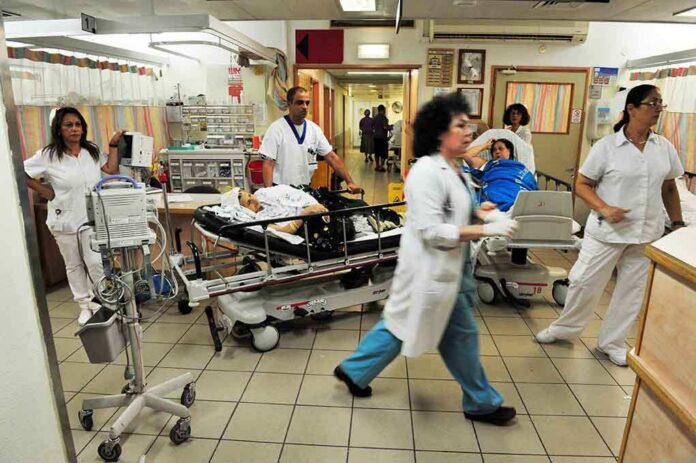
Emergency department “boarding” is no longer a backstage inconvenience; the federal government now classifies it as a measurable access failure with safety consequences, and it will be publicly reported against hospitals using uniform definitions and time thresholds.
At a Glance
- CMS defines ED boarding as holding admitted inpatients in the ED because no inpatient bed is available.
- Clinically significant boarding begins at more than four hours from the decision to admit to ED departure.
- Federal quality measures also capture long ED stays, excessive waits for a treatment space, and patients leaving without evaluation.
- CMS links access failures to higher mortality, delayed care, preventable errors, poor experience, and staff burnout.
What boarding is, in federal terms, and why the definition matters
Boarding has a precise operational meaning in federal quality policy: after a clinician has placed an order to admit a patient to the hospital, keeping that inpatient in the emergency department because no hospital bed is available constitutes boarding. This is not an ED process quirk; it is an output constraint that anchors the system-wide phenomenon of “access block.” CMS has codified that definition in its Emergency Care Access & Timeliness electronic clinical quality measure, adopted for the Hospital Outpatient Quality Reporting program. The measure starts the clock at the “decision to admit” order and stops it when the patient departs the ED; any interval beyond 240 minutes counts as boarding for quality reporting purposes.
The choice of timing anchors two crucial realities. First, by beginning at the decision-to-admit moment, the measure isolates what the ED controls from what it cannot; once a patient is accepted for inpatient care, the bottleneck is bed availability upstream, not triage speed or ED physician productivity. Second, by standardizing timestamps, CMS pushes hospitals to ensure their clinical and IT systems capture, reliably and comparably, the very moments when a crowding problem becomes a capacity problem—when an ED becomes, in effect, a boarding ward.
The four access failures CMS will score—and how they interact
Boarding is only one of four access gaps CMS will report. The measure flags encounters where: a patient waits more than 60 minutes for care in a private treatment area; an admitted patient boards in the ED beyond four hours; the total ED length of stay exceeds eight hours; or the patient leaves without evaluation. Treating these together reframes crowding as a continuum of access failure—input, throughput, and output—rather than a single queue at the front door. Each component has different levers: front-end delays may respond to triage redesign; long stays often reflect diagnostic or consultation bottlenecks; leaving without evaluation is a signal of perceived futility by patients; boarding exposes hospital-wide capacity constraints. By scoring any one failure as a miss, CMS closes the loophole where a hospital might improve one metric while letting another deteriorate, and it signals that patients experience the whole system, not a siloed unit.
Why does this bundling matter beyond public reporting? Because it shapes management attention. When the star ratings reflect not just how quickly a door-to-provider interval looks on a dashboard but whether admitted patients languish in hallways for hours after that decision, executive teams are forced to work the discharge schedule, bed turnover, hospitalist handoffs, and perioperative block times—not just nudge triage scripts. It is an explicit move to redefine ED crowding as an institutional capacity problem rather than a morale problem in the ED.
What the evidence does—and does not—say about harm
CMS grounds this measurement in an evidence base that ties access limitations to serious outcomes: increased mortality, delays in care, preventable errors, degraded patient experience, and staff burnout. These are associations, not patient-level causal verdicts for a specific death, but they are strong enough—and recurrent enough across studies and systems—to justify treating access failures as safety problems, not mere inconveniences. In that frame, a four-hour boarding threshold is less an arbitrary cutoff than a sentinel for when inpatient care is being delivered in a setting built for rapid stabilization, not prolonged treatment and monitoring.
In parallel, national research suggests the pressure is rising. Analyses using national survey data report that the share of ED visits involving boarding has roughly doubled since the early 2000s, and multicenter cohorts show boarding hours per day climbing markedly since 2019 even as attending-physician staffing hours remained flat—intensifying the boarding burden per clinician hour. Those findings reinforce the policy turn: the problem is not episodic or isolated; it is structural and escalating, which is exactly the class of problem quality regulation is designed to surface.
Measurement mechanics: timestamps, denominators, and gaming risk
The backbone of the CMS measure is a small set of timestamps that clinical systems can capture consistently: arrival time, time to evaluation in a private space, order time for decision to admit, and ED departure. That data architecture matters because credibility lives and dies with comparability. Using decision-to-admit as time zero aligns the denominator with patients whose disposition is settled and therefore excludes, appropriately, those still under diagnostic evaluation. It also mitigates gaming via delayed orders; by publishing a bundle of access failures, CMS reduces the incentive to “solve” boarding by postponing the admit decision or redefining hallway chairs as treatment spaces. The measure’s explicit, public definitions and its integration into Hospital Outpatient Quality Reporting give it teeth—on reputation, and ultimately on payment—without micromanaging local flow tactics.
Still, the measure compresses complexity into a few indicators. It will not, on its own, apportion blame among late discharges, environmental services turnaround times, elective OR blocks, hospitalist staffing, or scarcity of behavioral-health placements. Executives and clinicians will have to do that work locally, with internal flow analytics. But the federal score creates the external forcing function many hospitals have lacked.
The capacity problem behind the ED problem
Hospitals that treat boarding as an ED operations issue rarely make headway. The literature on crowding is unambiguous: input (volume and case mix), throughput (diagnostics, consultation, staffing), and output (availability and timing of inpatient beds) together determine flow. When inpatient units run at near-saturated occupancy with late-afternoon discharges, the ED becomes the pressure-release valve by default. Sustainable improvement has come from hospital-wide interventions—earlier discharges, real-time bed management, smoothing elective surgical schedules, and shared accountability between ED and inpatient services—rather than from adding a handful of ED stretchers or tweaking triage scripts.
That framing matters for clinicians and patients living the consequences. Boarders receive inpatient-level care in corridors and improvised bays; nurses carry double loads; medication timing, telemetry monitoring, and privacy all suffer. Meanwhile, incoming undifferentiated patients—stroke, sepsis, trauma—arrive to an ED whose resources are already committed. This is the patient-safety logic behind CMS’s move to public reporting: when the system uses ED hallways as spillover wards, risk rises across the board.
🚨 ED overcrowding is not an emergency department problem.
It is a health system failure.
The new CAEP position statement argues that hospital access block, not inappropriate ED use, is the primary driver of crowding. Patients waiting for inpatient beds experience worse… pic.twitter.com/CmXFKUg3fl
— CJEM (@CJEMonline) November 3, 2026
What to watch as public reporting comes online
Implementation will be staged: hospitals are preparing for reporting in the 2027 cycle, with broader mandates following. Expect three dynamics. First, documentation will improve; clean timestamps are the price of admission. Second, operational changes with real impact—earlier discharge targets, inpatient staffing alignment, bed turnover discipline—will compete with superficial fixes; the bundle structure nudges toward the former. Third, reputational and financial incentives will concentrate leadership attention where it belongs: on the whole-organization capacity plan, not a single unit’s heroics. The real test will be whether measured boarding durations and long-stay rates fall once hospitals are compared, transparently and at scale, on access and timeliness.
Sources:
wsj.com, ecqi.healthit.gov, qualityreportingcenter.com, onlinelibrary.wiley.com, academic.oup.com, ena.org