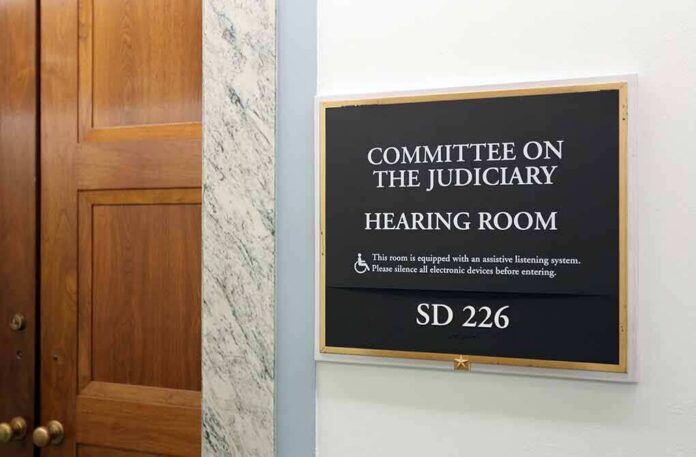
Jasmine Crockett’s “great replacement therapy session” line matters because it captures something larger than one flashpoint: immigration hearings in Congress are no longer just about enforcement; they are also performances in which race, legitimacy, and institutional power are fought over in public. Crockett used that language to argue that Republican lawmakers were staging moral theater while ignoring deaths in ICE custody and allegations of federal abuse.
Intro Header
- Crockett framed a House Judiciary immigration hearing as a “great replacement theory therapy session,” directly tying GOP messaging to racialized political rhetoric.
- Her criticism was aimed at a specific setting: a congressional hearing on immigration enforcement and detention conditions.
- The dispute sits inside a broader political pattern in which “replacement,” “white identity,” and “anti-immigrant” arguments are deployed as competing narratives about power and belonging.
- The central issue is not whether the phrase was provocative; it clearly was. The issue is what kind of politics it describes, and why that framing has become so durable.
What Crockett Was Doing in the Hearing
According to the reporting and posted hearing clips, Crockett denounced her Republican colleagues during a July 22, 2026 House Judiciary Committee session, saying they were holding another “great replacement theory therapy session” while they ignored “federal agents shooting and killing people and detainees dying in ICE custody.” A separate clip summarized her as saying, “We’re back again for another edition of the Republican Party’s great replacement theory therapy session,” while she criticized the panel’s focus on mass deportations. That is not a stray insult thrown in passing. It is a deliberate political frame: Republicans, in her telling, are not merely talking about immigration but laundering a racialized worldview through the language of oversight.
The language is sharp because the target is structural. Crockett was not arguing with a single witness or objecting to one bad line of questioning; she was attacking the premise of the hearing itself. In her formulation, the committee had become a ritualized venue for anti-immigrant messaging, with white male lawmakers presenting enforcement as common sense while she cast the underlying politics as a version of the “great replacement” narrative. That is why the phrase landed: it fused a committee-room dispute with a broader argument about who gets to define threat, order, and belonging in American politics.
Why the “Great Replacement” Frame Has Political Power
The phrase “great replacement” carries its own history, and that history explains why Crockett chose it as a weapon. In contemporary U.S. politics, the term has migrated from fringe conspiracy language into a broader rhetorical field where demographic anxiety, immigration restriction, and racial grievance overlap. Media monitoring has documented prominent conservative figures using explicit replacement-style language about immigrants, white voters, and demographic change; in that environment, Crockett’s use of the phrase is best understood as counter-accusation as much as critique.
That matters because hearings on immigration are not neutral technocratic exercises. They are among the most symbolic venues in Congress, where lawmakers speak not only to one another but to cable clips, donors, activists, and primary voters. When a Democrat calls an immigration hearing a “great replacement theory therapy session,” she is not trying to sound decorous. She is trying to name what she believes the hearing is doing politically: converting border enforcement into identity politics, and doing so in a way she considers racialized and deceptive.
The Broader Context: Immigration Oversight as Narrative Warfare
This confrontation belongs to a larger pattern in which immigration oversight hearings become stages for fights over race rather than simply evidence. Crockett has repeatedly positioned herself as a critic of Republican efforts to sanitize or reframe uncomfortable history and policy, including prior clashes over race, the Smithsonian, and the rhetoric surrounding immigration enforcement. In that sense, her July 2026 attack fits a consistent style: she treats Republican committee hearings as vehicles for ideological signaling, not just legislative scrutiny.
The content of her criticism also aligns with a recurring Democratic line about Trump-era immigration politics: that enforcement rhetoric often masks abuse, indifference, or cruelty. In reporting and clips about her criticism of the administration’s immigration agenda, Crockett argued that Republican policy and rhetoric were rooted in racism rather than public safety. That is the through-line. She does not present immigration as a purely administrative question; she presents it as a moral and racial one, and then uses the hearing itself as evidence for that claim.
How the Republican Side Uses the Same Terrain
The Republican response is structurally similar, though opposite in moral valence: GOP figures and allied commentators frequently cast Democrats as naïve on border security or hostile to Americans concerned about demographic and cultural change. Charlie Kirk, for example, publicly accused Crockett and Democrats of being part of a plot to “replace white people,” language that shows how directly replacement rhetoric has entered the exchange. Once that language is in circulation, both sides begin talking in the same symbolic code, even when they insist they are denouncing each other.
That is the deeper significance of Crockett’s phrase. It is not merely an insult; it is an attempt to seize the most charged vocabulary in the argument and turn it back on her opponents. She is saying, in effect, that the spectacle of “law and order” at the border is itself a racial performance. The political risk, of course, is that a line like that can harden the very tribalism she is condemning. But it is also why the line travels so far: it compresses a long-running fight over immigration, race, and authority into one memorable sentence.
Jasmine Crockett: “We’re back for another edition of the Republican Party’s Great Replacement Theory therapy session, where all the White men lecture Americans on the importance of mass deportations so they preserve their so-called American values.” pic.twitter.com/hzBYxoBLZ2
— Thomas Sowell Quotes (@ThomasSowell) July 23, 2026
What This Says About Crockett’s Political Method
Crockett’s style is confrontational by design. She tends to meet Republican provocation with a counterprovocation that is louder, more explicit, and harder to sanitize for the evening news cycle. That approach can be effective in a media ecosystem that rewards memorable conflict, but it also means she often frames her opponents in the most accusatory terms available. In this case, she was not merely saying Republicans were wrong on immigration; she was saying their hearing amounted to a “great replacement” performance, and that they were ignoring concrete human harms in favor of identity-coded theater.
For readers trying to understand the political substance beneath the rhetoric, the key fact is that the hearing became a proxy war over what immigration policy signifies. For Crockett, the answer is racial fear disguised as oversight. For Republicans and their allies, the answer is defensive realism about borders, law, and national cohesion. The reason the exchange resonates beyond one committee room is that both sides are fighting over a basic question of legitimacy: whether immigration politics in America is still about policy, or whether it has become a recurring referendum on who counts as part of the nation in the first place.
Sources:
twitchy.com, instagram.com, msn.com, mediamatters.org, youtube.com, politico.com, atlantablackstar.com, en.wikipedia.org