
Hospitals are designed for triage and treatment, not tactical lines; when federal agents formed a line across the ambulance entrance at a Los Angeles emergency department and ambulances were diverted for roughly two hours, the collision between immigration enforcement and emergency medicine stopped being theoretical and became operationally real.
At a Glance
- Adventist Health White Memorial said federal agents lined up across its ambulance entrance, prompting a two-hour diversion of ambulances to other hospitals.
- The hospital confirmed agents brought a person in custody to its emergency department, where clinicians provided care as they would any patient.
- Videos and eyewitness accounts describe agents pushing protesters and deploying what appeared to be pepper spray; at least two people were detained during the protest.
- LAPD says its officers responded to preserve emergency access and keep the peace, and that they did not engage in immigration enforcement.
- Mayor-elect Nithya Raman joined protesters and publicly linked the episode to broader community concerns over immigration enforcement at care sites.
What Happened Outside White Memorial’s ER
In early November, Adventist Health White Memorial in Boyle Heights publicly stated that federal agents arrived at the hospital, brought a person in their custody to the emergency department for treatment, and then formed a line across the ambulance entrance—an action the hospital says it neither requested nor authorized. Administrators reported diverting ambulances to nearby hospitals for about two hours while the line stood in place. Local outlets corroborated the hospital’s account: NBC Los Angeles reported the diversion window and relayed the hospital’s objection to the agent line at the ambulance bay; the Los Angeles Times likewise quoted the hospital’s statement that the ambulance entrance was blocked without the hospital’s approval.
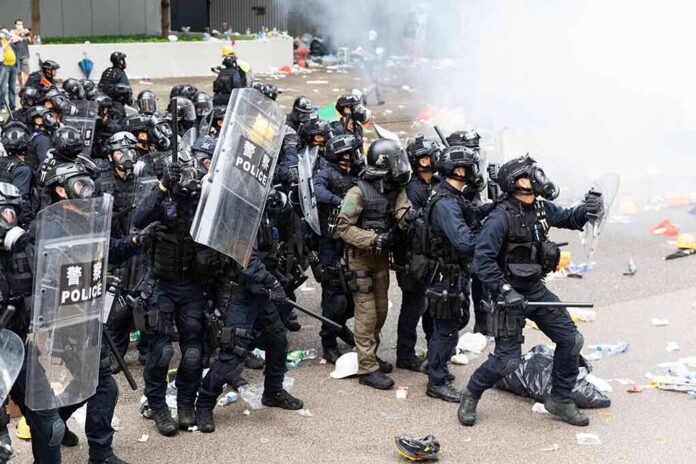
On the ground, the enforcement presence and a rapidly gathering protest collided. Multiple videos and contemporaneous reporting describe masked agents pushing demonstrators and spraying a substance that appeared to be pepper spray. LAist reported that at least two individuals were detained, and its coverage included protest audio of bystanders shouting, “You’re arresting U.S. citizens,” a claim echoed by rapid-response organizers on scene. While details such as the exact chemical and the final disposition of detainees await formal documentation, the observable facts—pushes, spray, and detentions amid a standoff outside the ambulance entrance—are not in serious dispute in the published record.
LAPD’s Role and the Immediate Public-Safety Frame
The Los Angeles Police Department describes its participation as reactive and circumscribed: officers were dispatched following a hospital-security call referencing approximately 30 protesters breaching the ambulance-access area. According to an LAPD spokesperson, the department’s mission was to maintain public safety, preserve emergency access, and keep the peace; LAPD emphasized that its officers did not engage in immigration enforcement activities alongside federal agents. That distinction matters operationally and politically—LAPD has long operated under rules that bar its officers from enforcing federal immigration law—but in the moment it meant two parallel missions were unfolding in the same space: federal custody and crowd management on one side, uninterrupted emergency throughput on the other.
In the hours that followed, the hospital-centric narrative—emergency ingress obstructed, diversion ordered—competed with accounts that protesters had themselves entered or blocked the ambulance corridor, a dynamic that often shapes public interpretation before a minute-by-minute chronology is assembled. Regardless of which actor stood where at every instant, the hospital’s diversion decision is a concrete operational impact with implications for regional EMS load balancing and patient routing.
Why Hospitals Became an Immigration Enforcement Flashpoint
For years, hospitals existed within a de facto buffer from routine immigration enforcement. Starting in the 1990s and reinforced by ICE memoranda in 2011 and 2021, health care facilities, schools, and houses of worship were treated as “sensitive locations,” where arrests and searches were discouraged absent special circumstances. The rationale was straightforward: people avoid essential services when they fear enforcement at the door.
That framework changed in January 2025, when the Department of Homeland Security rescinded the protected-areas guidance, removing a bright-line policy that had reduced the likelihood of enforcement at clinical sites. Legal and health-policy analyses since then have warned hospitals to prepare for direct encounters with immigration agents and to harden procedures that preserve access, privacy, and patient rights even when federal operations unfold nearby. The Kaiser Family Foundation and major law-firm advisories summarized the shift: enforcement at or near hospitals, once rare, would no longer be presumptively off-limits, and facility leaders would bear greater responsibility for keeping care pathways open.
Mechanics: How an ER Diverts, and What It Signals
Ambulance diversion is not a press release—it is an operational order triggered by compromised capacity or access. When a receiving hospital directs ambulances elsewhere, patients are rerouted under established EMS protocols that account for condition, distance, and the status of neighboring facilities. Diversion does not mean every patient is turned away; it means the system absorbs stress by distributing arrivals. Still, even a short diversion alters throughput at multiple hospitals and adds minutes to some transports, which is why hospitals escalate to diversion only when other mitigations fail. White Memorial’s confirmation that ambulances were diverted for about two hours indicates a sustained impairment of its emergency entrance—even as clinicians continued caring for the in-custody patient inside.
From a risk perspective, the combination of an enforcement perimeter, a volatile protest, and ambulance traffic is precisely the cocktail the former sensitive-locations policy sought to avoid. Each actor—federal agents securing custody, protesters asserting civil rights, hospital security managing ingress—creates vectors for delay and error if not carefully deconflicted. The operational lesson is banal but decisive: whoever controls the ambulance bay controls the standard of emergency access.
What the hell was ICE doing at this hospital?!
Glad to see that Mayor Elect Nithya Raman was at the protest.Two detained during anti-ICE protest at White Memorial Hospital in Boyle Heights: reports say https://t.co/1qKAlADmQW
— Leone Hankey (@HankeyLeone) November 7, 2026
Politics at the Curb: Raman’s Appearance and Community Response
Mayor-elect Nithya Raman joined demonstrators outside White Memorial, thanked participants, and framed the episode as evidence that immigration enforcement should not impede hospital functions. Her presence connected an administrative incident to an electoral mandate, aligning with longstanding advocacy in immigrant-rich neighborhoods like Boyle Heights. LAist and other local outlets documented Raman’s appearance and community organizations’ rapid response, underscoring that health-care sites have become focal points for civic contestation since the rescission of protected-areas guidance.
The public debate will inevitably feature dueling claims about who impeded whom first. But the elements that do not hinge on contested seconds are the ones that should drive policy: the hospital’s explicit statement that a federal line crossed its ambulance entrance without authorization; the documented decision to divert; and the reality that an in-custody patient received care inside while conflict brewed outside. The throughline is not partisan. It is operational governance.
What Competent Policy Looks Like Going Forward
Two imperatives can coexist without contradiction: federal agents may lawfully seek medical clearance for people in custody and, in rare cases, conduct operations that intersect with care sites; hospitals must guarantee unimpeded emergency access and a zone of clinical calm that extends to the ambulance dock. Reconciling those imperatives requires preplanned choreography rather than ad hoc postures at 2 a.m. Health systems should have written playbooks for any law-enforcement presence: a single point of contact; delineated zones that seal off the ambulance ingress from any perimeter; and clear rules for how custody is maintained without obstructing clinical flow. On the government side, agencies need standing directives that treat emergency ingress as sacrosanct; no line, no vehicle, no staging should compromise that lane for any duration absent an imminent life-safety threat. Since the federal protected-areas shield no longer exists, that discipline must be built by interagency agreements and local protocol rather than federal memo alone.
White Memorial’s account and the independent reporting around it make one conclusion unavoidable: the ambulance bay is not a negotiating space. If federal operations are necessary at a hospital, they must be executed in a way that is invisible to the rhythm of emergency care. When those rhythms are broken—even for two hours—the system has already paid a cost.
Sources:
nypost.com, laist.com, latimes.com, nbclosangeles.com, dorsey.com, jonesday.com