Pakistan’s reported dispatch of 8,000 troops and a jet fighter squadron to Saudi Arabia under a new mutual defense pact signals a sharper Gulf security realignment that conservatives should watch closely.
Story Snapshot
- Saudi Arabia and Pakistan publicly formalized a mutual defense pact in 2025; reports now say Pakistan deployed troops, fighter jets, drones, and air defenses to the Kingdom [2][1][4].
- Official language says aggression against one is aggression against both, elevating the stakes of any Gulf crisis [3].
- Analysts say this is a real security commitment built on decades of cooperation, not mere symbolism [5][6].
- Some details remain unclear, including exact unit composition and mission scope, with Pakistan offering limited public confirmation [1][3][4].
What Deployed: Reported Troops, Jets, Drones, Air Defense
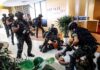
Multiple reports derived from a Reuters dispatch say Pakistan sent about 8,000 troops, a squadron of JF-17 fighter jets, drones, and air-defense systems to Saudi Arabia under their mutual defense pact, framing the package as combat-capable rather than a training mission [1][4]. Coverage cites a Saudi Ministry of Defence announcement acknowledging Pakistani forces, including fighter jets, arriving under the agreement [3]. Open-source observers reportedly tracked Pakistani airlifts of equipment during December and January before the public reporting emerged, adding circumstantial support [3].
While the numbers circulate widely, the specific unit designations, basing orders, and rules of engagement are not disclosed in the available public material [1][3][4]. That gap matters for understanding whether these jets and air defenses sit in continuous alert roles or rotate for training and deterrence. The reports present a consistent picture of substantial assets, but they rely on secondary summaries without an official Pakistani force-level roster, which leaves the precise scale unverified on the public record [1][4].
The Pact: A Formal Mutual Defense Commitment Since 2025
Saudi Arabia and Pakistan signed the Strategic Mutual Defence Agreement on September 17, 2025, in Riyadh, publicly elevating their long-standing security cooperation into a declared mutual defense framework [2]. Public summaries of the pact describe a clear clause: aggression against either state is considered aggression against both, signaling a collective response threshold that can reshape crisis calculations in the Gulf [3]. Expert commentary underscores that the pact formalizes decades of bilateral defense ties rather than inventing them anew [5][6].
Analysts also stress the continuity: Pakistani troops historically supported training and security functions in the Kingdom, so some portion of today’s posture may extend older patterns rather than mark an abrupt surge [5][6]. At the same time, the reported inclusion of a fighter squadron and modern air-defense systems points to capabilities that exceed advisory optics, suggesting practical deterrence value even if some mission details remain undisclosed [1][3][4]. The blend of continuity and capability is why observers read the move as meaningful, not merely symbolic [5][6].
Why It Matters For U.S. Interests And Conservative Priorities
Regional deterrence and energy market stability intersect here. A more secure Saudi Arabia, backed by Pakistani manpower and air cover, could harden key oil infrastructure against attack and reduce the odds of supply shocks that punish American families with higher fuel and grocery prices [1][4][5]. Conservatives concerned about inflation and energy costs have a stake in any arrangement that steadies production and shipping lanes, regardless of whether support comes from Washington or trusted partners in the region [5][6].
Pakistan, which is mediating tensions between Iran and the United States, has deployed 8,000 troops, fighter jets, drones and an air defense system to Saudi Arabia under a mutual defense pact between the two countries.
Reuters reported that the deployment includes 16 JF-17… pic.twitter.com/EliMJ6TYD6
— TOLOnews English (@TOLONewsEnglish) May 19, 2026
Questions remain. The sources available here do not publish the full treaty text, any annexes, or unit-level deployment orders, and Pakistan’s government has been relatively quiet publicly [1][3][4][5]. The reports link the timing to tensions with Iran, yet no cited primary statement defines the deployment explicitly as anti-Iran deterrence [1][3][4]. Readers should treat the core facts as credible where corroborated—pact signed, forces reportedly deployed—while recognizing limits on verifiable granularity about composition, basing, and authorized missions in open sources [1][2][3][4][5][6].
Sources:
[1] YouTube – 8000 Pakistani Troops & JF-17 Jets Deployed In Saudi Arabia
[2] Web – Strategic Mutual Defence Agreement – Wikipedia
[3] Web – Leaked Documents Reveal Details of the Secret Saudi Arabia …
[4] YouTube – Pakistan Sends Troops To Saudi Arabia
[5] Web – The Saudi-Pakistani Defense Pact and U.S. Force Posture in the Gulf
[6] Web – Understanding the Pakistan–Saudi Defense Agreement