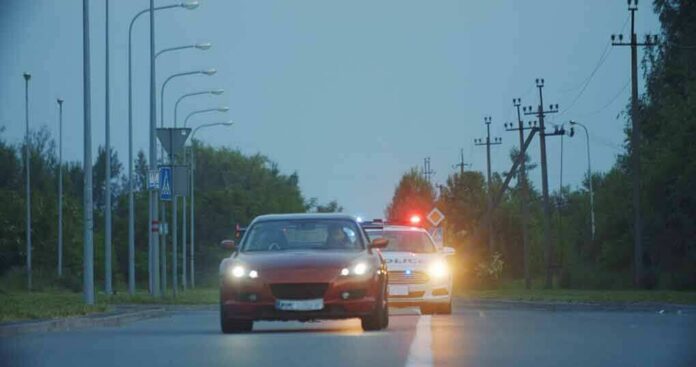
When a driver refuses to stop and turns a roadway into a weapon, the fastest path to safety is often a disciplined end to the pursuit—not a longer chase. That is the logic behind the Grappler Police Bumper, a tethering tool that lets a pursuing unit seize a fleeing car’s rear wheel and drag the event to a controlled stop. Used properly, it shifts a chaotic, rolling risk into a contained arrest.
At a Glance
- The Grappler is designed to terminate pursuits by snagging a fleeing vehicle’s rear tire and forcing a controlled halt, reducing the window for catastrophic crashes.
- Agencies deploying the device frame it as a safer alternative to open-ended high-speed chases and risky maneuvers like PIT at freeway speeds.
- Documented deployments show the Grappler ending pursuits quickly when conditions allow—sometimes within seconds of a unit taking over the lead.
- Pursuit policy still governs everything: supervision, risk assessment, and post-incident review determine when a Grappler is warranted and how it is judged afterward.
What the Grappler actually does, and why it can change the physics of a chase
The Grappler is not a spike strip on wheels; it is a precision tether. A reinforced nylon net stows in a cradle on the front bumper of a police SUV. In the “snag maneuver,” the pursuing vehicle closes to within several feet of the suspect’s rear quarter and feeds the net into the path of a spinning tire. The tire bites, the net cinches, and a high-strength tether couples the suspect car to the police unit. Done correctly, the suspect’s driven wheel can no longer rotate freely, yaw authority collapses, and momentum bleeds out as the lead unit modulates throttle and braking to bring both vehicles to a stop. Because control is centralized in the pursuing unit, the device is fundamentally different from impact-dependent tactics like PIT; it seeks capture-by-constraint rather than destabilization-by-force.
This mechanism matters in the real world. Pursuits are time-risk functions: each additional minute at freeway speed multiplies exposure for bystanders. A tool that ends the event in seconds trims the tail of the risk curve. Agencies adopting the Grappler say that is precisely the value proposition—less time at dangerous speeds and a more predictable terminal phase for officers, suspects, and everyone sharing the road.
Where agencies are using it—and what the field data says so far
Local deployments now span a range of contexts: stolen cars running triple digits on the interstate, reckless drivers weaving through city arterials, and felony eludes where spike strips would be hard to stage. In Washington State, for example, a well-documented incident ended 33 seconds after a Grappler-equipped deputy joined the pursuit; dash video shows the tether grab the fleeing car’s rear wheel and the event resolved without secondary collisions. In Florida, the Hillsborough County Sheriff’s Office published similar results: a refusal-to-stop escalated briefly, then ended cleanly when the Grappler seized the suspect’s wheel, avoiding a prolonged chase in commuter traffic.
Adoption is widening. Clark County, Washington, equipped two dozen patrol vehicles and cast the move as a deliberate shift toward faster, controlled terminations; leadership touted the Grappler as a safer alternative to traditional high-speed methods in the region’s mixed urban–suburban grid. Other agencies—from county sheriffs to state patrols—have piloted or fielded the system and integrated it into their pursuit playbooks as a specialized option when conditions align: adequate spacing, clear lanes, compatible vehicle profile, and a trained operator in the pocket to execute.
Pursuit policy sets the left and right limits
Even the best hardware fails without sound governance. Modern pursuit policies grew out of decades of research emphasizing two truths: pursuits can be necessary, and they are among the most hazardous operations in policing. That is why agencies codify thresholds to initiate, mandate continuous risk balancing against offense severity, and often require supervisor oversight and air support when available. Post-incident review is standard; the same goes for formal evaluation of any intervention tactic used, Grappler included.
Nationally, fatality trends underscore the stakes. Between 2017 and 2021, the United States saw 4,415 pursuit-related deaths, with a statistically significant rising trend; any tactic that can end a pursuit more quickly and predictably is not a curiosity but a potential lever on those numbers. Policy literature consistently recommends clear directives, robust training, and structured alternatives to indiscriminate pursuit—precisely the environment in which a tether device belongs.
How officers decide whether to deploy the Grappler
Three filters dominate: necessity, feasibility, and margin. Necessity asks whether the driver’s behavior has crossed from noncompliance to active endangerment—wrong-way driving, high-speed weaving, hit-and-runs, or clear felony elude. Feasibility checks vehicle compatibility (rear-wheel access, ride height), road geometry, and traffic density. Margin is the operator’s calculus: do I have the space and stability to close, align, and feed the net without triggering a secondary crash? The answer can change second by second; trained units often pace and wait for a clean lane or a traffic lull before committing.
When those conditions materialize, the payoff can be immediate. Agencies with early experience report deployments that end pursuits in seconds, often before spike strips can be staged or a PIT would be justifiable at prevailing speeds. Conversely, when conditions are not met—crowded lanes, erratic swerving, or mechanical mismatch—operators stand down and return to containment, air tracking, or deferred apprehension. A device that can be withheld is as important as one that can be used.
Strengths and limitations in the field
Strengths are straightforward. The Grappler allows capture without striking the suspect vehicle’s body, reduces the need for multiple cruiser contacts, and centralizes terminal-phase control in the trained lead unit. It is particularly valuable when speed and mass make PIT inadvisable—large pickups, SUVs at freeway velocities, or scenarios where a spinout would vector into occupied lanes. Because the tethered stop is deliberate rather than abrupt, secondary collisions can be minimized.
Limitations are equally real. Not every vehicle profiles well for a rear-wheel snag; low-slung sports cars or vehicles with obstructed wheel wells are harder targets. Complex traffic, narrow shoulders, or aggressive counter-maneuvers can spoil alignment. The tool also requires specialized training and disciplined fleet integration—Grappler units must be placed where they can actually intercept, and operators need recurrent reps to keep the timing crisp. Cost is nontrivial at installation and per-net replacement, which forces agencies to prioritize deployment and training pipelines prudently. These are solvable constraints, but they are constraints nonetheless.
How the Grappler fits alongside other pursuit tactics
Think in layers, not replacements. Aviation tracking buys time and reduces ground pressure. Communications discipline and supervisor control cap emotional decision-making. Spike strips remain valuable for corralling a route or draining speed when staging is feasible. PIT is still the right choice at lower speeds or on open stretches with clear runoff. The Grappler occupies the niche where immediate, controlled capture is preferable to a forced spin or an elongated shadowing game. Well-run agencies treat these not as competing hammers but as a kit, choosing the right lever for the risk profile at hand.
Documented practice reflects that layering. Some agencies have used the Grappler as the terminating move after spike strips softened a vehicle; others have gone straight to the tether when the window opened and a longer chase promised only escalating hazard. The throughline is not gadgeteering—it is risk governance anchored in policy and training.
It started as a reckless driving call…
and quickly became a serious threat to public safety.High speeds. Hit-and-runs. Oncoming lanes.
Deputies ended it with a Grappler and took the driver into custody safely.#PoliceChase #Grappler #Pursuit #FirstResponders #BodyCam #Heroes— Us Breaking Hub (@United_Threads) August 16, 2026
Why this approach aligns with what the research has told us for years
Serious scholarship on pursuits has pressed agencies toward three pillars: restrict initiation to justified offenses, supervise and reassess continuously, and invest in alternatives that reduce exposure time. The Grappler answers the third pillar directly. By letting a trained operator end an event deliberately, it complements restrictive policies rather than subverting them. That congruence matters because pursuit deaths have trended upward in recent years; any intervention that can shave minutes off a chase without trading them for a spinout into cross-traffic is a net public-safety gain when used within policy.
The evidence base around the Grappler itself is still dominated by agency reports, local news, and case documentation rather than longitudinal studies—no surprise given the technology’s relatively recent fielding. But we do not need to pretend ignorance about the core mechanism: shorter pursuits at lower terminal chaos translate to fewer opportunities for catastrophe. As more agencies publish audited outcomes and as researchers pool multi-jurisdictional data, expect the early pattern to be tested more rigorously. For now, the prudent reading is clear: used under strong policy, with trained operators and supervisory control, the Grappler is a meaningful addition to the pursuit-intervention toolkit—one that prioritizes containment over collision and closure over adrenaline.
Sources:
jsonline.com, nationaltoday.com, katu.com, cbs12.com, cbsnews.com, yahoo.com