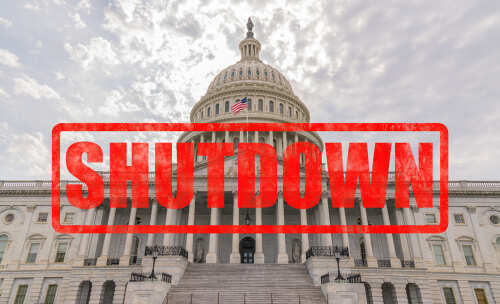
Democrats’ refusal to compromise triggered a government shutdown, exposing the very hypocrisy they once condemned—and millions of Americans now pay the price.
Story Snapshot
- Democrats demand increased health spending and policy reversals, resulting in a federal shutdown.
- Republicans insist on fiscal restraint and protecting legislative wins, refusing Democratic priorities.
- Nearly 1.6 million federal employees affected; critical health and social services suspended.
- Media and conservative analysts highlight Democratic hypocrisy, citing their prior opposition to shutdown tactics.
Democratic Hypocrisy Drives Federal Shutdown
On October 1, 2025, the United States government entered a shutdown after Congress failed to pass appropriations for the 2026 fiscal year. The impasse stemmed from Democrats demanding increased health spending and policy changes as conditions for passing a budget, despite their long-standing condemnation of shutdown tactics. This move has left millions of Americans facing disruptions to essential services, while Republicans, led by President Trump, maintain their stance against reckless fiscal expansion and policy reversals. The shutdown exposes a dramatic reversal in Democratic rhetoric, with blame narratives dominating public discourse.
Republicans have repeatedly offered to maintain current spending levels and preserve recent legislative achievements, insisting that responsible governance requires fiscal discipline. Democrats, however, have refused to budge on demands for expanded healthcare funding and permanent extensions of premium tax credits. Both parties possess enough Senate votes to block each other’s proposals, resulting in a stalemate that has now paralyzed government operations. This political gridlock has reignited conservative concerns about government overreach and irresponsible spending, with many viewing the shutdown as a direct consequence of Democratic inflexibility.
.@VP: Democrats are willing to shut down the federal government because we won't give them $1.5 trillion (including taxpayer-funded free health care for illegals). We're simply not going to do that. pic.twitter.com/QyPVatmwCI
— Rapid Response 47 (@RapidResponse47) September 29, 2025
Impact on Americans and Federal Services
The shutdown’s immediate effects are severe: nearly 1.6 million federal employees have been affected, including 900,000 furloughed and 700,000 working without pay. Critical programs such as the NIH, CDC, and WIC have been suspended, disrupting healthcare, research, and social support for vulnerable communities. The Department of Education and other agencies have scaled back operations, leaving millions without access to key services. These disruptions highlight the real-world consequences of partisan brinkmanship, as families, workers, and small businesses bear the brunt of Washington’s dysfunction.
Beyond short-term hardship, the shutdown risks undermining public trust in government institutions and delaying vital scientific research, public health initiatives, and welfare programs. The economic impact grows daily, with contractors and suppliers facing payment delays and uncertainty. Social instability increases as communities reliant on federal support struggle to adapt, and the broader healthcare sector faces funding gaps that threaten ongoing projects and services. For many Americans, this crisis serves as a stark reminder of the dangers of prioritizing partisan agendas over the needs of the nation.
Political Messaging and the Battle for Public Perception
President Trump and Republican leaders have used the shutdown to spotlight what they call Democratic hypocrisy, pointing to Democrats’ previous denunciations of shutdown tactics. Media outlets and conservative commentators amplify this narrative, arguing that Democrats now employ the very strategies they once condemned when it serves their interests. Meanwhile, Democrats accuse Republicans of inflexibility and blame them for refusing to negotiate on policy changes. The result is a polarized information landscape, with each side seeking to shape public perception in their favor. Neutral sources confirm both parties share responsibility for the ongoing impasse, but the prevailing conservative view frames Democratic actions as the ultimate display of hypocrisy.
While negotiations continue, there is no clear path to resolution as of October 12, 2025. Essential services remain operational but are stretched thin, and the political fallout intensifies as Americans demand accountability. Analysts warn of long-term damage to government credibility and highlight the cyclical nature of shutdowns driven by deep partisan divides. For conservative Americans, the shutdown reinforces urgent calls for limited government, fiscal restraint, and the protection of constitutional values against what they see as relentless leftist agendas and hypocrisy.
Sources:
2025 United States federal government shutdown – Wikipedia
Government Shutdown Clock – The White House
Government Shutdown Advisory – Holland & Knight
Government shutdown 2025: What to know – USAFacts