
SNAP fraud prosecutions rarely hinge on abstract allegations; they turn on concrete transactions, codified charges, and a pattern investigators can explain. The Hollywood, Florida case against convenience-store owner Al Amin exemplifies that playbook—detailed conduct over defined months, a specific discount-for-cash method, and an undercover operation anchoring a six-figure loss theory—set against a national integrity challenge the program has studied for decades.
The Short Version
- Federal prosecutors charged Al Amin with two conspiracies—unauthorized SNAP-benefit use and wire fraud—in a case alleging roughly $500,000 in trafficked benefits.
- The alleged method: buying EBT cards from recipients for about half their value, then using the cards to acquire bulk merchandise for store stock and resale.
- An undercover transaction cited in court records describes about $64,388 in benefits exchanged for $29,474 in cash, illustrating the alleged discount-for-cash model.
- The case aligns with a known retailer-level trafficking pattern; nationally, USDA’s 2015–2017 study estimated about 1.6% of SNAP benefits are trafficked, with higher violation rates among small retailers.
What prosecutors say happened, and why it matters
According to the U.S. Attorney’s Office for the Southern District of Florida, Al Amin, who operated Kwik Stop 72 in Hollywood, was charged via federal complaint with conspiracy involving the unauthorized acquisition or use of SNAP benefits (18 U.S.C. § 371) and conspiracy to commit wire fraud (18 U.S.C. § 1349). Prosecutors allege a scheme running from October 2023 through March 2026 in which Amin and others purchased Electronic Benefit Transfer (EBT) cards from SNAP recipients for roughly half their available balances, converting a public nutrition benefit into illicit cash liquidity. The complaint narrative asserts that the cards were then used to acquire bulk merchandise—some to stock his store, some resold to other retailers—effectively monetizing the benefits through inventory and resale channels.
The specificity of method is the point. Retailer-level trafficking prosecutions are built not only on the existence of unusual transactions but on a coherent mechanism: cash-for-benefits discounts, subsequent redemptions at cooperating or unsuspecting outlets, and a flow of physical goods or reimbursements that gives the paper trail economic meaning. Here, an undercover operation grounds the government’s allegations: court reporting describes an investigator supplying cards carrying about $64,388 in SNAP benefits in exchange for $29,474 in cash—an exchange ratio prosecutors say typified the scheme. While a complaint establishes allegations, not guilt, the charge architecture signals a theory ready for courtroom scrutiny rather than an administrative slap on the wrist.
How SNAP trafficking schemes typically work
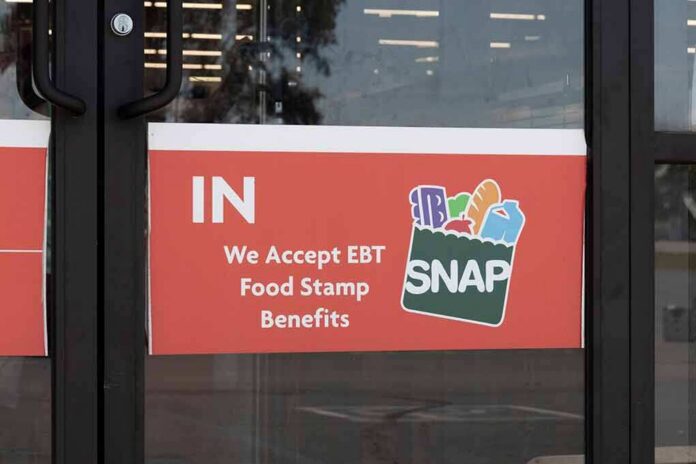
SNAP benefits, delivered via EBT, are restricted to eligible food purchases at authorized retailers. Trafficking occurs when recipients sell benefits to retailers for cash at a discount, and the retailer then redeems those benefits as if for legitimate food sales or uses the EBT-funded purchases to capture value another way. The arbitrage—cash now for the recipient; inventory, reimbursement, or resale margin for the retailer—undercuts the program’s purpose. Investigators use a mix of data analytics (flagging anomalous redemption patterns), undercover buys, EBT transaction records, and surveillance to test whether improbable activity corresponds to actual trafficking, as opposed to idiosyncratic but lawful shopping behavior.
In the Hollywood case, the government’s narrative matches that canonical pattern: discount purchases of recipient cards; large-scale use of those cards to obtain bulk goods; and downstream monetization through store stock and sales to other merchants. CBS Miami’s court-based reporting mirrors DOJ’s account, which is also consistent with how agents have historically documented retailer schemes—by tying specific cards, benefits, and cash exchanges to identifiable actors and merchandise flows.
Scope, statutes, and the investigative anchor
Prosecutors frame the alleged loss at more than $500,000, reflecting the combined value of benefits purportedly diverted through the scheme. The complaint’s pairing of 18 U.S.C. § 371 and § 1349 captures two dimensions of the alleged conduct: a conspiracy to misuse a federal nutrition benefit and a conspiracy to execute fraud through interstate wires, which in modern practice includes EBT transaction processing and electronic communications. Maximum statutory penalties differ by count—five years for the § 371 conspiracy, up to twenty for § 1349—though actual exposure depends on conviction and sentencing factors. This is not a civil disqualification case; it is a criminal prosecution premised on concrete events investigators believe they can prove.
The undercover transaction figure—roughly $64,388 in benefits for $29,474 in cash—serves as an evidentiary fulcrum in reporting on the case. Undercover buys are valuable because they compress many moving parts (actor identity, funds, benefits, venue, timing) into a controllable event, turning an abstract trafficking suspicion into a demonstrable exchange with known inputs and outputs. It gives prosecutors a centerpiece from which to expand outward into pattern evidence over the alleged three-year window.
How this fits the national picture—and how it doesn’t
Retailer-level trafficking is a known, recurring problem, but it is not the majority use of the program. The U.S. Department of Agriculture’s series of trafficking studies, which synthesize EBT data, compliance reviews, and investigative outcomes, estimate that about 1.6% of SNAP benefits were trafficked in 2015–2017—around $1.27 billion annually at the time. Smaller stores, like convenience outlets, exhibit higher violation rates than large grocers, a function of scale, staffing, and oversight differences. The Government Accountability Office has cautioned that national estimates carry uncertainty; even so, the program-integrity concern is real, and enforcement concentrates where the risk is greatest.
That dual reality matters. A single case cannot be inferred from national averages, but a single case can illustrate the mechanics that drive those averages: discount cash exchanges, concentrated redemptions on few terminals, and product flows out of proportion to typical neighborhood demand. The Hollywood complaint, as described, tracks those hallmarks, situating it within a broader integrity pattern without overgeneralizing from one prosecution to all small retailers.
Enforcement climate in South Florida
The timing of the Amin charges coincides with a federal pilot initiative targeting SNAP fraud in South Florida—an effort publicized by local and regional outlets as a coordinated push to investigate and prosecute trafficking more systematically. Such initiatives often pair data triage (identifying high-risk stores or card clusters) with undercover work and interagency cooperation, raising the likelihood that complex schemes—especially those involving merchandise resale beyond a single storefront—will be detected and pursued.
For legitimate small retailers, this environment underscores the importance of rigorous compliance—training staff to refuse cash-for-benefit solicitations, monitoring register activity for anomalies, and maintaining auditable inventory records. For prosecutors, the mandate is equally clear: build cases on specific transactions and corroborated narratives, not just statistical outliers.
.
Dumocrat.Hollywood Convenience Store Owner Charged in Alleged $500,000 SNAP Fraud Scheme https://t.co/kTesKmSsC0
— AmericanBoat (“A-Boat”) (@AAmericanboat) November 2, 2026
What to watch next
Federal complaints often precede indictments; if the case advances, additional filings typically clarify the transaction ledger, co-conspirator roles, and evidentiary exhibits. Sentencing exposure, if there is a conviction, will turn on the provable loss amount, the number of victims (including programmatic harm), role in the offense, and any obstruction or sophisticated means enhancements. For the broader public, the takeaway is straightforward: SNAP trafficking is a measured but persistent risk, concentrated in certain retail settings, and prosecuted through patient, transactional evidence—exactly the sort alleged here. As with any criminal case, charges are allegations until proved in court, but the structure and specificity of this complaint reflect a familiar and litigable theory of fraud.
Sources:
townhall.com, justice.gov, cbsnews.com, sun-sentinel.com, storage.courtlistener.com, cubitanow.com