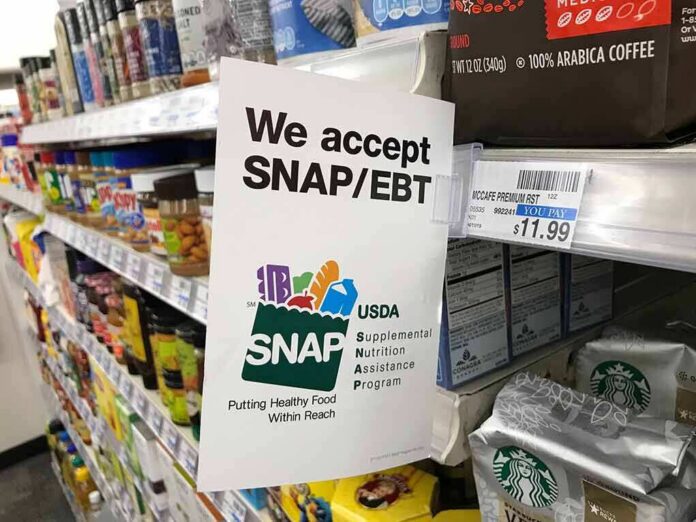
Retailer fraud is the fragile seam in SNAP’s social contract: when stores traffic benefits or ring up ineligible items, they don’t just skim taxpayer dollars — they corrode trust in the grocer–family–government chain that makes the program work. That is the stake behind USDA’s Operation SNAP Back in New York City and why retailer enforcement, when done with rigor and due process, is essential to program integrity.
At a Glance
- USDA launched Operation SNAP Back in New York City, taking action against 170 retailers for trafficking and illicit SNAP use, after undercover probes and data-driven targeting.
- Retailer trafficking — exchanging SNAP for cash — and selling ineligible items are established violations that trigger administrative disqualification and possible criminal referral.
- Historical prosecutions in New York and a 2025 multimillion-dollar scheme involving unauthorized EBT terminals show retail-side fraud is real and prosecutable.
- National studies find a small share of benefits are trafficked, but a much larger share of stores may be implicated; GAO cautions the true extent remains uncertain.
What Operation SNAP Back Targets — And Why It Matters
The operation trained on two categories of violations that sit at the core of SNAP’s design. First is trafficking — the exchange of SNAP benefits for cash — which severs the link between assistance and nutrition. Second is the purchase of ineligible items using SNAP, such as alcohol and other non-food goods, which converts a food benefit into a general-purpose subsidy and undermines the statute’s purpose. The agency publicly announced the effort in New York’s five boroughs, describing enforcement action against 170 retailers following investigative work; the mechanics align with USDA’s standard playbook: investigate, determine the violation, and take administrative action up to permanent disqualification where warranted.
That framework is not novel. It is codified in regulation and has been used for decades; when personnel of a firm traffic or engage in listed abuses, disqualification can follow, often permanently in trafficking cases. What has changed in recent years is operational tempo and the integration of undercover buys, transaction-pattern analytics, and device controls — a reflection of how trafficking evolves as payment technology and fraud techniques do.
How Retailer Cases Are Built
USDA’s retailer enforcement typically moves on two tracks: administrative and criminal. The Food and Nutrition Service (FNS) can permanently disqualify an authorized store based on evidence patterns — for example, repeated, high-dollar redemptions inconsistent with inventory, clustering of card activity, or corroborated undercover exchanges — without waiting for a criminal conviction. Parallel criminal cases can be referred to the USDA Office of Inspector General (OIG) and the Department of Justice where the evidence supports indictments. New York has seen both: a 2015 SDNY case charged five individuals tied to three Yonkers stores in a cash-for-benefits scheme; in 2025, prosecutors alleged a $66 million fraud-and-bribery conspiracy that secured unauthorized EBT terminals using insider information.
Administrative decisions illustrate the evidentiary threshold and the due-process path. In Bodega Market LLC and New York Grocery & Deli LLC, the retailers denied trafficking, but FNS sustained permanent disqualifications based on transaction evidence deemed indicative of trafficking. These decisions show that denials are heard — and sometimes rejected — in a formal record, with appeal rights into federal court.
The Known Scale — And The Uncertainty — Of Retailer Trafficking
National trafficking estimates are a steady reminder to separate outrage from measurement. Across multiple study cycles, USDA has estimated that about 1.5% to 2.0% of total SNAP benefits were trafficked, while the share of authorized retailers implicated in trafficking during one study period reached roughly 14% — a disparity that reflects the fact that many implicated stores are small grocers with relatively modest volumes. GAO has cautioned that the true dollar total is uncertain and could plausibly range wider than FNS’s point estimates due to modeling assumptions and data limits. Both truths can coexist: the aggregate percentage of benefits trafficked is relatively small, yet the number of stores touched is nontrivial, which makes concentrated, city-level crackdowns plausible without implying program-wide collapse.
Local context reinforces that plausibility. New York City agencies have previously uncovered payments fraud at the point of sale — including the discovery and removal of dozens of skimming devices during systematic inspections of thousands of terminals — showing that retail payment risk is not hypothetical in this market.
Where The Disagreement Lives
The counter-case is not a broad exoneration; it is case-by-case denial. In the Bodega Market and New York Grocery & Deli matters, owners contended no trafficking occurred and pointed to limited compliance histories. The agency nonetheless sustained disqualifications based on transaction patterns and investigative evidence. That is a meaningful disagreement — not over whether trafficking exists, but whether specific evidence crosses the line from anomaly to proof in a given store.
Two prudential cautions follow. First, public messaging around a multi-store sweep can move faster than docketed outcomes; not every action culminates in a criminal charge, and some administrative penalties are later narrowed on appeal. Second, 2026 also saw attention to retailer stocking standards — a separate compliance regime that, if conflated with trafficking, can muddle the public’s sense of who did what wrong. USDA issued updated guidance for staple-food stocking, and industry lobbying focused on timing and burden; these are regulatory debates, not trafficking prosecutions, and should be kept distinct to avoid false equivalence.
Mechanics Of The Penalty Box — And What Comes Next
Disqualification is the system’s most forceful lever because SNAP authorizations are privileges, not entitlements. Under 7 CFR 278.6, trafficking or certain patterns of abuse can trigger permanent removal. FNS has also emphasized device controls — identifying and shutting down terminals processing SNAP outside authorization — an important complement given the 2025 case alleging fraudulent procurement of EBT devices for non-authorized stores.
For Operation SNAP Back, the next phase should be transparency that tracks due process. Three disclosures would materially strengthen public confidence without compromising investigations: publication of retailer-level administrative outcomes once final; summary release of the analytic and undercover predicates used (categories, not tradecraft); and a post-operation audit matching actions to adjudicated results, including reversals. GAO has long urged better measurement of retailer trafficking; a targeted audit tied to a single citywide operation would test accuracy and deterrence in the real world.
USDA Launches 'Operation SNAP Back,' Takes Action Against 170 NYC Retailers Over Food Stamp Fraud https://t.co/J6IXfbfTzB
— 🌺🌿kam🌿🌺 (@pjkate) September 19, 2026
How To Read The Numbers Like An Adult
It is tempting to demand a single verdict: crackdowns prove rampant fraud or, conversely, overzealous bureaucracy. The record supports neither caricature. The operation rests on a credible pattern of retail schemes documented in New York courts and agency files; USDA says it has stepped up disqualifications and device interdictions as part of a broader integrity push. Simultaneously, the absence of a public store list and case files for all 170 actions should temper absolutist claims; enforcement is a process, not a press release. The adult reading is this: retailer fraud is real, the percentages are modest but the storefront count can be large, administrative remedies are appropriate when proved, and transparency about outcomes is the best guardian of both integrity and fairness.
What It Means For Households And Honest Stores
For families using EBT, retailer enforcement is not a sideshow; it is the guarantee that their benefits purchase food as Congress intended and that the corner store down the block will still accept their card tomorrow. For honest retailers — the majority — removing bad actors levels the playing field, eliminating the artificial revenue from trafficking that distorts competition. And for taxpayers, well-targeted operations reduce losses and improve confidence that a large, vital program is being stewarded with seriousness. That is the point of SNAP integrity work when it is done well — not to make headlines, but to keep the quiet promise between the register and the dinner table.
Sources:
townhall.com, fox4beaumont.com, theepochtimes.com, reuters.com, usda.gov, thegatewaypundit.com, fna.usda.gov, x.com, benefits.com, groceryroutes.com, nyc.gov, usatoday.com, dam-fns.usda.gov, congress.gov