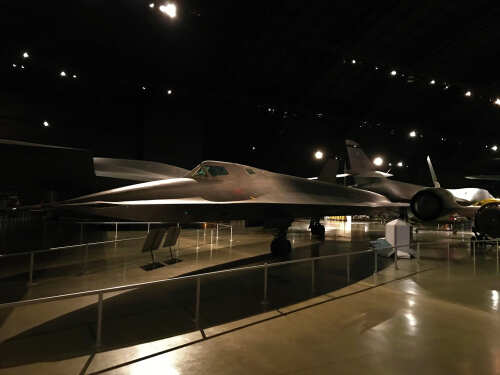
The SR-71 Blackbird’s legendary 1974 transatlantic speed record demonstrated American aerospace superiority during the height of the Cold War, crossing from New York to London in under two hours while showcasing cutting-edge military technology to the world.
Story Highlights
- SR-71 Blackbird set New York-London speed record in 1 hour 54 minutes 56.4 seconds on September 1, 1974
- Flight averaged 1,806-1,807 mph at 80,000 feet altitude, breaking previous Royal Navy transatlantic record
- Mission marked first public display of SR-71 outside United States at Farnborough Air Show
- Crew overcame mid-flight engine inlet disturbance that threatened record attempt
Record-Breaking Transatlantic Mission
Major James Sullivan and Major Noel Widdifield piloted SR-71A tail number 64-17972 from Beale Air Force Base, California to Farnborough International Air Show in the United Kingdom. The crew executed a precisely timed record attempt between radar gates near New York and London, maintaining supersonic cruise speed above Mach 3. Their flight covered approximately 3,490 miles in 1 hour 54 minutes 56.4 seconds, establishing a new recognized course record that averaged 1,806 mph.
The mission required multiple aerial refuelings from KC-135Q Stratotankers, including one critical refueling near Greenland. Flight planners routed the aircraft offshore to avoid sonic booms over populated areas while maintaining the high-speed profile necessary for the record attempt. President Gerald Ford personally congratulated the crew by telephone after their successful landing at Farnborough.
50 years ago #Today, the Lockheed SR-71 Blackbird flew from New York to London in 1 hour, 54 minutes, 56.4 seconds, still a world record for that route. pic.twitter.com/ZgNwJkJckP
— Massimo (@Rainmaker1973) September 1, 2024
Cold War Technology Showcase
The SR-71 Blackbird represented the pinnacle of 1960s American aerospace engineering, developed in secrecy by Lockheed’s Skunk Works under chief designer Clarence “Kelly” Johnson. The aircraft featured two Pratt & Whitney J58 turbo-ramjet engines burning specialized JP-7 fuel, extensive titanium construction, and stealth characteristics that reduced radar cross-section. Its design enabled sustained flight above 85,000 feet at speeds exceeding Mach 3, capabilities intended to outrun Soviet surface-to-air missiles and interceptors.
Lockheed built only 32 SR-71 airframes for the Air Force between 1964 and 1998, with the fleet primarily based at Beale Air Force Base in California. The aircraft served as America’s premier strategic reconnaissance platform against Soviet and Warsaw Pact targets throughout the Cold War. The 1974 record flight demonstrated these classified capabilities in a controlled, publicly acknowledged mission that avoided compromising ongoing intelligence operations.
Strategic Alliance and Basing Arrangements
The Farnborough display marked the beginning of deeper SR-71 cooperation between the United States and the United Kingdom. British authorities granted special clearances for the high-speed transatlantic overflight and supersonic transit through UK airspace. This cooperation later evolved into Detachment 4 at RAF Mildenhall, where two SR-71s maintained semi-permanent basing from 1982 to 1989 under Prime Minister Margaret Thatcher’s approval.
The UK retained control over sensitive missions flown from British territory, exemplifying host-nation oversight of American strategic assets. Designer Kelly Johnson attended the Farnborough display and publicly stated the SR-71 had “exceeded all my expectations,” validating decades of high-risk research and development. The United States later gifted SR-71 number 962 to the Imperial War Museum at Duxford, recognizing British support during Cold War reconnaissance efforts.
Sources:
New York to London in a Flash: A Look at an SR-71 Record Flight
Speed over Recognized Course – New York to London
This Week in Beale History: SR-71 sets speed record with New York to London flight