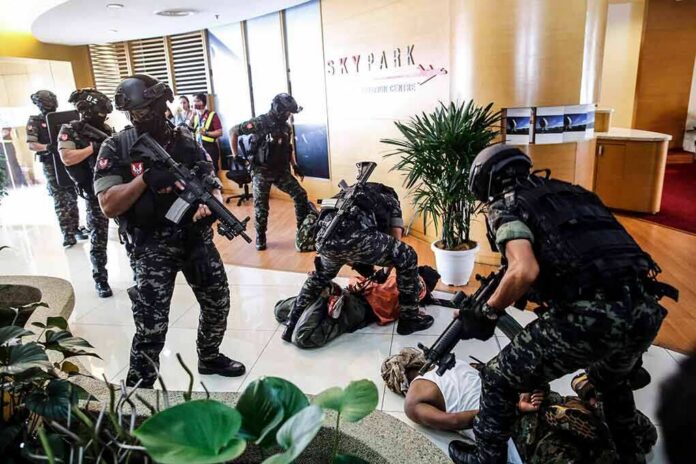
Heroism draws the camera, but coordination ends a siege; the Nairobi DusitD2 rescue worked because a lone British SAS operator ran toward gunfire alongside Kenyan security forces who, together, moved hundreds of civilians out of harm’s way.
At a Glance
- Roughly 700 civilians were evacuated during the 2019 DusitD2 complex attack, according to Kenya’s leadership and post-incident analyses.
- A British Special Air Service operator, present in Nairobi, joined Kenyan responders, guiding evacuations and engaging attackers under fire.
- The operation mixed ad hoc initiative and structured clearance tactics, containing militants and stabilizing the site over roughly 19–20 hours.
- Public memory often compresses multi-agency rescues into a single-hero narrative; the record shows decisive individual action within a team effort.
What actually happened at DusitD2
On January 15, 2019, al-Shabaab militants attacked the DusitD2 hotel and office complex on 14 Riverside Drive in Nairobi, using an initial explosion and small-arms fire to create chaos and fix civilians in place across multiple buildings. Kenyan authorities quickly established an interagency response and began evacuations while neutralizing active threats. By the time the government declared the incident over, officials reported that more than 700 people had been rescued from the compound—a figure echoed in independent security analyses and briefings that followed. The attack killed 21 civilians; all of the attackers were ultimately killed by security forces.
Amid that response, a British SAS operator—widely identified in subsequent profiles—entered the scene and moved with Kenyan units to pull civilians out, direct people to cover, and clear spaces where shooters had been sighted. Contemporary press accounts described him charging into fire to reach those trapped, an image that traveled worldwide because it is viscerally legible: one person, rifle in hand, making the choice to go forward when others run the other way.
Mechanics of the rescue: initiative meets method
Complex attacks thrive on confusion. The counter is disciplined movement, rapid information sharing, and a tempo that denies the assailants time to re-position. By late evening of day one, Kenyan security forces had contained the attackers to upper floors, a critical inflection point because vertical confinement simplifies angles of fire and makes stairwells and chokepoints tactically decisive. From there, responders executed systematic clearances—room by room, floor by floor—while escorting civilians out in controlled groups. That pattern is familiar from other siege responses: stabilize entrances and corridors, create safe lanes, then alternate suppression with evacuation.
A single highly trained operator can be catalytic in these conditions. Elite soldiers are taught to read a fluid scene, anchor a hasty plan around simple commands, and take responsibility for movement. But even the most skilled individual succeeds only when other professionals are also doing their jobs—cordoning, triaging, relaying updates, and preventing blue-on-blue engagements as multiple elements converge. The Nairobi rescue displayed that blend: a visible figure of resolve inside a larger mesh of Kenyan police and military work that made mass evacuation possible.
How the record formed: numbers, names, and narrative gravity
Authoritative tallies give the public spine of the event: attackers’ count, casualties, and rescued civilians. In Nairobi, those anchors are consistent—five assailants (including a suicide bomber), 21 civilians killed, and hundreds evacuated, with government statements and international reporting aligning on those points. The credit question, however, is always more granular than the broadcast headline. The operational record sits with Kenyan authorities; the public-facing story, inevitably, centers on the most narratable element. In this case, a single operator’s visible actions became the symbol of the rescue, while the bulk of the lifesaving—search, clearing, medical extraction, communications—remained distributed across Kenyan units whose names are less likely to appear in a photo caption.
Neither framing is wrong. The photograph of courage is true, and so is the ledger of coordinated work. Mature analysis holds both: a remarkable act inside a competent system. Over time, responsible summaries keep the scale straight—hundreds rescued, a multi-actor response, and a lone foreign commando whose initiative mattered without erasing the force that owned the fight on its own soil.
Why this response succeeded where others have stumbled
Counter-siege outcomes swing on four levers: speed, containment, interoperability, and morale. Nairobi’s responders moved quickly to disrupt attacker momentum; they confined the enemy vertically, simplified the battlefield, and protected evacuation corridors. Interoperability—particularly between Kenyan units accustomed to urban operations—reduced friction that has plagued other city-center attacks globally. Morale, that intangible but felt variable, spiked when trained leaders were seen taking risks that matched the stakes; civilians follow a confident escort out, and officers push deeper when they trust the team on their flanks. The result was a high rescue count given the attackers’ intent and tools.
This is not to romanticize danger. It is to underline a hard-earned lesson in modern urban counterterrorism: the first hour is strategic. Establish command, lock down movement, and begin extractions even as gunfire continues. Nairobi’s record—hundreds evacuated while contact was ongoing—reflects doctrine executed under pressure, not only bravery in the abstract.
Memory, meaning, and the right way to honor the day
The story now circulating—of a survivor meeting the SAS operator who helped bring her out—does something important for those who lived it. It collapses a bewildering, violent timeline into two human beings occupying the same frame: one who needed help, and one who offered it. That is what survivors remember, and it deserves respect. The fuller record deserves respect as well. Kenya’s security forces bore the weight of command and the grind of the long night; international partners and a single British operator added capability and nerve in crucial moments. Both can be true without competition.
Sources:
podcasts.apple.com, wionews.com, jamestown.org, securehotel.us, bbc.com, dfat.gov.au