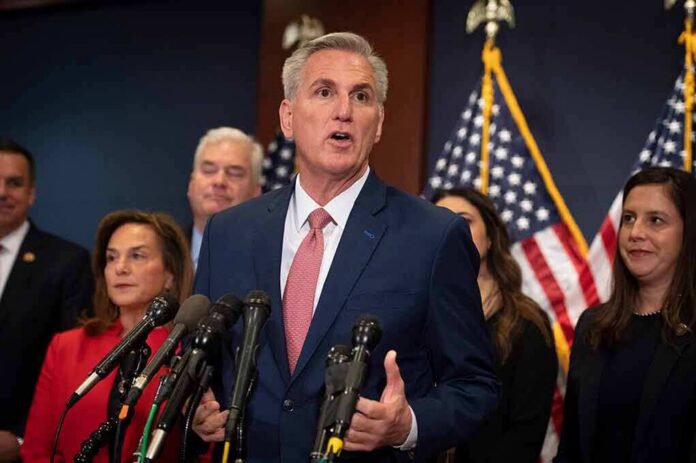
Political branding works when it reduces complexity to a felt choice; in 2026, House Republican Conference Chair Lisa McClain made that choice explicit, engineering and carrying a “common sense versus communist crazy” frame that Republicans used to unify message, mobilize donors, and draw a bright, moralized line between their platform and Democrats’.
At a Glance
- Lisa McClain, as House Republican Conference Chair, championed and repeated a “common sense versus communist crazy” contrast as a core GOP midterm message.
- The frame aligned with a broader Republican revival of anti-communist rhetoric pushed by President Trump and party leaders as a turnout and fundraising tool.
- Messaging theory and comparative politics research show “common sense” vs. “extremism” narratives are classic populist devices to normalize one side and otherize the opponent.
- The approach is historically effective at energizing base voters, though it is imprecise as policy description and controversial among scholars.
What Republicans Set Out To Do: Build a Clean, Emotional Contrast
Republicans did not stumble into the “common sense” line; they built it. As conference chair, McClain described the midterm strategy plainly: convene Republicans to showcase legislative wins and “compare and contrast the two roads,” framing the election as a choice between “communist crazy” and traditional American common-sense values. Across interviews, press appearances, and social posts, she returned to the same theme—casting GOP positions on taxes, energy, border enforcement, and schools as the practical mainstream, and Democrats as embracing radicalism. Effective message operations depend on iteration and discipline; McClain supplied both, repeating the language in Capitol press gaggles, conservative media hits, and stage remarks to keep the line top-of-mind among activists, donors, and aligned surrogates.
This was not a boutique slogan. It fit a broader party push that revived Cold War-style warnings about communism as a way to rally the faithful. Coverage documented how President Trump and allies leaned heavily into labeling Democrats “socialists” or “communists” as the midterms approached—an old American trope returning to center stage because it makes a complicated policy debate legible and high-stakes to voters already predisposed to skepticism of the left. In that environment, McClain’s “common sense vs. communist crazy” served as a distillation: energetically simple, easily memorizable, and flexible enough to apply across issues.
How The Frame Works: From Abstraction To Mobilization
At its core, the contrast does two jobs. First, it normalizes one side—“common sense”—by implying its ideas are intuitive, pragmatic, and shared by ordinary people; second, it stigmatizes the other as ideologically extreme. Political communication research identifies this as a common populist technique: claim the mantle of what any reasonable person would think, then define opponents as the fringe. The device is cognitively efficient. It bypasses policy detail and drops voters straight into identity and threat assessment. Communication strategists favor such frames in midterms, where differential turnout is decisive and cost-effective persuasion may be found in reinforcing preexisting attitudes rather than litigating white papers.
That efficiency also explains the language choice. “Communist” is a historically loaded label in U.S. politics; its deployment cues generational memory, national security anxiety, and moral clarity. Reuters and the Associated Press both chronicled the resurgence of anti-communist rhetoric within the GOP as a base-energizing move ahead of the elections, with Trump repeating the label frequently as aides tested message traction. McClain’s twist—pairing “communist” with “crazy”—adds an affective punch that implies not only ideological danger but also irrationality. For mobilization, that’s potent.
Why Lisa McClain Became The Messenger
Titles matter in party messaging architecture. The House Republican Conference Chair’s portfolio spans internal coordination, message amplification, and surrogate recruitment; it is the node where legislative talking points meet campaign imperatives. McClain used that perch to knit policy claims—tax relief, energy costs, border enforcement—into a single identity story about the GOP as custodians of order and affordability. Her on-camera riffs were consistent: “On our side, we got common sense; on the other side, we got communist crazy”. In elite media, she positioned the midterm convention itself as a compare-and-contrast exercise to rally the base and define stakes. In movement venues and social feeds, she sharpened the line further, making the binary the test of tribal belonging. That consistency is what transforms a slogan into a party-wide brand.
Crucially, the message synced with other Republican leaders. The Hill reported McClain echoing the caucus push to confront “radical left” policies; allied outlets amplified the phrasing, creating repetition across channels that voters actually see—cable hits, Facebook clips, short videos. Coordination is the difference between a line everyone quotes for a day and a frame that shapes months of coverage.
Historical Roots And Analytical Limits
Anti-communist branding is not new. From mid-century “red menace” campaigns to late–Cold War wedge fights, labeling opponents as communists has been one of the oldest weapons in the American partisan arsenal, precisely because it compresses ideological dispute into moral threat. Scholars and analysts, however, routinely note the mismatch between the label and mainstream Democratic platforms, which remain capitalist and parliamentary in structure; the term functions metaphorically rather than descriptively in modern usage. That tension is a feature, not a bug, in mobilization frames: precision takes a back seat to salience.
There is also the comparative lens. Studies of European and Latin populist right parties show a durable pattern: present your platform as “common sense” to push it toward the mainstream, and depict critics as elite ideologues or dangerous radicals; doing so can shift the Overton window and soften resistance among undecided voters. The GOP’s 2026 formulation sits squarely in that tradition, with its American flourish—communism as the foreshortened name for the far left’s alleged endgame.
Strategic Upsides And Predictable Frictions
As a turnout tool, the frame offers clear advantages. It is emotionally sticky, travels well across issues, and supplies a story activists can repeat at doors and on small-dollar fundraising pages. It also primes in-group solidarity: “we” are practical doers; “they” are reckless ideologues. The AP’s reporting emphasized how Republican leaders used the rhetoric to energize core supporters ahead of November. That said, what works as a base catalyst can invite scrutiny when applied to specific races or candidates. When opponents surface counter-narratives—pointing to controversial behavior or positions they argue contradict “common sense”—the branding can become a rhetorical boomerang. That is the normal friction of high-salience, low-specificity frames in competitive environments; the party that coined the slogan must police alignment between message and messenger to preserve credibility.
The deeper trade-off is familiar to practitioners: broad moral binaries make for excellent rallying cries and agenda-setting, but they can flatten policy nuance that swing voters sometimes seek in late-breaking decisions. Parties that choose this path typically complement it with targeted, district-level policy messaging to hedge against backlash in competitive suburbs, while keeping the high-heat national story for fundraising and volunteer activation.
What Endures After The Election Cycle
Regardless of electoral outcomes, the architecture behind “common sense vs. communist crazy” will persist because it sits at the intersection of three durable forces: the institutional incentive to nationalize midterms, the psychological power of identity-laden contrasts, and the modern media ecology’s preference for repeatable, polarized language. McClain’s role shows how a skilled conference chair can translate that reality into a lived message—book the hits, keep the phrasing tight, and bind policy claims to identity. The scholarship, for its part, reminds us what such language does and does not do: it rallies and simplifies; it does not adjudicate the underlying policy merits. Strategists on both sides would do well to remember the distinction—and plan accordingly.
Sources:
nypost.com, youtube.com, justthenews.com, cbsnews.com, thehill.com, gop.gov, theguardian.com, facebook.com, foxnews.com, csmonitor.com, ciaotest.cc.columbia.edu, link.springer.com, milwaukeeindependent.com, pure.uva.nl