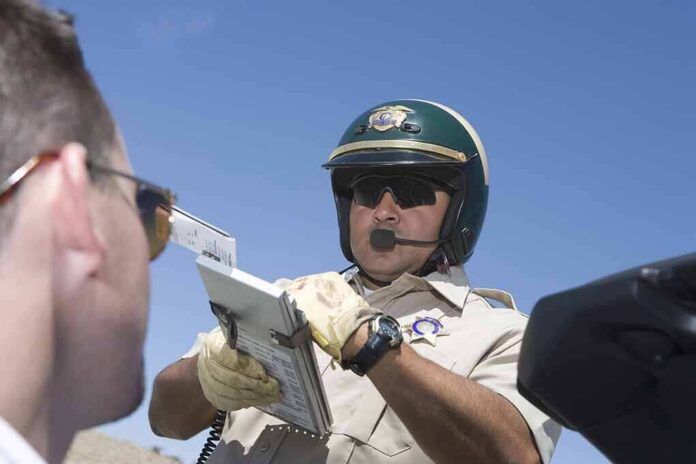
When nearly half of a city’s low-level enforcement tickets collapse before a hearing officer ever reaches the facts, the problem isn’t public order — it’s the pipes that carry the case. New York City’s civil summons system is hemorrhaging cases on preventable, paperwork-driven defects, and the evidence points squarely at a paper-first workflow that builds human error into the process.
At a Glance
- Roughly 46,000 of 98,000 NYPD civil summonses were dismissed last fiscal year, largely for paperwork and service defects rather than the merits.
- Officials at the city’s administrative court have linked higher dismissal risk to handwritten summonses; NYPD legal leadership has conceded the process needs fixing.
- This pattern isn’t new: high dismissal rates for low-level tickets have recurred across years and forums where procedural sufficiency decides outcomes.
- The mechanism is straightforward: hand-completed forms plus strict due-process rules on notice and service produce large, avoidable failure.
The core finding: dismissals are driven by process defects, not conduct
Data reviewed by reporters show that hearing officers at New York City’s Office of Administrative Trials and Hearings (OATH) tossed roughly 46,000 NYPD civil tickets — about 47% of 98,000 — in the last fiscal year, with the bulk dismissed for “defective service” and “defective notice of violation.” Those are not judgments on whether the underlying behavior occurred; they are determinations that the ticket, as a legal instrument, failed to meet threshold requirements of notice, accuracy, or service. The pattern matches what seasoned practitioners would expect in a paper-heavy, high-volume environment with unforgiving procedural rules, and it explains why the same categories cluster in dismissals year after year.
City officials have connected the dots publicly. An OATH spokesperson has said handwritten summonses “inevitably” heighten dismissal risk because they create more avenues for human error — from misspelled names and garbled addresses to mis-cited code sections and incomplete service affidavits — any one of which can doom a case before it starts. NYPD’s deputy commissioner of legal matters, testifying after the numbers surfaced, put it plainly: “We need to fix that,” acknowledging the dismissals stem largely from paperwork and handwriting issues, not from improper stops or nonexistent violations.
Why the mechanism fails: hand entries meet strict due-process gates
In administrative enforcement, form is function. A civil summons has to do three things: correctly identify the respondent, articulate the legal basis for the charge with enough specificity to allow a defense, and document proper service. Each step has failure modes that paper amplifies. Illegible handwriting or a transposed digit can misidentify a person; a wrong code section or missing narrative can render a notice “facially insufficient”; a half-completed or unsigned certificate of service defeats jurisdiction. OATH and the courts treat those as threshold defects because due process requires clear notice from the outset. The NYPD’s own patrol guide warns officers that the service affidavit must be fully completed and signed “or the summons will be dismissed” — a bright-line consequence that, in practice, is triggered far too often when everything is done by pen under field conditions.
None of this is novel in New York. Historical court-system data covering millions of summonses show large shares dismissed at “defect review” stages long before merits adjudication — first for missing signatures and narratives, then for facial insufficiency. That two-step culling was built into citywide operations precisely because so many paper tickets arrived flawed; it functioned as a quality screen, but it also masked the true front-end error rate that should have been driven down at issuance, not filtered out later.
A recurring pattern, not a one-off spike
High procedural-dismissal rates for low-level New York enforcement are a chronic governance issue. A state attorney general report, using Office of Court Administration data, found 47.7% of NYPD summonses from 2009–2012 were dismissed for legal insufficiency or serious defects — nearly the same order of magnitude as the recent OATH figures, across a different forum and period. When the venue is administrative rather than criminal court, the labels change (“defective service,” “defective notice”), but the mechanism — form failure blocking a merits decision — is the throughline.
Reforms have adjusted where cases go more than how well they are built. The Criminal Justice Reform Act steered certain minor offenses toward civil summonses at OATH to avoid criminal exposure, but it did not — by itself — modernize how the NYPD captures, validates, and transmits the facts that make a summons legally sufficient. In a hand-completed regime, volume merely multiplies opportunities for error; it does not produce better paperwork.
What the department says — and what that implies
NYPD’s legal leadership has emphasized that most tossed civil tickets could have been issued as criminal summonses and that officers were exercising leniency by choosing the civil path. That may be true as a statement about officer discretion; it is not a rebuttal to the process-failure diagnosis. A more lenient charging decision does not cure a defective affidavit or a wrong code citation. The department has indicated it is retraining on technical requirements. Training matters, but when the workflow itself is error-prone — handwritten fields, cramped boxes, duplicate entry downstream — no amount of refresher instruction can reliably deliver a 95% compliance rate in the field. Digital issuance systems with embedded validation rules can.
The OATH spokesperson’s observation about handwriting sits alongside the department’s own rulebook: legibility and completeness are mandatory, and incompleteness requires dismissal. That clarity of sanction makes sense as due process; it is unforgiving as operations. The result, visible in the data, is a systemic attrition of cases on the front-end form, not the back-end facts.
What fixing it requires: design out the error
Modernization here is not conceptual; it is mechanical. Agencies that have reduced dismissal rates have done four things well: moved to e-summons platforms with dropdown offense libraries and in-line legal elements; enforced required fields and digital signatures so no officer can submit an incomplete certificate of service; integrated address and identity verification to catch obvious mismatches at the curb; and synced issuance data directly to the tribunal so there is no rekeying step that can introduce new errors. Each step targets a known failure mode illuminated by New York’s dismissal categories.
None of this lessens due-process protections; if anything, it honors them by ensuring the notice actually says what the law requires, cleanly and consistently. It also narrows the zone of contest to the merits — whether the person did what is alleged — rather than whether a box was left blank in the rain.
WHAT DOES NYPD ENFORCEMENT ACTUALLY BUY NEW YORK?
New York City knows how to count police activity. Arrests. Summonses. Pedestrian stops. Deployments. Overtime.
But activity is not the same thing as performance.
From 2021 to 2024, NYPD pedestrian stops increased from 8,947 to… pic.twitter.com/HHy14M9pn1
— Eric Sanders, Esq. (@esq_sanders) September 21, 2026
Why it matters: legitimacy, deterrence, and efficient government
Quality-of-life enforcement stands on two legs: fair process and credible consequences. When almost half of tickets die on paper defects, neither leg holds. For residents and businesses, that looks like arbitrary governance — a lottery where the same conduct draws a ticket that may evaporate because of handwriting. For officers, it is demoralizing churn: time spent issuing, appearing, and explaining cases that never see a merits ruling. For the city, it is fiscal and reputational waste — overtime, docketing, and tribunal resources consumed to no public-safety effect. The public draws a rational inference from that pattern: the state can hassle you, but it cannot competently hold you to account.
Practical next steps that would survive contact with the street
Several steps are low drama and high yield. First, mandate department-wide e-summons issuance for all civil violations returnable to OATH, with offense libraries keyed to current code and automatic checks for service certification. Second, require real-time error dashboards by command — the only way to manage what you measure — and tie supervisory review to specific defect codes. Third, integrate training with the tool: if an officer selects an offense frequently miscited, the app should prompt the required elements and proof standards in-line, cutting error at the source rather than in a classroom months later. Finally, coordinate with OATH on a feedback loop so defect trends inform form design and field prompts, not just after-action reports.
Bottom line
The evidence is consistent across years and venues: New York’s summons pipeline loses an extraordinary share of low-level cases to avoidable, paperwork-centered defects. City officials and the department agree on the diagnosis; the cure is to design out the failure modes that paper bakes in. Until the inputs are fixed — fields validated, service certified, offenses correctly cited at the point of contact — the city will continue to mistake volume for enforcement, and due process for dismissals.
Sources:
zerohedge.com, tollbit.gothamist.com, worldjournal.com, law360.com, pix11.com