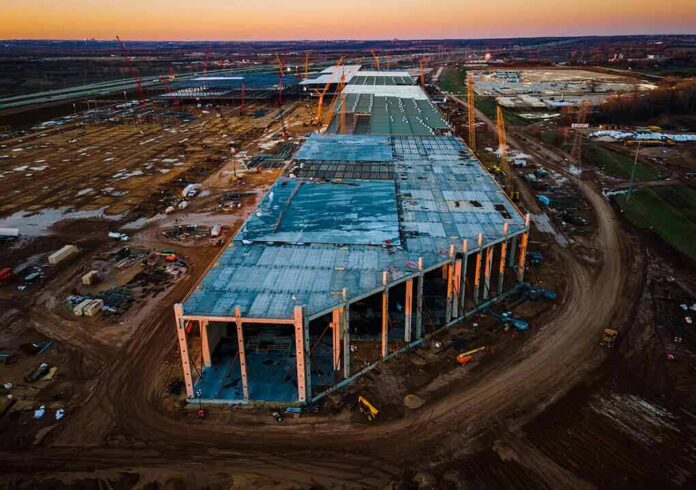
When hyperscale ambition meets Europe’s maturing environmental rulebook, speed yields to sequence: in Finland, regulators did exactly what the framework is designed to do—freeze site work until the environmental impact comes first, not after the chainsaws.
At a Glance
- Finland’s licensing and supervision authority ordered Google’s local project entity to suspend environmentally significant preparatory work at two planned data center sites until required environmental impact assessments (EIAs) are completed.
- The halt targets projects in Muhos and Kajaani amid scrutiny over large-scale forest clearing—reports cite more than 300 hectares—conducted before completing EIA procedures.
- The stoppage landed weeks after Google announced a headline €13 billion Finland buildout across data centers and energy assets; the EIA pause does not negate the investment but enforces process discipline.
- This clash is part of a broader European pattern: data centers are increasingly treated as major infrastructure with commensurate disclosure and environmental obligations, not as routine industrial builds.
What Finland Actually Ordered—and Why It Matters
Finland’s Licensing and Supervision Authority (LVV) instructed Tuike Finland Oy, Google’s local project company, to halt “environmentally significant preparatory work” at the Muhos and Kajaani sites until the legally required environmental impact assessments are completed. That is the operative event; it is procedural, not ideological, and it turns on sequence—EIA first, then clearing and grading, not the reverse. This is not a discretionary nudge: the order binds site activity that can alter land permanently. The trigger is specific allegations that work began without the mandated assessment, including extensive forest clearing on at least one site, which moved the matter from paperwork into enforcement.
Critically, the halt does not cancel projects. It compels compliance with the EIA regime before construction-affecting actions resume. In practical terms, that means pausing site conversion, running the assessment to scope direct and cumulative impacts, canvassing alternatives and mitigations, and disclosing enough for regulators—and the public—to judge proportionality and compatibility with regional plans.
The Investment Context: A €13 Billion Build Meets a Procedural Wall
In early September, Google announced its largest European commitment to date—at least €13 billion across Finnish data centers and energy infrastructure—citing steady demand for core services and AI workloads and Finland’s attractive power and climate profile. The package, as described by the company and major outlets, spans multiple sites, expansions, and long-dated energy arrangements, including large low-carbon power purchases, positioning Finland as a strategic compute hub. Those ambitions, however, run alongside national processes that are neither anti-growth nor ad hoc; they are codified checks to ensure land-use change and infrastructure siting clear environmental due diligence before irreversible work proceeds.
Seen correctly, the EIA halt and the €13 billion plan are not mutually exclusive. They are orthogonal: one enforces lawful sequencing; the other outlines industrial scale. The tension arises when project momentum—survey crews, contractors, clearing schedules—gets ahead of the formal gate that EIA represents.
Mechanism: How the EIA Gate Works for Hyperscale Builds
Environmental impact assessment is not a single permit; it is a structured study and disclosure process designed to surface significant effects, alternatives, and mitigations before decisions that commit resources or alter environments are locked in. For large data centers, that lens often includes land conversion, biodiversity impacts, stormwater and runoff, air emissions tied to backup generation, grid interconnection effects, noise, light, and water use for cooling. The output is decision-useful: it does not ban projects but forces a documented accounting and, where needed, redesign, offsets, or conditions of approval.
For hyperscale operators, the operational logic—secure land early, clear for geotechnical work, de-risk schedules—can collide with EIA staging. A forested tract converted to a graded pad is an environmental decision in concrete and gravel; regulators therefore police the “no-irreversible-steps-before-assessment” boundary. That is precisely the line Finland drew here.
Evidence Weighing: What Is Established vs. Contested
On the record, LVV has issued a halt order tied to the absence of completed EIAs for the Muhos and Kajaani sites; multiple outlets cite the agency’s directive and its basis in pre-assessment land-clearing concerns. Reports describe more than 300 hectares of forest affected, and the supervisory agency is examining whether clearing proceeded unlawfully without the EIA; these details anchor the enforcement posture and underscore why the order is not a symbolic warning.
Google’s position concerns the investment’s scale, intent, and energy pairing—long-term purchases of low-carbon power, including nuclear and new renewable projects—framed as a net-positive for Finland’s economy and grid. Those claims speak to benefits but do not refute the core procedural issue raised by LVV. In short: the enforcement case rests on specific statutory sequencing; the corporate case speaks to macro upside. Both can be true; the former governs what happens next on the ground.
Europe’s Shift: From Zoning Disputes to Infrastructure Scrutiny
This Finnish episode is a microcosm of a continental adjustment. As AI-era data centers scale toward campus footprints and utility-scale loads, European regulators and civic groups increasingly treat them as critical infrastructure with correspondingly high expectations for transparency. Activists and some policymakers push for full EIA treatment where law has been ambiguous; legal complaints target opacity around energy and water use; and permitting battles now routinely address grid adequacy, backup generation emissions, and cumulative regional impacts, not merely parcel-level compliance.
The throughline is simple: once facilities can rival small cities in electricity demand, the old permitting heuristics no longer suffice. Environmental law has long contemplated major projects—pipelines, dams, power plants—under rigorous assessment. Hyperscale computing is being pulled into that orbit, and with it, the sequencing discipline that Finland just enforced.
Work at Google data center sites in Finland ordered to halt https://t.co/c9ZJavhQmh
— Daily Finland (@DailyFinland) October 7, 2026
What Competent Compliance Looks Like Going Forward
The playbook is clear and achievable. First, respect the chronological gate: complete EIAs before any action that irreversibly alters the environment. Second, scope beyond parcel edges—grid interconnection studies, water sourcing and discharge, backup generation air permits, and waste-heat integration if feasible—so the assessment addresses cumulative realities, not a paper abstraction. Third, design-in mitigation: habitat buffers, phased clearing, stormwater controls sized for extreme events, and measurable biodiversity offsets where applicable.
On the energy side, pairing new load with additional low-carbon supply and storage can turn a liability into a system asset; long-dated nuclear and renewable procurement, plus grid-balancing batteries, are credible tools when transparently documented and synchronized with load ramp. Public confidence rises when modeling and contracts are surfaced in accessible form and independent regulators can test assumptions against reliability and rate impacts.
The Stakes—for Finland and for Hyperscale Builders
For Finland, the upside of anchoring a European AI infrastructure node is tangible: construction cycles, supply chains, district-heating synergies, and a proof-point for marrying industrial policy with clean power. For builders, the lesson is not that Europe has turned inhospitable; it is that the cost of schedule certainty now includes rigorous, front-loaded environmental process. Treat that as a constraint to engineer around, not a hurdle to be nudged aside. When the assessment leads and design follows, projects survive scrutiny—and stay built.
Sources:
zerohedge.com, ledauphine.com, nampa.org, newsnow.com, datacenters.economictimes.indiatimes.com, bloomberg.com, dailysabah.com, yahoo.com