When a national figure parachutes into a swing district with a message about concentrated wealth and political power, it is not just another rally; it is a case study in how modern campaigns braid policy branding, candidate boosting, and media choreography into a single, high-yield moment.
At a Glance
- Bernie Sanders’ “Fighting Oligarchy” tour stopped in Bakersfield, with Randy Villegas as special guest, at Harvey Auditorium on Sunday, October 4.
- The event fused a national economic-justice message with a local congressional race in California’s 22nd District.
- Campaign advisories, local outlets, and live video created a layered record of time, place, and program.
- This format—policy banner plus candidate co-billing—is now a standard tool for shaping attention and volunteer energy late in the cycle.
What Happened: A Tour Stop That Worked Like a Campaign Swiss Army Knife
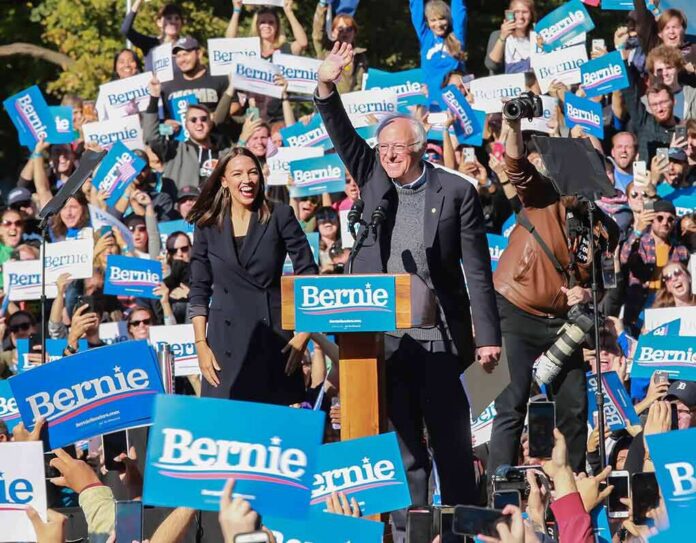
Sanders’ Bakersfield stop was formally billed as “Fighting Oligarchy: Where We Go From Here with Bernie Sanders in Bakersfield,” with doors at 4:00 p.m., a 6:00 p.m. speaking program, and Bakersfield High School’s Harvey Auditorium as the venue; Randy Villegas, the Democratic nominee in California’s 22nd Congressional District, was listed as the special guest. Local media and regional political press flagged the appearance in advance and same-day, framing it as both a rally for Villegas and a plank in Sanders’ broader tour across California. A live video stream captured Sanders addressing supporters alongside Villegas under the “Fighting Oligarchy” banner, preserving the central claim of the event in real time.
That pairing—national surrogate plus local candidate—accomplishes several goals at once. It transports a national message (in Sanders’ case, that the outsized influence of billionaires distorts policy and democracy) into a district-specific contest, and it furnishes the local nominee with crowd energy, media oxygen, and an implied policy coalition. The Bakersfield booking, in an area best known for energy production and split-ticket politics, underscores the strategic choice: carry a populist economic message directly into contested terrain rather than preaching only to friendly metros.
How Surrogate Tours Are Built: Mechanism and Media Cadence
Events like this do not materialize by accident. Campaigns stage them through a predictable cadence: advisory and RSVP infrastructure, local amplification, and on-site program. The RSVP hub supplied the particulars—date, doors, speaking time, and venue—while the main tour page positioned Bakersfield as a designated “next stop” with Villegas co-billed. Local outlets and community calendars replicated that information, translating a national advisory into neighborhood relevance—how to attend, when to line up, which entrance to use. For modern campaigns, this scaffolding is the point: advisories and listings are an indispensable first mile for turnout and press interest, not an afterthought.
On event day, the media picture completes itself. TV segments, regional write-ups, and live streams supply the proof-of-occurrence and the message clips that campaigns recycle into fundraising and volunteer mobilization. Here, an embedded live video of Sanders in Bakersfield alongside Villegas closed that loop; it is the strongest, low-ambiguity artifact tying the billed program to what actually happened on stage.
Why Bakersfield, and Why “Oligarchy” as the Frame
Bakersfield is not chosen for its ideological comfort. Kern County is the operational heart of California’s oil industry and the media market for multiple competitive districts. By setting a populist message against that backdrop, a surrogate tour tests whether an economic-justice frame—taxing extreme wealth, curbing corporate influence, pressuring monopoly power—can travel into places animated by energy jobs and cost-of-living anxiety. Coverage around the California swing made this explicit: Sanders’ appearances were yoked to a push for a billionaire tax and to support for named progressive candidates, Villegas among them.
The “oligarchy” label is not just rhetorical flourish; it is the campaign’s diagnostic. In practice, it packages disparate proposals—wealth taxation, campaign-finance reform, antitrust, labor rights—into a single, legible antagonist. For local candidates, that bundling offers coherence: their stump pivots from a grab bag of planks to a throughline about power and who benefits from the status quo. In Bakersfield, attaching that banner to Villegas turned a district race into a chapter of a national argument, which is precisely how surrogates earn their keep.
How We Know: The Event Record and Its Reliability
Three independent strands establish the Bakersfield stop: the campaign’s own infrastructure (RSVP pages and tour listings with times, venue, and guest billing); pre-rally and day-of reporting in local and regional outlets naming Bakersfield High’s Harvey Auditorium, the speaking time, and Villegas’ role; and direct audiovisual evidence of Sanders speaking in Bakersfield alongside Villegas under the tour’s title. This is the contemporary standard for political event verification: a primary announcement corroborated by local coverage and anchored by on-scene footage.
Journalistically, that triangulation reflects best practice. Campaign advisories are designed to create news hooks; responsible coverage treats them as a starting point, then cross-confirms details and captures primary-source material from the site. In Bakersfield, the record assembled as expected: advisory first, neighborhood outlets next, live images last—yielding a stable account of the who, what, when, and where.
What It Means for the Race and for Campaign Craft
As a tool of campaign craft, the Bakersfield rally demonstrates the leverage of narrative coherence. When a surrogate with a defined brand brings a policy banner to a local nominee, the event is more than a joint appearance; it is a distribution channel for identity. Volunteers hear a unified script, small-dollar donors get a reason to click, and local media can situate a down-ballot contest within a statewide or national storyline. That is why these stops recur late in the cycle and in contested geographies: the marginal voter or low-propensity supporter experiences one clean message, not a scatterplot of issues.
There is a practical coda. The Bakersfield production—clear RSVP logistics, consistent local pickup, and an accessible live feed—illustrates the baseline now expected of serious campaigns. A coherent advisory without on-site images leaves skeptics room to quibble; on-site images without advance scaffolding limit turnout and press. Marry both, and a tour stop pays dividends beyond the hour on stage: it seeds the next week’s canvass scripts, underwrites a fundraising push, and lodges a frame—here, “fighting oligarchy”—that rivals must answer on their own terms.
VALLEY IN THE RALLY: Vt. Senator Bernie Sanders stumps for District 22 Congressional Candidate Randy Villegas in Bakersfield on Sunday. Despite triple digit heat, attendees packed a Kern County venue weeks ahead of Election Day.
Our own @GrantJohnsonABC was there for the event. https://t.co/uuD42RW1dp— Christina Lopez (@CLopezABC30) October 5, 2026
Bottom Line
Sanders’ Bakersfield stop with Randy Villegas was a tightly executed instance of surrogate politics: national brand meets local race, policy banner meets district stakes, and a modular media stack turns a two-hour rally into weeks of narrative momentum. The documentation—advisory, local coverage, and live video—confirms the essentials; the strategy explains why campaigns keep doing it.
Sources:
facebook.com, bakersfield.com, abc30.com, foxnews.com, fresnobee.com, act.berniesanders.com, tehachapidemocrats.com, bakersfieldnow.com, villegasforcongress.com, yahoo.com, sjvsun.com, commondreams.org, kmjnow.com, lr.edu, rm.coe.int, ctb.ku.edu