
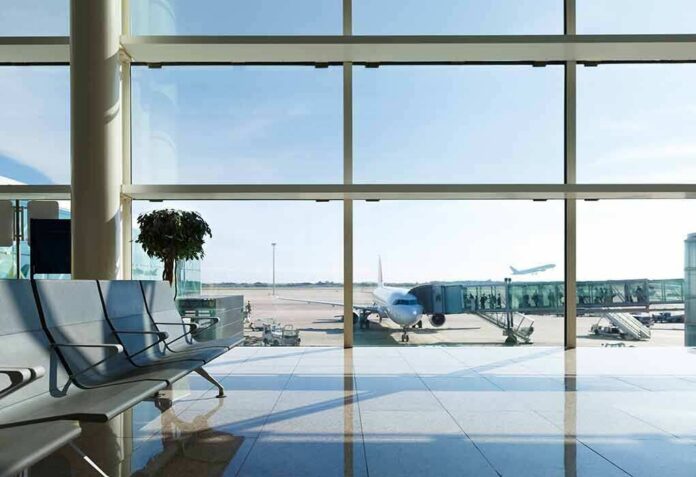
One person slipping past the boundary between terminal and tarmac can halt an airport within minutes; that is the lesson when a ticketed passenger became an intruder, stole a tug, crashed it, and was arrested on the airfield at John Wayne Airport.
The Short Version
- Authorities say a Delta passenger breached a terminal access point, entered the airfield, and stole an airport tug before crashing it.
- The suspect, identified as 26-year-old Skyler Jay Barr of Everett, Washington, was arrested on suspicion of vehicle theft, vandalism, and misdemeanor trespass.
- He allegedly attempted to take a second vehicle, an airline lavatory service truck, before airport police detained him.
- Air traffic control referenced an immediate ground stop, briefly disrupting operations while responders secured the ramp.
What happened on the ramp and why operations paused
Multiple outlets, citing airport officials and air traffic audio, reported that a Delta passenger exited the secure area onto the airfield at John Wayne Airport in Santa Ana, California, and commandeered a tug—an airside workhorse typically used to tow baggage carts or push aircraft. He drove it on the ramp, crashed it into another vehicle, then moved toward a second piece of ground equipment before officers moved in. Controllers referenced a security breach and indicated a ground stop as the situation unfolded, a standard protective measure that buys responders time to re-establish a sterile airfield and confirm no additional hazards are present.
Airside vehicles are purpose-built for torque and low-speed control, not speed; even so, an unauthorized driver amid aircraft, fuel lines, and personnel is an acute safety risk. Reports say the suspect then tried to take a lavatory service truck—high-profile and slow-turning—before airport police apprehended him. He was booked on suspicion of felony vehicle theft and vandalism, and misdemeanor trespass, and was held in county custody following the arrest.
Identification of the suspect and the charges
Authorities and multiple reports named the suspect as Skyler Jay Barr, 26, of Everett, Washington. Outlets that tracked the case across October 7–9 describe him as a Delta passenger who left the terminal area for the ramp and was taken into custody by airport police after the tug collision. Booking and charging language reported by regional outlets is consistent: vehicle theft and vandalism characterized as felonies, and trespass as a misdemeanor. That charge mix aligns with the core facts alleged—unauthorized entry onto the airside, taking and operating a vehicle without permission, and causing property damage when the tug struck another vehicle.
One detail recurs in accounts: after crashing the tug, Barr allegedly attempted to steal an American Airlines lavatory truck, a distinctive vehicle used to service aircraft waste tanks. That second act matters legally because it tends to show a continuing course of conduct on the airfield rather than a single impulsive breach; procedurally, it also helps explain why police intercepted him away from the first crash point.
How a passenger reaches the airside: the access gap and why it exists
Several reports attribute the breach to an emergency exit or restricted door near Gate 12 in John Wayne’s terminal complex, allowing the suspect to move from the public-facing concourse onto the ramp. In modern commercial airports, airside access sits behind multiple layers: access-controlled doors, alarms, camera coverage, ramp badges, and procedural checks such as “challenge” culture among ground staff. The system is resilient but not hermetic; rare events occur when an individual capitalizes on a momentary door cycle, an alarmed exit, or a brief lapse in monitoring. The public often reads such an incident as baffling; professionals treat it as a known class of risk, addressed by redundancy and response speed rather than a promise of zero breach probability.
Once an intruder is on the ramp, the risk calculus changes quickly. Controllers and airport operations prioritize aircraft clearance from the immediate area, restrict movements that could put crews or passengers in conflict with the unauthorized vehicle, and task law enforcement to contain and isolate the threat. That is why, as reported in the air traffic audio, a ground stop entered the conversation almost immediately—the safest configuration of a dynamic system is temporarily to make it static.
The vehicles at the center: why a tug and a lavatory truck matter
Airport tugs span two common categories: baggage tugs that tow carts and belt loaders, and pushback tractors capable of moving narrow- and wide-body aircraft. Both classes emphasize torque, low gearing, tight turning radii, and heavy-duty braking; neither is designed for joyriding. Keys may be managed differently across operators, but in many operations tugs are staged and cycled rapidly between crews, making key custody and immobilization devices a perennial security topic after any breach. Reports specify that the tug taken was affiliated with airline ground operations and that the subsequent attempt targeted a lavatory service truck; the latter includes tanks and pumps built for closed-waste systems. From a safety standpoint, unauthorized operation of either vehicle around aircraft risks personnel injury and equipment damage even at low speeds.
Property damage from the tug crash underpins the vandalism allegation described in charging reports. While “vandalism” evokes graffiti in common speech, in many jurisdictions it encompasses intentional or reckless damage to property; colliding a stolen tug with another vehicle on the ramp fits that statutory frame, which is why outlets framed vehicle theft and vandalism as the felony pair, with trespass capturing the initial unauthorized presence.
What makes this kind of breach rare, visible, and operationally disruptive
Airside intrusions are statistically uncommon compared with terminal screening violations, but they are visually dramatic, often caught on security or bystander video, and force immediate operational decisions. The combination—rare, risky, and highly visible—guarantees outsized media attention. Aviation security practitioners analyze such events less as freak anomalies and more as stress tests of layered defenses: how quickly was the breach detected, were aircraft movements halted appropriately, how fast did law enforcement gain control, and what procedural or hardware adjustments will harden the specific access point that failed. In this incident, public reporting converges on a brief disruption tied to a tower-referenced ground stop, quick police response, and an arrest on the field, all hallmarks of a system doing what it is designed to do once a breach occurs.
The consistent facts across outlets—the suspect’s identity, his status as a Delta passenger, the theft and crash of a tug, the attempted second vehicle theft, and the post-breach operational pause—are straightforward. Reports do not ascribe a motive, and there is no published toxicology or mental-health conclusion; that absence does not alter the legal elements that carry the case forward. The case, as described, will turn on proving unauthorized access, taking of vehicles without consent, and property damage—elements well supported by the sequence described by airport officials and by video contemporaneously cited in coverage.
A 26-year-old man broke onto the tarmac at California’s John Wayne Airport Tuesday, stealing an airport vehicle and driving near parked planes before crashing it into another airport vehicle, authorities say.
Skyler Jay Barr of Everett, Washington, was scheduled to fly out of… pic.twitter.com/sYRU45wFCu
— Mosheh Oinounou (@Mosheh) October 8, 2026
Why the charges, not the spectacle, will decide the outcome
Public conversation naturally gravitates to the spectacle of a “joyride” on the tarmac; prosecutors and defense counsel will argue over narrower questions. Did the defendant knowingly bypass a restricted barrier? Did he exercise control over the tug without permission? Did his actions cause damage that meets the threshold for felony vandalism in the charging jurisdiction? And did the attempted second vehicle theft demonstrate intent sufficient for additional counts? Those are provable, concrete elements, and they track closely with the undisputed conduct reported here: a passenger-turned-intruder, a stolen tug, a crash, an attempted second theft, and an arrest by airport police.
Sources:
newsbreak.com, foxla.com, wideopencountry.com, mynewsla.com, abc7.com, spotcrime.com