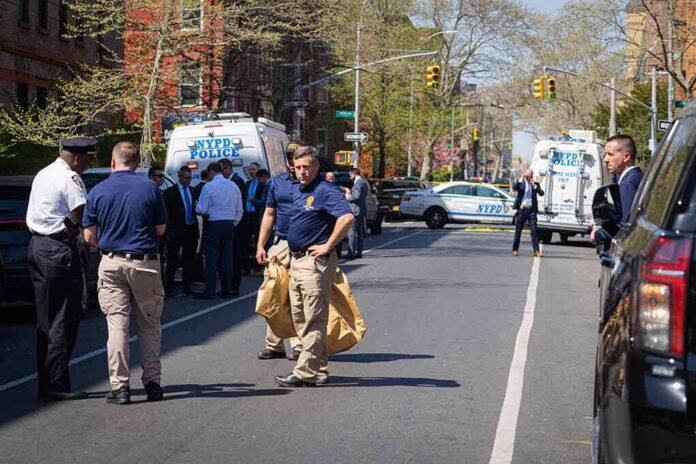
A 33-year-old NYPD detective survived seven knife wounds on a Bronx sidewalk because he did something most victims of a chain-snatching never attempt: he chased the men who stabbed him. That single act of resistance — and the week-long manhunt it triggered, ending in a basement recording studio in Lynn, Massachusetts — turned an ordinary street robbery into a case that touched policing, immigration enforcement, and the limits of off-duty vigilance all at once.
Key Points
- Detective Jose Mercedes, 33, of the 44th Precinct, was stabbed seven times during an attempted robbery in the Norwood section of the Bronx on Oct. 2 while off duty.
- Two suspects allegedly tried to snatch his gold chain after Mercedes confronted them near his vehicle’s open trunk; he fought back and pursued them before collapsing from blood loss.
- Mercedes was treated at Jacobi Medical Center and discharged in stable condition days later, greeted by cheers from colleagues.
- The suspects, identified by police as D’Angelo Carabello and Sneider Mejia, were tracked to Lynn, Massachusetts, and arrested after a multi-agency manhunt; DHS says both are in the country illegally.
- Both men agreed to extradition to New York, where they face charges tied to the attack, including an expected attempted-murder count.
What Happened on Rochambeau Avenue
Just before 2 p.m. on Oct. 2, Mercedes was off duty near Rochambeau Avenue and East 208th Street in Norwood when two men approached his parked vehicle, its trunk open. Witnesses told reporters the men appeared to be rifling through the trunk when Mercedes intervened — a decision that escalated in seconds. One bystander’s account, relayed by News 12, captured the sequence plainly: the suspects broke into his car, he approached, and he was stabbed. Rather than retreating, Mercedes chased his attacker down the block before collapsing near East 206th Street, bleeding from wounds to his chest, neck, back, arm, leg, and side.
Police have described the incident as an attempted robbery centered on Mercedes’s gold chain, which the suspects allegedly tried to grab before the confrontation turned violent. The exact count of wounds has varied slightly by outlet — most reporting settles on seven, though some descriptions suggest as many as eight distinct strikes — a discrepancy common in fast-moving crime coverage before formal medical and forensic documentation becomes public. What is not in dispute is the severity: FDNY and NYPD personnel responded within minutes, and Mercedes was rushed to Jacobi Medical Center in what hospital staff would later classify as stable condition.
A Recovery Watched by the Department
Mercedes’s hospitalization drew visits from Mayor Eric Adams and Police Commissioner Jessica Tisch, both of whom publicly wished him a swift recovery. Days later, he was discharged and reportedly greeted by cheering colleagues — a moment widely covered as a rare bright spot in an otherwise brutal case. The NYPD, in a since-widely-quoted social media post, framed the attack in institutional terms: “If you come for one of us, you’ll have the full force of the NYPD coming for you.” That statement, circulated across department accounts and picked up by local outlets, signaled how seriously the force treated an assault on one of its own, even off the clock and off the books on that particular shift.
The manhunt that followed was substantial by any measure: a joint New York–New Jersey task force, Massachusetts State Police, and U.S. Marshals converged on the case within days. Investigators traced a suspect vehicle to a residential basement at 10 Central Avenue in Lynn, Massachusetts — a recording studio just blocks from the local police station — where both men were apprehended. They appeared before a judge in Lynn District Court and agreed to extradition back to New York, where they are expected to face charges including attempted murder.
Identities, Immigration Status, and the Federal Dimension
Police identified the suspects as D’Angelo Carabello and Sneider Mejia; some outlets rendered the names slightly differently, as Dangelo Rafael Jean Caraballo and Sneider Mejia Bautista. The Department of Homeland Security subsequently stated that both men are in the United States illegally and placed detainers on them, a detail picked up across local and national coverage and amplified quickly on social platforms. Several reports also cited prior criminal histories for the pair, though the full documentary record — arrest reports, charging instruments, and any prior dispositions — was not uniformly available across the outlets covering the case in its first week.
Police say two men accused of stabbing and robbing an off-duty NYPD detective in the Bronx were arrested overnight in Massachusetts after authorities found them hiding in the basement of a home. https://t.co/sRzXf8YZGO pic.twitter.com/CVYSpwdDlx
— Eyewitness News (@ABC7NY) October 7, 2026
Why This Case Reads the Way It Does
Stories combining violent crime with undocumented-immigrant suspects tend to travel further and faster than comparable crime stories involving citizens, a pattern long documented in media research. An analysis of more than 2,200 immigration-related news stories in major U.S. papers from 1990 through 2013 found that most coverage framed immigrants as crime-prone or as a driver of rising crime, and that this framing grew more common, not less, over the period studied. Other research puts the share of immigration coverage tied explicitly to crime at roughly 9 percent of all immigration stories — a real but minority slice, suggesting the “crime frame” is influential less because of its prevalence than because of how sharply it sticks in public memory.
None of that changes the facts of what happened to Jose Mercedes on a Bronx sidewalk. It does explain why this particular robbery, rather than any of the dozens the 44th Precinct handles in an ordinary month, became a vehicle for a much larger argument about immigration enforcement and public safety — an argument playing out in comment sections and cable segments largely independent of the underlying criminal case now headed toward a New York courtroom.
What Comes Next
With both suspects extradited and facing New York charges, the case moves from manhunt to prosecution — a phase that will produce the charging documents, forensic reports, and courtroom testimony that early reporting, by its nature, could not fully capture. Mercedes’s recovery, meanwhile, stands as the case’s one unambiguous outcome: a detective who ran toward danger rather than away from it, and lived to return to his precinct.
Sources:
redstate.com, cbsnews.com, abc7ny.com, nydailynews.com, nypost.com, bronx.news12.com, amny.com, boston25news.com, the-express.com, dailywire.com, foxnews.com, academic.oup.com, tandfonline.com