
Debates over voter ID in California are not really about a celebrity video; they’re about whether rare, prosecutable violations justify rewriting the rules for tens of millions of perfectly lawful voters—and whether the specific rule being proposed actually addresses the specific risks on the table.
At a Glance
- Documented cases exist: federal prosecutors charged more than two dozen people in California with illegal registration or voting, underscoring that violations are not purely hypothetical, though they appear numerically small.
- The proposed cure and the alleged disease do not neatly align: photo ID at polling places targets in-person impersonation, while recent allegations center on unlawful registration and noncitizen voting.
- California already runs front-end identity checks through DMV and Social Security records; adding a polling-place ID layer is an administrative choice, not an inevitability.
- Research and official testimony consistently describe impersonation and noncitizen voting as rare; evidence that strict ID rules reduce fraud is limited, while effects on turnout are mixed across studies and populations.
What voter ID would—and would not—actually do
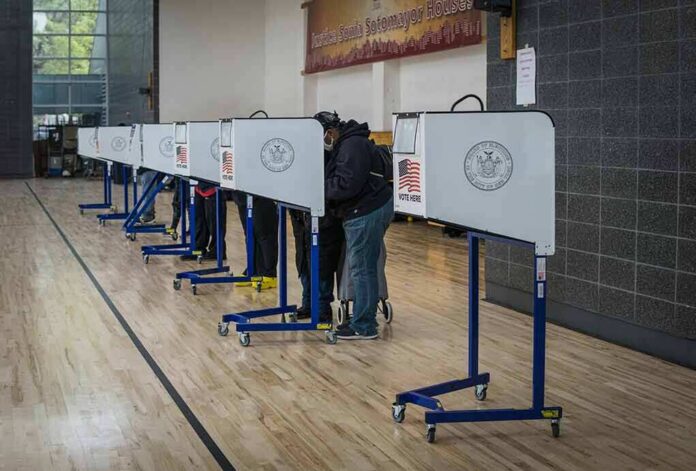
Photo voter identification is a point-of-service control: it verifies that the person standing at a check-in table is who they claim to be before receiving a live ballot. It is therefore tailored to a narrow class of misconduct—classic in-person impersonation. It does not itself verify citizenship, detect registration irregularities that were accepted upstream, or police mailed ballots. By design, it is a second fence at the polling place, not the front gate to the voter roll.
California’s current system relies on front-end checks at registration. The state matches applicant data against Department of Motor Vehicles and Social Security Administration records and can request documentation from some first-time voters. A polling-place ID rule would not replace these checks; it would sit alongside them as an additional verification layer. As such, its benefits depend on how often the specific risk—impersonation at the polls—actually occurs, and whether the incremental barrier is worth the tradeoffs for voters who already navigated registration successfully.
What we know from prosecutions and official reviews
Illegal registration and voting do occur, and they have been prosecuted. In October 2026, federal authorities charged more than two dozen people in California in a sweep focused on alleged noncitizen voting or registration, with reporting indicating roughly three dozen ballots at issue across several election cycles. These cases show that violations are not theoretical; they are chargeable and, when detected, pursued. But the public record of that sweep does not demonstrate widespread in-person impersonation at polling places, nor that the numbers were remotely outcome-determinative in statewide races.
California’s chief election officials and multiple hearings have repeatedly characterized fraud as rare. Secretary of State Shirley Weber has emphasized that fraud requires intent and is uncommon in California’s system. Opponents argue that new ID mandates would target an already low-incidence risk and risk excluding eligible voters who lack easy access to compliant identification. That institutional stance, coming from the office that runs the system, sets a high bar for proving that a new checkpoint is necessary and well matched to observed threats.
The contested evidence offered by proponents
Supporters of a statewide voter ID requirement argue that even rare violations warrant more visible controls to deter abuse and reassure the public. They also point to a corpus of incident reports compiled by the Election Integrity Project California (EIPCa), which claims VoteCal—the statewide voter database—showed numerical discrepancies between voters and votes in 2020 and 2022. Those assertions, presented to the Legislature, are serious if verified; however, in the record available here, they remain allegations from an advocacy organization rather than findings from an independent audit or a court-tested reconciliation of voter and ballot records. Without neutral replication or adjudication, they cannot carry the policy debate by themselves.
The strategic case for ID—“another check can only help”—has intuitive appeal. But administrative intuition is not evidence that the particular check addresses the observed modes of misconduct. The 2026 prosecutions concern unlawful registration and noncitizen voting; a polling-place photo check would typically not detect either if the underlying registration had already been accepted and the voter was properly listed in the roll on election day. The fit between rule and risk is the heart of prudent election design.
Turnout, access, and who bears the friction
Two things can be true at once: high-quality studies have found negligible average effects of strict ID laws on turnout, and distinct research has documented negative impacts concentrated among specific groups—especially lower-income and less-educated voters—under stricter regimes. The literature is mixed partly because laws vary in stringency, documentation alternatives, and mitigation (such as free IDs and broad provisional-ballot cures), and because implementation details often matter more than slogans. Several hearings in California put concrete stakes on the table: disability advocates and civil-rights groups warned that people with disabilities, seniors, low-income residents, and some students face persistent barriers obtaining and maintaining compliant IDs. Those burdens are not theoretical—they are administrative frictions that accumulate on real voters.
Policymakers weighing a new rule should separate two questions that often get conflated. First: on average, across a state, will turnout fall? Second: regardless of the average, will the law predictably shift friction onto voters who are already at the margins of participation—non-drivers, those with unstable housing, or people whose documents frequently lapse? Evidence cited in California proceedings and national research indicates that stricter identification regimes can depress participation more among lower-income and less-educated registrants, even when aggregate turnout looks unchanged. That asymmetric burden is a distributional choice, not a statistical footnote.
What a disciplined policy test would ask next
If the goal is precision—solving the problem that actually exists—then the next tranche of evidence should be specific, not rhetorical. First, scrutinize the 2026 federal cases: what fraction involved in-person impersonation that a poll-site ID check would have stopped versus upstream registration errors, noncitizen self-attestation, or mail voting? A clean typology tied to case files, not headlines, is crucial. Second, commission an independent reconciliation of the alleged VoteCal discrepancies: align voter files, cast-vote records, and certified totals with full chain-of-custody documentation to determine whether anomalies reflect timing and list-maintenance artifacts or unlawful ballots. Third, measure how often California’s existing first-time-voter documentation requests and DMV/SSA matches fail in a way an at-poll ID requirement would uniquely catch; that yields a real denominator for benefit.
On the cost side, catalogue who currently lacks compliant ID, how quickly and cheaply they can obtain it, and how robustly any “free ID” program would function in practice. Observe real-world provisional-ballot cure rates under strict-ID analogs, not idealized processes on paper. Both sides of the ledger—prevented incidents and created frictions—should be quantified before a rule change that touches every voter.
'Favorite Ad Ever'! 'Sydney Sweeney' Makes a GREAT Case for Voter ID Law in California https://t.co/wOThreEsNT
— Whyle Kiote (@whylek) October 22, 2026
Where the Sydney Sweeney video fits—and doesn’t
Satirical or celebrity-framed advocacy can galvanize attention, but it is not evidence about administrative effect. The question before California is technical: does a photo ID checkpoint at polling places measurably reduce the kinds of violations that actually occur here, at a tolerable access cost? The enduring pattern in American election fights is clear: a visible security measure is proposed to answer concerns that often arise from different failure modes entirely. The strongest way to break that cycle is not to dismiss concerns or embrace symbolism, but to align remedies to documented risks and to test those remedies against the lived realities of the voters who will have to navigate them.
Sources:
latimes.com, pro.stateaffairs.com, selc.senate.ca.gov, aelc.assembly.ca.gov, yahoo.com