
Public demonstrations of elite military skills are meant to inspire; when they go wrong, they reveal the unforgiving physics of height, load, and human systems in a venue never designed for rope work. The Air Force’s identification of Tech. Sgt. Ian Patterson after his fatal fall at the Alamodome puts names, units, and responsibilities on a tragedy that now moves from spectacle to safety investigation.
At a Glance
- The Air Force identified Tech. Sgt. Ian Patterson as the airman who died after a fast‑rope demonstration fall at the Alamodome before the UTSA–Navy game.
- He was a Tactical Air Control Party instructor assigned to the 6th Combat Training Squadron, Detachment 2, at Joint Base San Antonio–Camp Bullis.
- The fall occurred during a four‑person descent from stadium rafters—an inherently high‑risk technique adapted to a temporary, non‑operational venue.
- An Air Force mishap investigation will parse equipment, rigging, procedures, and supervision; the public pressure to find quick meaning will collide with methodical fact‑finding.
What is confirmed: identity, unit, and setting
The U.S. Air Force formally identified the service member as Tech. Sgt. Ian Patterson, a Tactical Air Control Party (TACP) instructor assigned to the 6th Combat Training Squadron, Detachment 2, at Joint Base San Antonio–Camp Bullis. Nellis Air Force Base Public Affairs released his name and role after next‑of‑kin notifications, underscoring that this was not rumor but official attribution of identity and assignment. That unit trains and supports Air Force Special Warfare capabilities; its instructors are accustomed to live‑environment risk, but also to doctrine that manages it.
The mishap unfolded inside San Antonio’s Alamodome just before a UTSA football game against Navy, during a pregame display that featured four Air Force personnel descending by rope from the rafters. Multiple outlets corroborated the sequence—descent, fall from significant height, on‑field medical response, transport, and later confirmation of death—anchoring the public narrative in consistent eyewitness accounts and official statements rather than speculation.
Fast‑rope and rappelling: similar optics, different mechanics
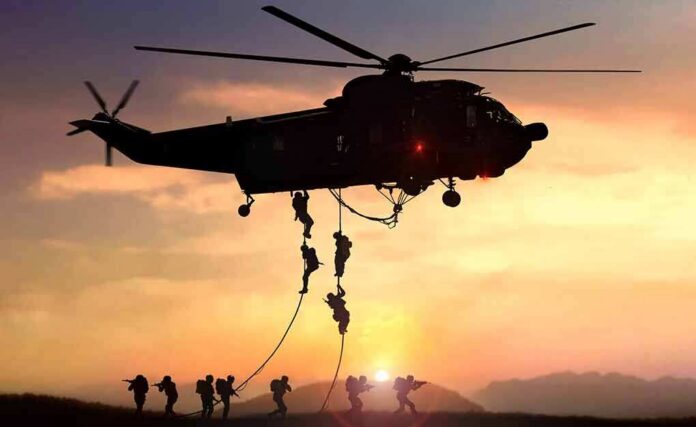
To the layperson, “rappelling” and “fast‑roping” can look interchangeable; they are not. Rappelling uses a harness and a friction device that captures the rope; the system is clipped to the climber, and descent rate is controlled mechanically. Fast‑roping, by contrast, uses a thick static rope and gloved hands to modulate friction as the operator slides without a harness attachment—rapid, tactically efficient, and unforgiving of grip errors, contaminated gloves, or misjudged friction. Demonstrations often hybridize these visuals under show lighting and time pressure. The physics, however, never change: mass, gravity, and friction determine energy on contact, and the margin for error compresses with height and speed.
Stadium rafters introduce further complexity. Unlike a helicopter skid or a purpose‑built training tower, an indoor roof demands temporary rigging, anchors rated for dynamic loads, edge protection to prevent rope sheath damage, and rehearsals that replicate sightlines, lighting, and acoustics. The more “one‑off” the site, the more procedure must substitute for familiarity. That is why formal risk assessments and run‑ups matter as much as the operators’ individual skill.
Why venue demonstrations stretch safety systems
Pre‑game military demonstrations combine specialized techniques with nonstandard environments, broadcast cameras, and a hard start time. This is not merely colorful context; it is a risk driver. The same maneuver executed on a training tower carries a known rope, a known anchor, a known descent path, and a safety officer whose sole job is to halt the evolution if a parameter is wrong. On game day, organizers layer ceremonial scripts, music cues, and crowd management on top of those fundamentals. The crowd at the Alamodome—reports cite roughly twenty to twenty‑three thousand people—was not the hazard; the compressed timeline and the temporary rigging were. When four people are scheduled to descend, spacing, rope condition, and contingency signaling must be drilled under conditions that approximate the real show.
The pattern is sadly familiar: a low‑probability but high‑consequence failure occurring in front of thousands, instantly reframed from safety problem to institutional crisis. The investigation that follows has to ignore the optics and grind through method—hardware inspection, rope analysis, gloves, footwear, rigging points, supervisory checklists, medical autopsy if relevant, and time‑stamped video from multiple angles. Each discipline speaks a piece of the truth; only together do they explain causation.
What an Air Force mishap investigation will actually examine
Air Force investigators work from the inside out: the individual’s training and medical readiness; the equipment’s certification, service life, and post‑event condition; the rigging plan’s engineering; the rehearsal record; and the command’s risk acceptance. In rope evolutions, questions tend to cluster around five domains: anchor integrity and load path; rope selection and history; descent technique (fast‑rope versus rappel and whether that changed last‑minute); glove condition and friction management; and spacing/communications between team members. Investigators will also parse who held stop‑work authority and whether any cue—visual slip, rope twist, audible distress—should have triggered an abort. None of this is glamorous. It is how preventable errors are found and corrected, and how non‑preventable hazards are bounded rather than wished away.
The presence of broadcast‑quality video, eyewitness clips, and stadium operations logs will accelerate timeline reconstruction but does not shortcut physics. A precise drop distance, descent rate, and body orientation on impact can be estimated from frame analysis; equipment autopsy either corroborates or refutes those inferences. The service’s promise to identify causes, not scapegoats, is not a platitude but a precondition for learning that sticks.
TACP instructors and the burden of competence
TACPs integrate airpower with ground maneuver; their training pipeline stresses fieldcraft, communications, and the ability to operate under pressure. As an instructor, Patterson would have been subject to recurring evaluations and currency requirements. That does not immunize anyone from mishap—competence reduces risk, it does not eliminate it. The tragedy lands especially hard in training and demonstration units precisely because they are custodians of standards. Unit cultures that honor that responsibility make two moves quickly after loss: they care for families and teammates, and they get clinical about facts. The first is human; the second is how they keep faith with the next generation.
The public event problem: success is invisible, failure is total
When a demonstration ends safely and on time, almost no one outside the team notices the scaffolding of safety that made it so. When it fails, witnesses remember the silence and the sirens. Reports from the Alamodome captured that instant hush and the rapid medical response, followed by the decision to resume the game after a brief delay—decisions event managers and commanders must balance in real time, with imperfect information and a duty to both the injured and the public. The right lesson is not to eschew public demonstrations categorically, but to treat them as their own discipline: distinct planning cells, specialized rigging oversight, and the authority to scrub a show when conditions drift from plan.
https://twitter.com/IAmyLeigh/status/2112176805889151430
What it means going forward
For the Air Force, the measure of institutional seriousness will be whether its findings translate into enforceable changes—venue selection criteria that prioritize engineered anchor points, standardized fast‑rope kits for demonstrations, rehearsals under silent‑stadium conditions, and hard abort rules that privilege physics over pageantry. For stadium partners, it means understanding they host not just a show but a complex rope system whose safety envelope must be engineered, not assumed. For the public, it is a reminder that military skill on display is still real skill, with real risk.