
When five people collapse in one home within minutes, the response is medical, tactical, and communal all at once; in Oroville, California, that meant police reviving who they could, declaring two beyond help, and rushing three to the hospital as investigators began the methodical work of determining what, exactly, turned a private residence into a mass casualty scene.
At a Glance
- Police found five people suffering suspected overdoses at a residence in Oroville on the morning of November 21, 2026.
- Two were pronounced dead at the scene; three were transported to the hospital, two in critical condition and one stable.
- Responding officers administered Narcan, performed CPR, and provided care until medics arrived.
- Authorities described the case as apparent or suspected overdoses while the investigation proceeded; no specific substance was identified publicly.
What Happened Inside the Oroville Home
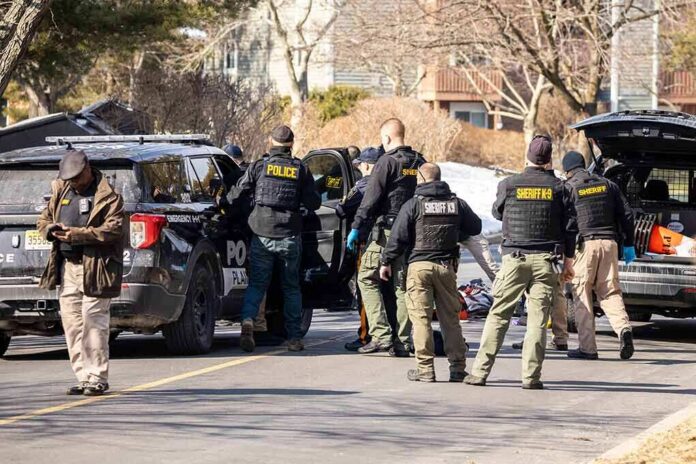
Shortly after 8 a.m. on November 21, Oroville police were dispatched to a residence in the 100 block of Hammond Park Drive after a report of multiple suspected overdoses. Officers encountered five people in medical distress. Two were declared deceased at the scene; three others were transported to area hospitals, with two listed in critical condition and one in stable condition at the time of transport. The police account, provided in a department news release and reflected in multiple outlets, detailed concrete interventions by first responders: officers deployed Narcan, initiated CPR, and continued life-saving efforts until emergency medical personnel assumed care.
The immediate facts across independent reports align on the core outcomes: five victims, two fatalities, and three hospitalizations. The initial call time—around 8:10 a.m.—and the description of the location as a single residence also match. While some outlets use slightly different street names in describing the block, the accounts consistently place responders at a single Oroville home that morning for what police characterized as suspected overdose emergencies.
How Police and EMS Work a Clustered Overdose Scene
First responders treat simultaneous overdose-like presentations as a time-critical cluster: secure the scene, triage quickly, reverse opioid toxicity if suspected, support breathing and circulation, and move patients to higher care. Naloxone (commonly branded as Narcan) is administered when responders suspect opioid involvement; because its safety profile is favorable, it is often given empirically when respiratory depression and unresponsiveness suggest opioid toxicity. CPR and airway support proceed in parallel when pulses or breathing are compromised, buying time until advanced life support or emergency department teams can take over. The Oroville release’s account—Narcan on scene, CPR initiated—tracks closely with these protocols, which are designed for exactly the kind of multi-patient emergency described here.
In the hours that follow, two tracks unfold. Clinically, hospitals work to stabilize patients and, where appropriate, collect specimens for toxicology screens that can guide care. Investigatively, police and medical examiners document the scene, identify the deceased, notify next of kin, and begin establishing whether the victims shared a common exposure source. That may involve cataloging paraphernalia, seizing suspected substances for lab analysis, interviewing witnesses, and coordinating with public health if a dangerous supply is suspected. Those steps take time; the medical and legal determinations that convert “suspected overdose” into a confirmed cause of death typically require toxicology and coroner findings.
What We Know, What We Don’t, and Why the Distinction Matters
Based on the police-attributed accounts, officials framed the event as suspected or apparent overdoses pending further investigation. No agency publicly identified a specific drug, and the names of the five individuals were not released in the initial reporting window. Such restraint is standard: early public statements center on scene safety, casualty counts, and immediate risk communication, not premature medical conclusions. Media descriptions of clustered events as a “mass overdose” are commonplace because the operational reality—multiple patients, similar presentations, same location—demands a scaled response even before toxicology confirms a single substance as the driver.
That provisional label has implications. Clustered suspected overdoses can signal an unusually potent or contaminated drug supply and, in some cases, trigger broader alerts. But the term itself does not predetermine the toxicological outcome. Confirmation of cause rests with the medical examiner and, for survivors, clinical findings. In Oroville, the uncontested facts are the five patients, the two on-scene fatalities, and the emergency measures officers took before medics arrived; substance identification and definitive cause-of-death determinations had not been released in the initial coverage window.
Two dead in mass overdose in Oroville home https://t.co/drPwF9gMpY pic.twitter.com/C0WlGc3naq
— SFGATE (@SFGate) November 22, 2026
Where This Fits in the Larger Public-Health Pattern
Events like the Oroville case sit within a national pattern in which clusters of overdose-like emergencies draw rapid attention because they can indicate shifts in the illicit market—higher-potency batches, adulterants, or novel psychoactive substances—and carry a risk of immediate recurrence. Public-health practice treats these clusters as signals; confirmation of etiology follows from clinical data, scene investigation, and toxicology rather than from first impressions on the curb. That sequencing—rapid operational labeling, slower medical confirmation—has become a predictable feature of how communities and the press experience overdose clusters.
What Comes Next for Oroville
In the aftermath of a fatal cluster, agencies typically pursue three priorities. First, victim identification and family notification proceed alongside autopsies and toxicology to establish cause and manner of death. Second, investigators work to determine whether the hospitalized individuals shared a common source with the decedents, and whether any seized substances link to a broader distribution chain. Third, if evidence points to a dangerous lot or a wider public threat, police and public-health officials coordinate outreach—ranging from targeted community alerts to distribution of naloxone and treatment referrals—to prevent additional harm. The initial Oroville reporting already indicates a serious, contained scene response; the next wave of information customarily comes from coroner findings and any investigative developments that trace a source or pattern.
Sources:
nypost.com, eastbaytimes.com, mercurynews.com, yahoo.com, hoodline.com, fox40.com, article.wn.com, actionnewsnow.com, dnyuz.com