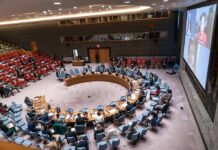
The hinge of the Abu Dhabi channel is not a ceasefire line; it is whether the war in Ukraine can be nested inside a broader, durable European security framework that answers Russia’s stated concerns without compromising Ukraine’s sovereignty or its path toward Europe.
The Short Version
- U.S.-mediated talks in Abu Dhabi restarted direct Russia–Ukraine negotiations and produced a concrete humanitarian deliverable: a major prisoner exchange, with further workstreams set on security guarantees and de‑escalation.
- Washington’s envoys framed the agenda around post‑war security arrangements and a multilateral format that brings European partners into the room, not a bilateral carve‑up.
- Moscow signaled it wants the talks to anchor a reworked European security architecture—an ambition many European leaders resist, citing the bedrock principles Russia has violated.
- The strategic test is implementation: any security guarantees for Kyiv must be specific, enforceable, and embedded in European buy‑in to avoid the fate of past paper guarantees.
What the Abu Dhabi track actually put on the table
Abu Dhabi hosted the first Russia–Ukraine negotiations in months, under U.S. mediation, with a mandate broader than battlefield pauses. U.S. envoy Steve Witkoff outlined a docket that included ending the war, post‑war security agreements, and de‑escalation measures—a sequence that deliberately marries near‑term humanitarian relief to long‑term architecture. Across two days, the delegations agreed to a large prisoner exchange—an outcome that matters on its own terms and establishes a cooperative channel for follow‑on steps. The core political files—territory, security guarantees, and the future format—remained open. That is not surprising; in conflicts of this magnitude, humanitarian trades usually come first, then confidence‑building measures, then the structural questions. The Abu Dhabi round restarted that ladder.
Crucially, U.S. mediators pitched the talks as a transition point from trilateral mechanics to a multilateral framework that includes key European stakeholders. The logic is straightforward: even the most elegant security blueprint will fail in implementation if the states expected to resource and enforce it weren’t co‑authors at the design table.
Europe’s place in the room—and why it matters for the endgame
Russia’s delegation telegraphed an ambition to make the negotiations a venue for remaking Europe’s security order, describing a post‑war framework as the main thrust of the process. European leaders, by contrast, argue that the continent already has a security order grounded in sovereignty, territorial integrity, and the non‑use of force; the problem is serial violation, not a missing architecture. That divergence is not a semantic squabble. It’s a fork in the road: is “European security” a neutral umbrella for stabilizing arrangements, or a euphemism for granting one belligerent a privileged say over neighbors’ choices?
Abu Dhabi did not resolve that question, but it did fix the stakes. If Europe is structurally outside the room, any commitments relying on its funding, training pipelines, sanctions policy, or air defense backstops will be brittle. Conversely, a process that folds in EU and NATO institutions can translate text into capability—arms stocks, industrial ramp‑ups, border monitoring, and long‑horizon financial support—without which “guarantee” is an empty noun.
Security guarantees: the mechanism problem, not just the promise
Security guarantees are the spine of this negotiation—both the promise to deter renewed aggression and the practical arrangements that let Ukraine rebuild and integrate with Europe. The history here is sobering: soft assurances rarely change an adversary’s calculus, and even formal obligations fail when they lack specific triggers, assigned responsibilities, and credible enforcement ladders. Comparative research on peace settlements shows a high attrition rate in implementation; design quality and guarantor resolve determine whether agreements survive their first stress test.
That experience points to design principles rather than slogans. Guarantees that work tend to include time‑bounded delivery of military capabilities, persistent training and intelligence sharing, disciplined escalation pathways for violations, and multilateral monitoring with publicly reported benchmarks. They mesh political commitments with logistics and law. For Ukraine, that likely means multi‑year air defense and artillery pipelines, integrated early‑warning networks, cross‑border energy resilience measures, and financial scaffolding that does not crumble the first time markets wobble. These are not afterthoughts; they are the content of deterrence.
What both sides signaled—and what it implies
On the Russian side, negotiators indicated progress on humanitarian tracks yet maintained hard positions on the territorial file, consistent with prior maximalist demands. They also expressed skepticism about an EU role “for now,” reflecting a preference to bargain over European security with fewer Europeans present. On the Ukrainian and U.S. sides, the through‑line was to keep sovereignty non‑negotiable while pushing the process toward a larger table—one capable of underwriting any settlement with real resources and collective legitimacy.
The immediate implication is practical: expect more near‑term deliverables—prisoner exchanges, civilian protection measures, possibly battlefield de‑confliction—while the architecture debates ripen. That is not drift; it is sequencing. Durable settlements are rarely born whole. They’re built in layers, each tested against incentives and verified in the field.
Where the real disagreements live
The substantive split is not over whether to have “security guarantees,” but over their scope, authorship, and implied vetoes. Moscow’s framing of an “indivisible” European security umbrella often comes bundled with constraints on neighbors’ alliances and force posture—features many Europeans view as rewarding aggression under the cover of doctrine. Kyiv and its partners, meanwhile, press for guarantees that protect Ukraine’s European choice while reducing incentives for renewed attack—conditions that resist external vetoes and instead lean on capability provision, sanctions snap‑backs, and multilateral compliance machinery. Embedded here is the central design question: are guarantees primarily promises of restraint by Ukraine and the West, or primarily instruments to raise the cost of renewed Russian coercion? The trajectory of the war, and basic deterrence theory, argue for the latter.
How this could shape the post‑war order
If the Abu Dhabi track succeeds in shifting from a trilateral mechanism to a multilateral settlement design, the outputs can be concrete even without treaty grandiosity: codified military aid schedules mapped to reforms, EU‑Ukraine integration milestones protected from coercion, energy infrastructure hardening financed and insured by a European‑U.S. consortium, and a joint monitoring mission with clear violation reporting. None of these require rewriting Europe’s security canon; they require resourcing it. They also align with the hard lesson of past arrangements: ambiguity is the enemy of compliance, and promises without capabilities invite tests.
Conversely, a process that elevates “architecture” while eliding agency—the ability of Ukraine and European states to choose their alignments and defenses—would likely reproduce the very instability it claims to cure. Stability in Europe has historically correlated with clear rules and credible power behind them, not with spheres of influence glossed as indivisibility.
Russia and Ukraine have reached an agreement on a prisoner exchange following US-led peace talks in Abu Dhabi, but failed to make progress towards ending the war. @alia_aglan
— Janna Khaled Taalab (@Jannataalabb) November 18, 2026
What to watch next
Three markers will reveal whether the Abu Dhabi channel is bending toward a durable outcome. First, whether European institutions and key capitals move from corridor consultations to formal seats in the next rounds; if they do, implementation odds improve markedly. Second, whether the prisoner‑exchange mechanism becomes a recurring, rules‑based channel; repetition converts goodwill into process and sustains talks through crises. Third, whether “security guarantees” graduate from rhetoric to schedules, stockpiles, and surveillance—provisions that make deterrence legible to all parties, including domestic audiences that will ultimately finance and enforce them. None is glamorous. All are dispositive.
Sources:
theamericanconservative.com, reuters.com, carss.du.ac.bd