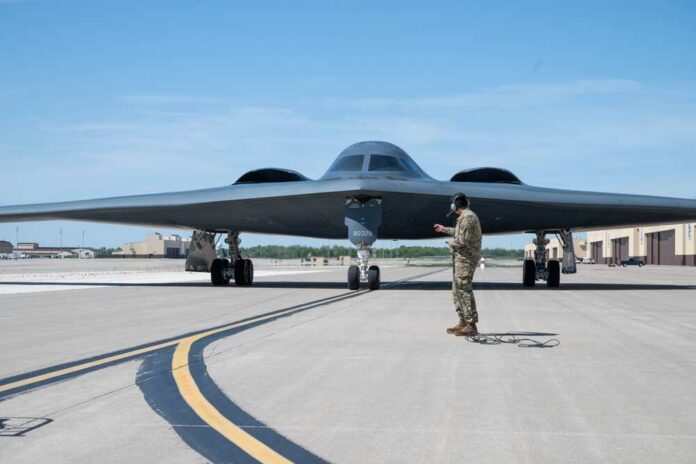
The Air Force’s next-generation B-21 Raider stealth bomber continues advancing through flight testing at a pace that suggests the program is avoiding the costly delays and overruns that plagued previous defense acquisitions, though claims of early completion remain unverified by official sources.
Story Snapshot
- B-21 Raider flight testing progresses on schedule at Edwards Air Force Base with no official confirmation of early critical test completion
- Second test aircraft arrival in September 2025 accelerates weapons and mission systems evaluations, expanding testing capabilities
- Program benefits from digital engineering and over 1,000 hours of flying test bed experience, avoiding software issues that delayed past bombers
- Northrop Grumman and USAF maintain flight tempo of two-plus sorties weekly, supporting plans for 100-plus aircraft fleet by 2070s
Testing Progress Remains on Track
The B-21 Raider program continues flight and ground testing at Edwards Air Force Base in California, with the U.S. Air Force and Northrop Grumman reporting steady progress through early 2026. The second test aircraft arrived at Edwards on September 11, 2025, enabling the Combined Test Force of the 412th Test Wing to shift focus toward advanced weapons and mission systems evaluations. Secretary of the Air Force Troy Meink stated the second aircraft “gains substantial momentum” and will “expedite critical evaluations.” However, no credible public sources confirm claims that the bomber has “passed its critical flight test campaign early.”
Digital Engineering Reduces Development Risks
The B-21 benefits from extensive pre-flight preparation that distinguishes it from troubled predecessors like the B-2 Spirit, which faced significant delays in the 1990s. Northrop Grumman conducted over 1,000 hours of flying test bed missions before the Raider’s first flight on November 10, 2023, allowing engineers to identify and resolve software issues on the ground. Tom Jones, president of Northrop Grumman Aeronautics, reported in March 2025 that the first aircraft requires minimal software changes and maintains a tempo exceeding two sorties per week. This pace reflects the Air Force’s emphasis on open-architecture design and rapid technology upgrades, core principles for maintaining strategic deterrence against peer competitors.
Strategic Importance Amid Great Power Competition
The B-21 Raider serves as the cornerstone of the Air Force’s future bomber fleet, designed to replace aging B-1 and B-2 platforms and provide long-range, penetrating strike capability through the 2070s. The program, initiated in 2011 and awarded to Northrop Grumman in 2015 after competition with Boeing-Lockheed Martin, emphasizes low observability and integration with networked warfare systems. U.S. Strategic Command views the Raider as essential for nuclear and conventional deterrence as China and Russia expand military capabilities. Air Force Chief of Staff Gen. David Allvin stated the second aircraft “accelerates the path to fielding,” underscoring the urgency of modernization in an era of renewed great power competition.
Economic and Industrial Base Implications
The $80-billion-plus B-21 program sustains thousands of jobs at Northrop Grumman’s facilities in California and bolsters the domestic defense industrial base at a time when supply chain vulnerabilities and foreign dependencies concern national security planners. The Air Force plans to procure at least 100 Raiders, with low-rate initial production already underway alongside testing. Andrew Hunter, Assistant Secretary of the Air Force for Acquisition, testified to the Senate that the program is “proceeding well” and “on track to deliver,” a contrast to cost overruns and schedule slips that have eroded public trust in defense procurement. Success here could set standards for digital engineering on future programs like the Next Generation Air Dominance fighter.
Program secrecy limits public details, but available evidence points to a well-managed acquisition that avoids the pitfalls of past bomber developments. The absence of official announcements regarding early test completion suggests either operational security or that recent claims stem from misinterpretation of classified milestones. Regardless, the Raider’s progress offers a rare example of government and industry collaboration delivering capability on schedule, a welcome development for taxpayers weary of defense waste and for those who recognize that credible deterrence requires not just advanced technology but timely fielding of operational systems.
Sources:
Air Force Technology – USAF B-21 Raider
Defense News – Second B-21 flies for first time as Air Force eyes testing expansion
U.S. Air Force – US Air Force announces arrival of second B-21 test aircraft at Edwards AFB
U.S. Strategic Command – B-21 Raider continues flight test production
Air & Space Forces Magazine – B-21 good progress flying test bed