

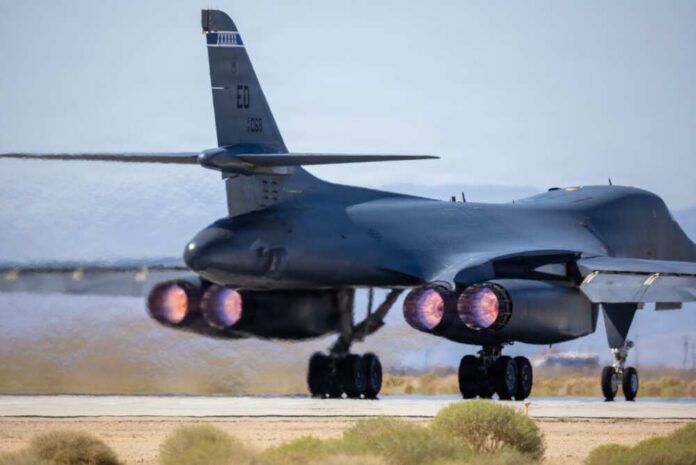
A Cold War workhorse just fell out of the sky on American soil, and Washington is already going quiet about what really happened.
Story Snapshot
- A U.S. Air Force B-52 Stratofortress crashed shortly after takeoff at Edwards Air Force Base in California.
- Officials confirmed the crash and emergency response, but have not revealed crew status or cause.
- The incident raises hard questions about aging bombers, maintenance, and Pentagon transparency.
- Conservatives are watching closely to ensure answers, accountability, and support for military families.
B-52 Goes Down On Takeoff At Edwards Air Force Base
On Monday morning, a United States Air Force B-52 Stratofortress heavy bomber crashed shortly after takeoff on the airfield at Edwards Air Force Base in California’s Mojave Desert, around 11:20 a.m. local time, according to the base’s official social media statement. The aircraft went down on or near a runway, with video showing a large plume of dark smoke rising from the crash site and charred ground not far from the concrete strip.[7] The base immediately closed air traffic and diverted incoming aircraft.[1]
Edwards Air Force Base confirmed that emergency crews rushed to the wreckage and began fire suppression and rescue efforts within minutes. Footage from news helicopters and online clips showed black smoke, scattered debris, and responders working across a wide impact area on the desert floor.[7][8] Reporters on scene described the bomber as “devastated,” with little left that resembled a complete aircraft.[7] As of the latest official updates, leaders have not released the number of crew on board or whether there were survivors.[5]
Silence On Crew And Cause Fuels Public Frustration
The Air Force’s initial public line has been short and tightly controlled: confirmation of the crash, the time, and the base location, plus a promise of more information “as it becomes available.” Officials have said only that emergency crews responded and the “situation is ongoing,” offering no confirmed word on injuries, fatalities, or why the bomber went down.[5] This pattern fits other recent military aviation mishaps, where families and taxpayers wait weeks or months before hearing basic truth about what failed and who paid the price.[4]
News outlets across the spectrum repeated the same bare facts from the Edwards statement, then filled air time with speculation on whether weather, mechanical problems, or pilot actions might be to blame.[1][3][7] Some commentators highlighted past B-52 crashes, including deadly training accidents, to suggest how serious such events usually are. But none of that replaces hard data from flight recorders, tower logs, or maintenance records. For now, the people who know the most about this aircraft and its mission are saying the least in public.
What This Says About Our Aging Bomber Force And Readiness
The Boeing B-52 first entered service in the 1950s and has been the backbone of America’s bomber force for generations, flying in conflicts from the Cold War through the war on terror.[7] The Air Force plans to keep upgraded B-52s flying into the 2050s, which means some airframes will serve for nearly a century. That long life demands intense upkeep, constant inspection, and honest reporting when something goes wrong. Every crash of a legacy bomber should trigger tough questions about parts, maintenance, and leadership decisions.
🚨 TRAGIC — B-52 STRATOFORTRESS CRASH AT EDWARDS AFB CLAIMS ALL 8 CREW 🔥
A United States Air Force B-52 has crashed on the airfield at Edwards Air Force Base in California.
Officials now say the incident was not survivable all 8 crew members are believed lost.
One of America’s… https://t.co/oUKSQmPRpy— ZeroBarkThirty (@zerobarkthirty) June 15, 2026
Edwards Air Force Base is the main test hub for new aircraft, weapons, and software, so any B-52 there may have been tied to advanced systems or upgrade work. Some aviation analysts have already raised the possibility that this bomber was supporting radar or electronics testing, though official channels have not confirmed the specific mission or tail number.[5] If the aircraft was flying a test profile, some technical details may be classified, which can slow or narrow what the public learns. That makes congressional oversight even more important when billions are being spent to keep these old giants in the air.
Why Conservatives Want Answers, Not Spin
For many conservative Americans, this crash hits several nerves at once. It involves the safety of our service members, the health of our nuclear and conventional deterrent, and the honesty of a Pentagon that has not always been open about cost overruns, readiness gaps, or past aviation failures. A lost B-52 is not just hardware; it is a warning light on the dashboard of national defense. Voters who back a strong military also expect straightforward accounting when a key weapon system falls out of the sky at home.
Going forward, lawmakers aligned with constitutional, limited-government principles can press for the basics without revealing sensitive tactics: the crew count and status, the confirmed mission type, the bomber’s maintenance history, and a clear, unclassified summary of what caused the crash once the investigation is complete. Past B-52 disasters have been traced to poor leadership and rule-breaking as well as technical failure, and transparent reports helped fix those problems.[1] The men and women who fly under the American flag deserve nothing less this time.
Sources:
[1] YouTube – Air Force B-52 bomber crashes at Edwards Air Force Base
[3] Web – B-52 Crashes at Air Force Base, Officials Say – The New York Times
[4] Web – US Air Force B-52 bomber crashes after takeoff … – Al Jazeera
[5] YouTube – U.S. Air Force B-52 Stratofortress crashes after takeoff on Edwards …
[7] Web – [PDF] Leadership and Ethics – Civil Air Patrol
[8] Web – June 24, 1994, A United States Air Force Boeing B-52 Stratofortress …