

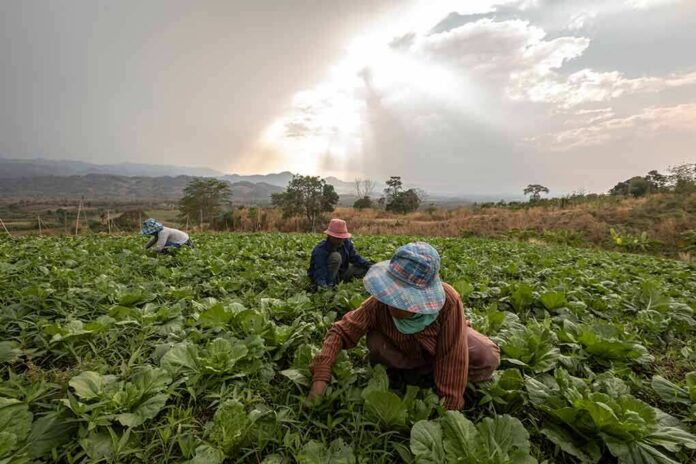
The significance of this case is not merely that one university was accused of sending students into farm and factory work; it is that the allegation fits a long-established Xinjiang pattern in which “practice,” “training,” and “internships” can become administrative instruments for channeling labor under conditions students may not freely refuse.
Key Points
- The allegation centers on Xinjiang Agricultural University and a mandatory “rural support labor practice” program that reportedly pulled second-year students out of regular classes for about 20 days.
- The online account says students were sent to farms, Xinjiang Production and Construction Corps units, and tomato-processing plants to do manual labor, not optional volunteer work.
- Circulated documents reportedly included a safety agreement that shifted accident risk to workers and said the company would not provide social insurance, which is why the labor conditions drew scrutiny.
- The case matters because Xinjiang has a documented history of coercive “work-study,” labor transfers, and “vocational training” schemes that blur education policy and forced labor concerns.
What the accusation says happened
According to the report, a self-identified graduate posted on Zhihu that Xinjiang Agricultural University had long required students to participate in a “Rural Support Labor Practice Course,” with second-year students suspending regular classes for roughly 20 days before being transported to agricultural sites and food-processing plants. The alleged placements included farms, state-linked agricultural settlements, and tomato-processing factories, where students performed seasonal work such as harvesting cotton, peppers, grapes, and tomatoes, as well as packaging and boiler assistance on production lines.
The most important detail is not the slogan attached to the program but its structure. A genuinely educational practicum is bounded, supervised, and legible as training; the allegation here describes compulsory manual labor folded into coursework, with students told to show up, work, and accept conditions they could not meaningfully negotiate. That distinction is the difference between a curriculum and a labor pipeline.
Why the safety agreement matters
What sharpened the controversy was the appearance of an internal-looking agreement tied to a tomato-processing company. The document, as described in the reporting, said workers would assume full responsibility for workplace accidents, waive the right to seek compensation, and acknowledge that the employer had no obligation to provide social insurance. Those provisions are notable because they cut against the ordinary protections one would expect in an educational placement, especially one presented as part of a university program.
In labor-rights terms, the problem is not only whether students are paid. It is whether they are exposed to industrial risk while stripped of the basic safeguards that make labor lawful, bounded, and compensable. When a university program sends students into agriculture or factory work and the arrangement appears to disclaim liability up front, the educational veneer becomes much thinner.
Why Xinjiang changes the meaning of “work practice”
This story sits inside a far broader Xinjiang record. For years, the Congressional-Executive Commission on China has described controversial “work-study” programs in the region that required students to spend time picking cotton and doing other physical labor, despite objections from students and parents. Earlier CECC reporting also said authorities in Xinjiang continued to force students into cotton picking and other physical labor, directly framing the practice as child labor. The U.S. State Department has likewise said forced labor is a central tactic in repression in Xinjiang and that the region’s “vocational training” system is part of that coercive architecture.
That background matters because Xinjiang’s labor systems do not operate in isolation. They connect schools, farms, state production entities, industrial parks, and security-linked governance in ways that can make a labor assignment look administrative on paper while functioning coercively in practice. When a university program is embedded in that environment, the burden of proof falls heavily on the institution to show that participation is voluntary, safe, and genuinely educational.
The line between internship and coercion
China has long used student labor in industrial settings, often under the cover of internships or work experience. Reporting on Foxconn and other factories has documented cases in which university students were told they would not graduate if they refused assignments, worked long shifts, and performed tasks unrelated to their studies. That older pattern is useful context: the coercion does not always look like overt imprisonment. More often, it is administrative leverage — graduation requirements, school directives, and the threat of penalty — applied to students who are formally “learning” while being deployed as labor.
The Xinjiang case appears to follow that familiar logic, but with an even more politically charged setting. Agricultural labor, processing work, and state-linked units in Xinjiang are not neutral workplaces in the way a generic campus practicum might be. In a region already scrutinized for coerced labor and labor transfers, a mandatory student deployment to farms and factories is not a mundane educational footnote; it is a structural signal.
Leaked documents and a graduate’s account allege Xinjiang Agricultural University sent students to factories while shifting workplace risks onto them. https://t.co/P4O2khVJ8B
— The Epoch Times – China Insider (@EpochTimesChina) July 29, 2026
What is proven, what is alleged, and why the distinction still leaves a serious case
The reporting rests on an allegation posted online by a self-identified graduate and on documents said to have circulated with it. That means the immediate facts should be read as allegations, not adjudicated findings. But the allegation is not floating in a vacuum. It lands in a region where U.S. government reporting, CECC analyses, and other independent research have repeatedly documented forced labor, labor transfers, and coercive “vocational” systems affecting students and rural workers alike.
The result is a case that is analytically simple even if the institutional facts remain contested: if the program was truly mandatory, if students were transported to work sites rather than placed in bona fide training settings, and if the surrounding paperwork removed normal protections, then the university was not merely teaching labor practice. It was helping normalize coerced labor through academic language. That is why the story resonated beyond one campus. It touches a broader Xinjiang system in which education, discipline, and labor have repeatedly been made to serve the same administrative purpose.
Sources:
zerohedge.com, theepochtimes.com, cecc.gov, timesofindia.indiatimes.com, state.gov, en.wikipedia.org, youtube.com, 2017-2021.state.gov, ofac.treasury.gov, csis.org, shura.shu.ac.uk