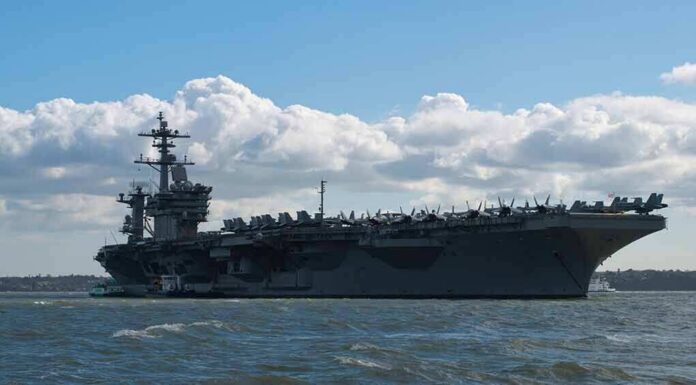
The aircraft carrier did not become vulnerable overnight; it became vulnerable the moment an adversary solved a targeting problem that took the U.S. Navy fifty years to master itself, and that adversary is China.
Key Points
- China has fielded a layered family of anti-ship missiles — the DF-21D, DF-26, YJ-18, YJ-21, and the emerging DF-27 — explicitly designed to hold U.S. carrier strike groups at arm’s length from Taiwan and the First Island Chain.
- These weapons combine extreme range (the DF-26 is credited with roughly 4,000 km, the DF-27 with 5,000-8,000 km) with maneuverable warheads that complicate interception.
- No anti-ship ballistic missile has ever been fired at a moving carrier in combat, so claims of guaranteed lethality remain unproven even as the theoretical threat is taken seriously by the Pentagon and independent analysts alike.
- The Navy’s actual constraint may be magazine depth and production rates rather than missile speed alone — interceptors are expensive and slow to build, missiles are cheap and produced in volume.
- The carrier is not being retired; it is being forced to operate differently — farther offshore, more dispersed, more dependent on submarines, drones, and directed-energy defenses.
A Strategy Built Around One Ship
Every major navy since 1945 has organized itself around the aircraft carrier, and for good reason: it is a mobile airbase that projects fighter and strike aircraft anywhere within a few hundred miles of open water, independent of a host nation’s permission or geography. The U.S. Navy has eleven of them, nuclear-powered, each carrying roughly 5,000 sailors and airmen and representing an investment north of $13 billion. That concentration of capability is also a concentration of risk, and China’s military planners have spent three decades designing a strategy explicitly meant to exploit it.
The doctrine is called anti-access/area denial, or A2/AD, and CSIS’s Missile Threat project describes it plainly: Beijing combines ballistic and cruise missiles launched from air, land, and sea to target U.S. and allied military assets across the Asia-Pacific theater. The goal is not necessarily to sink a carrier. It is to make operating one near China’s coast so costly that American commanders choose not to.
The Missile Family Built to Hunt Carriers
The centerpiece of this arsenal is the DF-21D, which the U.S. Department of Defense confirmed in 2010 had reached initial operating capability as the world’s first operational anti-ship ballistic missile, with a range exceeding 1,450 kilometers. It was purpose-built, according to CNAS’s assessment, to strike carriers at distances greater than 600 nautical miles while riding on a highly survivable, road-mobile launcher that can fire from off-road conditions. Its successor, the DF-26, extends that reach dramatically — analysts credit it with a range approaching 2,500 miles, dual-capable for both conventional and nuclear payloads, far enough to threaten U.S. bases at Guam. China is now developing the DF-27, which the 2025 Department of War assessment of Chinese military power identifies as Beijing’s longest-range anti-ship ballistic missile, with a stated maximum range of 5,000 to 8,000 kilometers — enough to reach Alaska and Hawaii.
Layered beneath these land-based ballistic weapons sits a family of cruise missiles fired from ships, submarines, and bombers: the supersonic YJ-12 and YJ-18, and the newer YJ-21, a hypersonic anti-ship weapon with a claimed operational range near 1,500 kilometers that can be launched from Type 052D and Type 055 destroyers. RAND’s assessment of the resulting threat is direct: China has rapidly improved its ability to reliably locate and attack U.S. carrier strike groups at distances up to 2,000 kilometers from its coast. That figure matters because it exceeds the effective combat radius of a carrier air wing, meaning a ship forced to stay outside missile range may struggle to put ordnance on target at all.
Where the Claim Runs Into Real Limits
The “carrier killer” label is popular in headlines and Chinese state media alike, but it glosses over a targeting problem that has never been solved in actual combat. Hitting a stationary target on a desert range, which China has done repeatedly, is not the same as hitting a 100,000-ton ship maneuvering at 30 knots somewhere within a moving 150-square-mile uncertainty zone eight to twelve minutes after launch. A ballistic missile’s midcourse guidance cannot update in flight, and its terminal phase is complicated by an ionization blackout — a plasma sheath that can blind onboard radar for tens of seconds during reentry. No modern aircraft carrier has ever been struck by a DF-21D or any comparable weapon, a fact repeatedly noted even by analysts who take the threat seriously. That gap between demonstrated range and demonstrated lethality is the honest center of this debate, and it cuts against treating “carrier killer” as an established fact rather than a design intention.
Set against that skepticism is the kill-chain investment China has made to close the gap: over-the-horizon radar, reconnaissance satellites, and maneuverable reentry vehicles with onboard terminal sensors intended to find and correct toward a moving target in the missile’s final seconds. The 2020 South China Sea tests, in which China fired both a DF-26B and a DF-21D at a moving maritime target and hit it, are the closest thing to operational validation available in open sources. That single data point does not resolve the argument, but it is real evidence, not propaganda, and it is why the Pentagon has not dismissed the threat as theoretical.
The Navy’s Actual Bottleneck: Magazines, Not Speed
The more immediate constraint may not be missile velocity at all — it is inventory. A carrier strike group’s escorts carry perhaps 150 to 200 loaded air-defense interceptors across their vertical launch cells, each SM-6 costing roughly $4.3 million, while the U.S. produces on the order of 125 of them a year. China’s cruise and ballistic missiles cost a fraction of that per unit and are built in far greater volume, producing an exchange ratio that favors the attacker in any sustained engagement. Recent operational experience against Houthi drone and missile attacks in the Red Sea, where U.S. destroyers expended interceptors faster than they could be replaced and at least one ship returned to port mid-deployment to rearm, is the clearest real-world preview of that arithmetic playing out at a smaller scale.
Reloading a warship’s vertical launch cells at sea has historically been considered too dangerous in anything but calm water, which is why depleted ships have had to sail home — a three-to-four-week round trip that a high-tempo Pacific conflict may not allow. The Navy’s October 2024 demonstration of an at-sea reload system aboard USS Chosin is a genuine step toward solving this, but it remains unproven under combat conditions and requires two ships to maneuver close together, itself a vulnerability.
Your Blue Angels segment featured an interview with a "Navy Master Sergeant".
There's no such rank. The man is in the U S Marine Corps, not the Navy.
— Kerry Daly (@scragsma70) July 30, 2026
What This Means for the Fleet’s Future
None of this argues that the aircraft carrier is finished, and no serious naval planner is proposing the Navy retire the class. What is changing is the assumption that a carrier can safely operate wherever it chooses. The more defensible reading of the evidence is that carriers are being pushed toward operating farther from contested shores, screened by submarines and unmanned systems that absorb the first wave of risk, while the fleet invests in directed-energy weapons — lasers like the Helios system now integrated on Arleigh Burke-class destroyers — that can engage incoming threats at the speed of light and at a cost of dollars rather than millions per shot. The USS Gerald R. Ford’s next-generation reactors were built with exactly this kind of future power demand in mind.
The historical pattern is instructive here: battleships did not vanish because a single weapon sank one in a lab test; they became obsolete when carrier aviation made their core mission unaffordable and irrelevant. Carriers are not there yet — no comparable at-sea proof exists for anti-ship ballistic missiles — but the direction of travel is unmistakable, and the Navy’s own budget requests for missile defense, distributed lethality, and reload-at-sea logistics are the clearest admission that the threat is real, even if its ultimate lethality remains, for now, unproven.
Sources:
cimsec.org, deagel.com, china-arms.com, en.wikipedia.org, youtube.com, armyrecognition.com, nationalsecurityjournal.org