
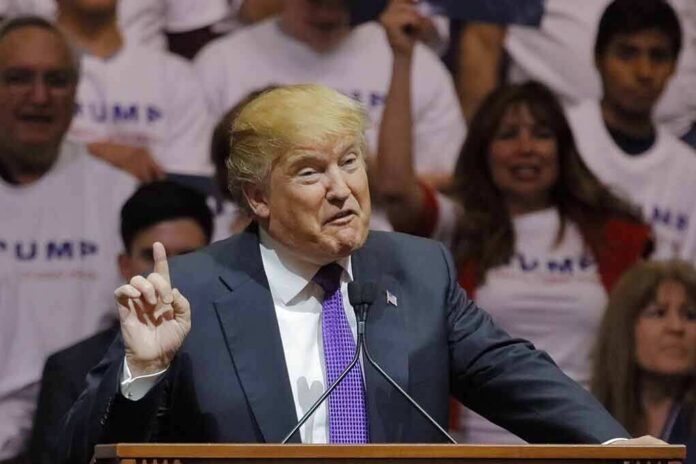
The surest test of a candidate’s command of the room isn’t the applause line; it’s the interruption. In Myrtle Beach, President Trump met a loud heckle with a quick reframing and a joke, kept the crowd with him, and moved on—an old rally skill executed cleanly.
At a Glance
- During a Myrtle Beach rally, a heckler interrupted; Trump paused, reframed the shout as “Trump nation,” and told security to “leave her alone.”
- Security escorted the protester out as the crowd chanted; Trump resumed swiftly, signaling control rather than escalation.
- He capped the moment with a light jab—“mom is voting for us”—and returned to the stump.
- The exchange fits a long-running pattern at modern rallies: brief disruption, crowd response, security removal, and a quick rhetorical reset.
What Happened in Myrtle Beach
At a South Carolina rally supporting Senate candidate Darline Graham, a brief outburst from the audience cut across President Trump’s remarks. He stopped, listened, and, instead of meeting confrontation with confrontation, treated the interruption as a garbled cheer: “Was that a good thing? … I think she said ‘Trump nation,’ I like that.” He added, “Leave her alone, don’t touch her,” then affirmed the line—“Trump Nation is okay”—before returning to his message. That initial deflection framed the moment as benign rather than hostile and invited the crowd to follow his lead.
Event staff and law enforcement moved to remove the protester; the crowd responded with chants as the escort unfolded. The sequence was familiar: brief disruption, quick assessment from the stage, a nudge from the principal to keep tempers down, and the logistical resolution by security. Reporting from the event indicates Trump resumed his remarks promptly once the aisle cleared.
The Reset Line—and Why It Works
Trump punctuated the episode with a practiced closer—“That’s all right … mom is voting for us”—a small gag designed to redirect attention away from the heckler and back to his themes. In rally environments, a line like that does two jobs at once: it denies the interrupter a starring role and gives supporters a shared point of levity to re-synchronize energy. On-ramp humor, particularly one that converts a jab into a claim of broader support, tends to shorten the half-life of a disruption. Here, it did; the program moved on.
This approach—brief pause, measured quip, and an explicit instruction not to escalate—has antecedents across Trump’s campaign history. He has often invited security to “get ’em out,” sometimes sharply; at other times he opts for a shrug and a one-liner. The throughline is theatrical timing: allow the room to register the interruption, define it in terms favorable to the speaker, then hand it back to staff to conclude. The mechanics are simple, but the sequencing—frame, cue, release—is what preserves momentum.
How Rallies Handle Disruptions
American campaign events are built with predictable choke points for disruption: the room layout, the aisle access to cameras, and the call-and-response cadence of a stump speech. The playbook for a standard disturbance is likewise predictable. First, the principal pauses—both to avoid competing for audio and to prevent the crowd from becoming self-directed. Second, the principal sets a tone signal (“leave her alone,” “be nice,” “we love our protesters”) that cues the audience to de-escalate. Third, security executes a narrow removal while the principal either fills with patter or goes silent. The goal is containment without spectacle; measured handling shortens the interruption window and reduces copycat attempts.
In Myrtle Beach, those mechanics were visible. The crowd’s chant provided a sonic buffer while security did its work; the podium language—acknowledgment, then a calming directive—kept the audience’s energy channeled toward the stage rather than into the aisles. The result was a quick reversion to the planned program. That is less about personality and more about stagecraft developed over years of stadium-style campaigning.
Why These Moments Spiral—or Don’t
Three variables typically determine whether a heckle becomes a headline: the principal’s tone in the first five seconds, the crowd’s appetite for policing its own, and the precision of the security response. A combative tone can feed the crowd’s adrenal edge; a minimizing tone starves it. Crowds take their cues from the stage, but they also follow their own norms—if the self-appointed ushers in the aisles are calm, copycats tend to melt back into their seats. Finally, security that is visible but not performative denies the cameras a tableau that would stretch a five-second disruption into a minute of B-roll.
In this case, the tonal choice—treating the shout as a near-compliment and specifically telling people not to touch the protester—tilted the room away from confrontation. The staff’s removal completed the job; the closing joke sealed the reset. It reads, in full, as a textbook containment rather than a running battle for the microphone.
The Broader Pattern in U.S. Campaigns
Heckling is not an aberration in American politics; it is a structural feature of open campaign forums. Modern rallies, especially those staged for national figures, regularly draw a mix of supporters and organized dissenters who view interruption as a tactic for earned media. Across cycles and candidates, the rhythm is familiar: disruption, chants, ejection, resumption. The candidate’s team calibrates staging, sound, and staffing around that inevitability—less to prevent every outburst than to shorten its duration and keep the program intact.
Trump’s rallies have long illustrated the point. He treats the podium as a performance space with improvisational beats—stopping for chants, riffing on signs, folding interruptions into the act when useful. That flexibility is why the Myrtle Beach moment felt unsurprising to close observers: the line, the calming instruction, the quick pivot back to the message were all in character and in sequence. The clip economy may elevate the disruption, but the operational story on the ground is continuity—keep the crowd with the program, and keep the program on time.
🚨 FACT CHECK: No, Trump Wasn't “Heckled by His Own Crowd” in South Carolina
A viral post is claiming President Trump was “heckled by his own crowd” at Friday night's Myrtle Beach rally.
That's a pretty misleading way to describe what happened.
Trump was interrupted by a… pic.twitter.com/WjZOIHu5xQ
— 🎹 Ames™ 🎹 (@Real_Ames) August 22, 2026
What It Means Going Forward
Campaigns cannot eliminate hecklers; they can only train for them. The Myrtle Beach exchange underscores the value of a clear escalation ladder from the stage and a shared understanding with the crowd about boundaries. Leaders who can absorb a jolt without inviting a pile-on minimize risk to attendees and to their message; staff who can move cleanly through aisles minimize risk to themselves. For voters, the takeaway is less about the content of a single shout than about how a candidate handles the unscripted: does the room stay governed, does the temperature drop, and does the argument resume.