

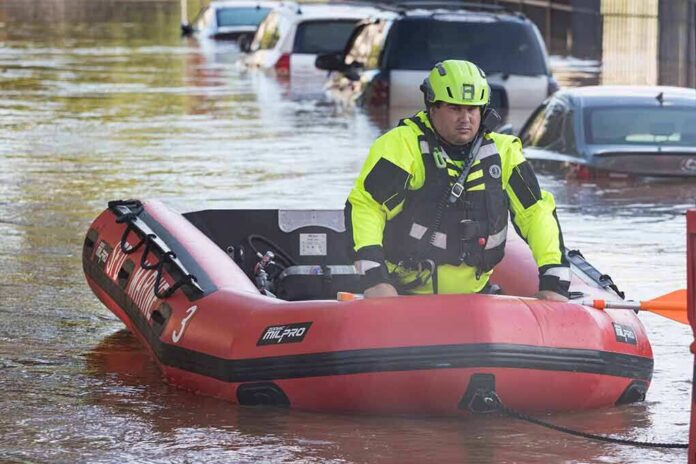
A Texas rescue helicopter crew fought raging floodwaters to save lives while officials still struggle to explain why so many people were left in danger in the first place.
Story Snapshot
- Travis County’s STAR Flight helicopter crews rescued people and pets from fast-moving floods in the Hill Country.
- Aerial video from Gillespie County shows a dramatic hoist rescue from a building surrounded by deep water.
- State officials confirm multiple deaths during wider flood operations, raising questions about warning and response systems.
- Confusing rescue numbers and mixed messaging feed public distrust in how government handles major disasters.
Helicopter crews race rising water in Central Texas
During catastrophic flash flooding in the Texas Hill Country, Travis County’s emergency helicopter service, known as STAR Flight, was sent into neighboring counties to pull people from danger. One helicopter flew to Gillespie County and another to Kerr County as rivers jumped their banks and roads turned into black water channels. County Judge Andy Brown said multiple rescues were underway in both counties by mid-morning, with crews moving fast before waters rose even higher.
Video shared by local officials shows one rescue in Gillespie County where floodwaters had swallowed streets and climbed several feet up a building. A STAR Flight helicopter hovers above the structure as a crew lowers a rescuer on a hoist to reach a trapped man inside. The rescuer secures the man, and both are lifted up through the spray and debris below, then flown away to safety as water rushes around the building. The scene lasts only minutes but shows how close the call was.
STAR Flight’s role and what we know about the numbers
Travis County STAR Flight is a government-run helicopter program that provides air ambulance, search and rescue, firefighting, and law enforcement support across Central Texas. It operates around the clock and can cover about 16,000 square miles in the Hill Country for emergencies like these floods. In one separate flooding incident inside Travis County, STAR Flight crews rescued nine people and two dogs from submerged roads and homes, showing how busy they were across the region.
County leaders and news outlets have praised STAR Flight’s actions, but the exact number of people the helicopters saved in these Hill Country floods remains unclear. Officials reported “multiple rescues” in both Gillespie and Kerr Counties and confirmed at least four rescues in Gillespie alone. At the same time, the Texas Army and Air National Guard reported rescuing more than 525 people statewide by July 8 in a large joint operation, a figure that mixes many agencies together and does not break out STAR Flight’s share.
Deaths, damage, and growing anger over disaster response
Despite many rescues, the flooding still turned deadly. Governor Greg Abbott said two people died in separate incidents in Comfort and Uvalde during flood rescue operations in the Hill Country. One victim was swept away in a recreational vehicle, and the other was carried off while driving on a flooded road. In Kerr County, local officials also confirmed at least one death connected to the flooding near Center Point. These losses add to the sense that warnings and protection failed when people needed them most.
Across central Texas, residents are now dealing with ruined homes, lost cars, and long-term money worries. Federal Emergency Management Agency (FEMA) disaster declarations and state aid offer help, but past floods show many families fall through the cracks or wait months for support. Research on recent Texas disasters points to repeated problems: mixed messages from different agencies, slow response in some communities, and thin staffing for life-or-death emergencies. These patterns feed a belief on both the left and the right that government is quick to hold press conferences but slow to fix systems that keep people safe.
Confusing data and fading trust in the “system”
One reason anger grows after each disaster is that basic facts are hard to pin down. In this flood, media reports highlight the dramatic helicopter rescues and the large statewide totals from military units, but they rarely separate out what each local program, like STAR Flight, actually did. When rescue numbers are blended together and official logs lag behind, it becomes easy for people to wonder who is telling the full truth and whether leaders are using hero stories to distract from deeper failures.
🚁 Our Travis County STAR Flight dispatched to the Hill Country yesterday (7/16). This is a water rescue in Gillespie County.
We are incredibly grateful to all first responders who continue working tirelessly to protect lives during this flooding event. 💙 pic.twitter.com/B8zAFb3uQI
— Travis County Emergency Services (@TravisCountyES) July 17, 2026
This confusion fits a long-running pattern. Reviews of past floods and hurricanes often find that local responders and federal or military teams clash over credit, blame, and resources once the cameras leave. Meanwhile, everyday people see the same problems repeat: warnings that come late or do not reach everyone, building in risky areas, and policy fights that stall real fixes. For conservatives worried about waste and mismanagement, and liberals worried about equity and safety nets, the Texas floods feel like one more sign that the “system” works best for the insiders, not the families stuck on rooftops waiting for a helicopter.
Sources:
facebook.com, fox7austin.com, cbsaustin.com, capitol.texas.gov, traviscountytx.gov, cbs4local.com, en.wikipedia.org, nature.com