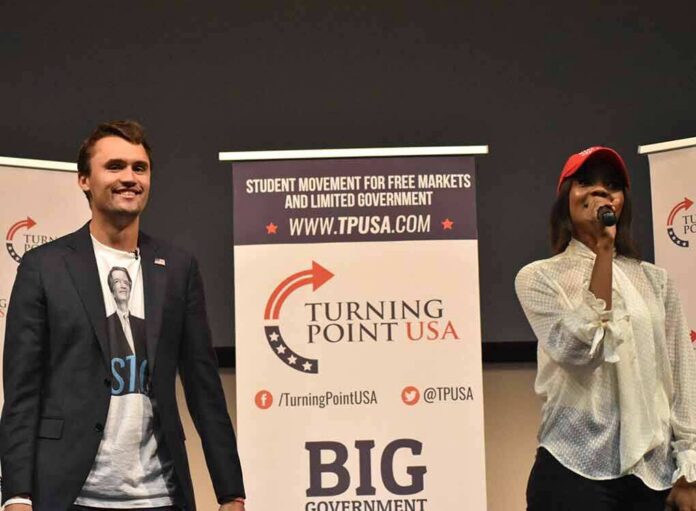
When a movement loses its founder to violence, what follows is not silence but a contest over meaning — and, often, a surge of resolve. The one-year commemoration of Charlie Kirk at Utah Valley University exemplified that pattern: an event that treated his killing as a political assassination and his legacy as a living mandate for young conservatives to keep organizing.
At a Glance
- Federal and state leaders publicly framed Kirk’s death as an assassination and a national political event, elevating his stature posthumously.
- Turning Point USA staged a large one-year memorial at Utah Valley University, signaling organizational continuity at the site of the killing.
- UVU adjusted campus operations for the anniversary and anticipated protests, underscoring the event’s civic and security significance.
- Published research and reporting agree on the core facts: Kirk was shot and killed on September 10, 2025, during a campus appearance; the memorial centered on sustaining his youth-focused political project.
What Happened and Why the Commemoration Mattered
Charlie Kirk, a prominent conservative activist and close ally of President Trump who built a powerful pipeline to campus conservatives, was shot and killed at Utah Valley University on September 10, 2025. Coverage by major outlets — including the Associated Press, NPR, BBC, Al Jazeera, and CNN — established the core facts of his death and his national profile as a mobilizer of young Republican voters. In the weeks that followed, public officials cast the event in political terms: a state governor called it a political assassination, and the White House later issued a National Day of Remembrance honoring “the legendary Charlie Kirk” and describing him as “assassinated in broad daylight”. The framing was not incidental. It made Kirk’s death a matter of civic memory, not just private grief.
One year later, Turning Point USA — the organization he founded and led — convened “Freedom Built to Last” at UVU’s UCCU Center. The venue choice was deliberate: a short walk from where he was shot. UVU coordinated around the anniversary, acknowledging community trauma, pausing operations, and keeping the arena open for the privately organized memorial. That administrative choreography, mundane as it may seem, is a strong signal of institutional salience: the university planned for crowds, dissent, and security, reflecting how the episode had entered the region’s civic calendar.
How Turning Point USA Curated the Legacy
Movements do not run on memory alone; they run on programming. Turning Point used the anniversary to reaffirm mission and transmit narrative. The speaker roster — including media figures and senior TPUSA personnel — was built to braid personal testimony with ideological continuity, and to plant a flag where the killing occurred. Deseret News’ advance reporting named speakers such as Glenn Beck and Frank Turek and situated the event precisely in the campus geography of the shooting, emphasizing proximity as symbolism. The organization’s event page framed the commemoration as a throughline from Kirk’s life to an ongoing project, not a coda.
Official rhetoric from national leaders reinforced that throughline. NPR captured President Trump’s language about Kirk’s role with American youth — a portrait of a figure who translated movement talking points into campus recruitment and identity formation. The White House proclamation memorialized him in explicitly national terms, a rare honor that signals government-level acknowledgment of political impact. Whether or not a proclamation can prove durable cultural influence on its own, it is an instrument for placing a person in the canon of a constituency. It also offers a template for how supporters talk about him a year later.
The Place of Protest and the Politics of Commemoration
Public memory does not exist in a vacuum; it exists in a contest. Counter-mobilization emerged alongside the memorial planning, with student groups preparing to protest and the university anticipating heightened security. Coverage captured both the logistical posture — preregistration for attendance, door times, and crowd control — and the anticipated protests that accompany high-salience political rites on campus. Such counter-ceremonies are part of how democratic societies metabolize contested figures. They also shape what participants remember: not just the words from the stage but the context that surrounded them.
The literature on leader deaths is useful here. Assassination tends to catalyze routinization of charisma — the transformation of a founder’s personal authority into organizational rituals, calendars, and cadres. Commemorations function as bridges that carry emotional energy into durable infrastructure: chapters, conferences, and recruitment pipelines. Movements that survive founder loss typically either consolidate around an institutional successor or splinter into successor claimants; the choice of venue, speakers, and shared language is how an organization lays claim to the founder’s mantle and normalizes succession. The UVU event fits that script.
What the Evidence Establishes — and What It Does Not
The public record supports several bedrock conclusions. First, Kirk’s death was treated by federal and state officials as a political assassination, a categorization that elevated its civic gravity. Second, the memorial was real, large-scale, and organized by the institution he founded, at the site of the killing with a roster designed to harmonize faith, free-speech advocacy, and youth mobilization. Third, multiple independent outlets corroborated the basic timeline and Kirk’s role as a high-profile activist tied closely to President Trump and Republican youth politics.
What the record does not supply — at least not yet — is rigorous, organization-level data demonstrating posthumous expansion attributable to the martyr-narrative: chapter counts, fundraising trajectories, membership retention curves, and campus penetration rates after September 2025. Anecdotes abound, but hard numbers reside inside an organization’s databases, donor files, and campus affiliation registries. The absence of those figures in public does not undercut the memorial’s significance; it simply sets the boundary between commemorative rhetoric and measurable institutional growth.
Why the Memorialization Lens Fits This Case
Movements routinely leverage anniversaries to bind a narrative: a “day of” becomes a “day of remembrance,” and then a recurring obligation. The White House proclamation formalized remembrance nationally; TPUSA localized it at UVU with a stage program and a pilgrimage back to the site; and allied media amplified the storytelling, especially around Kirk’s role with youth conservatives. The pattern is a classic one in contentious politics: enshrine the origin story, name the villainy, and call the adherents to finish the work. It is not merely eulogy; it is strategic narrative construction that converts grief into recruitment.
For supporters, that scaffolding offers clarity: a shared language of sacrifice, a calendar to convene, and recognizable emissaries who can carry forward the founder’s idiom. For institutions, it presents operational choices — security planning, speech logistics, and community messaging. And for opponents, it presents a target: the very symbolism that sustains adherents also invites critical counter-framing. That is why the UVU commemoration, complete with protests and heightened security, reads less like a memorial service and more like the annual proving ground of a live political movement.
The Crusaders have COMPLETELY TAKEN OVER Time Square NYC!!!!! 🇺🇸
Zohran Mamdani PULLED our PERMIT last night for Charlie Kirk Memorial…
WE HONORED CHARLIE ANYWAY 💪🏻 pic.twitter.com/UWZB8qeIG0
— Bella 🥰 Wilson 💕 (@BWilson79035) September 11, 2026
The Durable Takeaway
Kirk’s supporters vowed to continue what he started; the year-one memorial showed they have the organizational means and narrative discipline to try. The government-level recognition, the careful selection of venue and voices, the anchoring of youth mobilization at the core of the story — all of it points to an effort to routinize a founder’s charisma into structure and ritual. Whether that translates into sustained growth will be judged in enrollment lists, campus event calendars, and electoral work in the years ahead. But the essentials are not in dispute: a nationally framed assassination, a memorial that doubled as a movement convocation, and a constituency determined to make remembrance do real political work.
Sources:
facebook.com, whitehouse.gov, apnews.com, breitbart.com, dailycaller.com, npr.org, tmz.com, x.com, aljazeera.com