

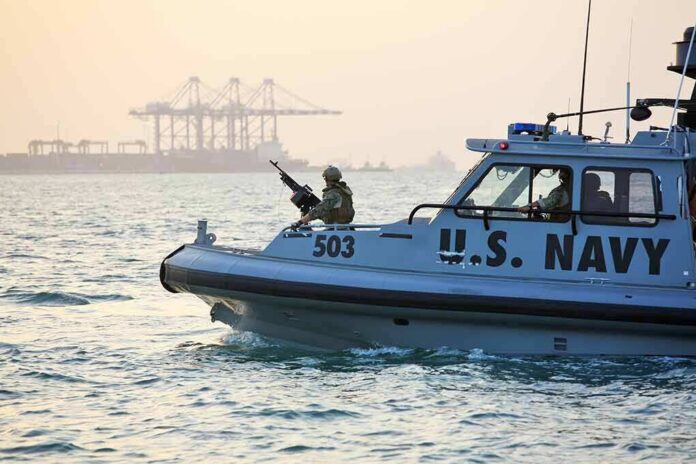
Lethal maritime strikes have moved from the exception to a recurring instrument of U.S. counter-narcotics policy, and the latest operation—killing four people aboard a suspected drug-smuggling boat in the Caribbean—illustrates how far practice has shifted from traditional interdiction toward military use of force at sea.
At a Glance
- U.S. forces struck a suspected drug-trafficking vessel in the Caribbean, killing four; no U.S. personnel were harmed.
- Southern Command framed the action as part of an ongoing counter-trafficking campaign along established smuggling routes.
- The strike fits a broader series of lethal maritime actions since late 2025 across the Caribbean and eastern Pacific.
- This approach marks a departure from the long-standing law-enforcement model of stop, board, and seize at sea.
What Happened: A lethal strike on a suspected drug boat in the Caribbean
U.S. military forces conducted a strike against a suspected drug-smuggling vessel transiting the Caribbean Sea, resulting in four fatalities aboard the craft. Multiple outlets reported the action and its outcome, citing U.S. officials; Southern Command said the vessel was operating along known narco-trafficking routes and that the strike was part of a continuing campaign targeting alleged traffickers. No U.S. personnel were harmed in the operation.
The reported location and nature of the target align with a pattern of maritime actions over the last year in both the Caribbean and the eastern Pacific. Outlets tracking the series have tallied repeated lethal engagements against small craft described by the military as drug-smuggling boats; taken together, they indicate a sustained operational tempo rather than an isolated event.
How this tool works: sensors, authorities, and maritime strike mechanics
Modern counter-trafficking operations at sea depend on fusing detection networks—airborne and space-based sensors, maritime patrol aircraft, drones, and partner-nation reporting—with rapid interdiction options. Since 1989, Congress has tasked the Department of Defense as the U.S. “lead agency” for detection and monitoring of maritime drug trafficking, a role that matured into joint task forces and data-sharing frameworks with the Coast Guard and allied services. In the current campaign, when commanders assess a vessel as a hostile or uncooperative threat linked to trafficking, they have increasingly employed precision munitions rather than the classic playbook of signal, stop, and board.
Tactically, the strike package is straightforward: persistent surveillance to fix the boat’s position and behavior; positive identification against a target profile; and a munition from a surface platform, aircraft, or unmanned system to disable or destroy the craft. The approach minimizes risk to U.S. personnel—no boarding under uncertain conditions—and denies smugglers the chance to scuttle cargo or flee into territorial seas. The trade-off is that the evidence chain that interdiction traditionally produces—seized cargo, hull modifications, logs, and crew identities—is rarely generated by a kinetic outcome.
From interdiction to force: what changed in U.S. maritime counter-narcotics
For decades, U.S. practice in the transit zones of the Caribbean and eastern Pacific relied on law-enforcement paradigms: detect, pursue, signal to stop, board under consent or authority, and, if warranted, seize and prosecute. Bilateral agreements underpinned this model—pre-authorizing shipboarding, clarifying jurisdiction, and streamlining evidentiary handoffs between navies and coast guards. The Coast Guard’s long record in drug cases, stretching back to 19th-century seizures, reinforced the norm that narcotics at sea were a criminal enforcement problem first, with DoD in a supporting, surveillance-centric role.
The recent series of lethal maritime strikes diverges from that lineage. Analysts and commentators have noted that moving from interdiction to deliberate attack implicates the international law of force and narrows the space for post-incident judicial process at sea. Whether framed as self-defense against armed criminal actors or as a wartime-like campaign against “narco-terrorists,” the operational reality is that lethal effects are being used more routinely against small vessels previously approached as law-enforcement targets. The current strike—the latest of many in the region—sits squarely within that shift.
Why the Caribbean and eastern Pacific remain the focal transit zones
The geography of trafficking explains the operating picture. Maritime routes from source and transshipment points in the northern Andes and Central America converge in the Caribbean and eastern Pacific, exploiting long littoral arcs, patchy radar coverage, and countless legitimate small craft. Go-fast boats, low-profile vessels, and semi-submersibles provide speed and low signatures, while mother ships extend range. Joint task forces map these corridors, placing sensors and ready forces at the chokepoints. When a craft matches patterns—route, speed, emissions, rendezvous behavior—operators escalate response. The strike reported here occurred along such a corridor, consistent with years of pattern-of-life mapping and prior engagements.
This pattern-based approach is not new; what is new is the frequent willingness to neutralize the vessel outright rather than force compliance and recover cargo. The operational advantage is clear: speed and safety for the interdiction force. The strategic question is whether this tool, used often, redefines counter-narcotics at sea from a policing mission to a military one.
Consequences and implications: effectiveness, risk, and policy trajectory
Effectiveness is measured in disrupted loads, degraded smuggling networks, and deterrence. Lethal strikes promise immediate disruption—no cargo lands if the boat is destroyed—and arguably impose higher costs on facilitators. They also reduce the exposure of boarding teams to armed resistance or booby-trapped holds. The latest strike, accomplished without U.S. casualties, exemplifies that risk calculus. Yet routine kinetic actions can complicate cooperation with partners whose legal frameworks emphasize arrest and prosecution, and they can limit the intelligence yield that boarded seizures often produce—ledgers, phones, and crew debriefs that map networks.
Institutionally, the Department of Defense’s detection-and-monitoring mandate has proven elastic, accommodating a campaign that blends military tools with law-enforcement aims. Commentators have highlighted legal debates over when lethal force is permissible against suspected traffickers on the high seas and how such actions align with treaty-based boarding regimes. Those legal discussions will continue, but the operational through-line is already clear: commanders now have, and are using, a menu of options that includes precision strikes against small craft in the transit zones. The Caribbean incident that killed four is part of that established practice, not an aberration.
What to watch next
Three indicators will show where this trajectory is headed. First, operational tempo—whether strikes remain frequent across the Caribbean and eastern Pacific, or revert toward interdiction and seizure. Second, partner-nation alignment—how regional governments integrate or constrain lethal options within joint frameworks grounded in long-standing boarding agreements. Third, institutional doctrine—whether detection-and-monitoring remains the statutory center of gravity or is effectively supplanted in practice by strike-oriented rules of engagement. For now, the facts of the current operation are straightforward: U.S. forces struck a suspected drug-smuggling boat in the Caribbean, killed four aboard, took no casualties, and did so as part of an ongoing campaign against maritime narcotics trafficking.
Sources:
cbsnews.com, theguardian.com, reuters.com, today.com, cnn.com, ajc.com, abcnews.com