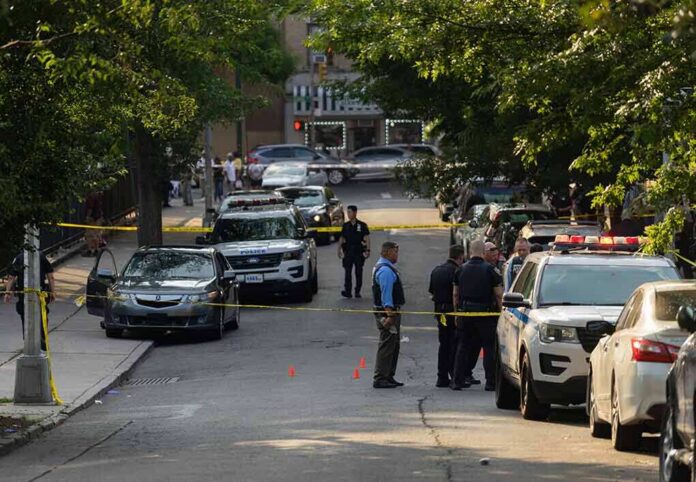
When gunfire moves across multiple locations in a quiet county, the most consequential fact for the public is clarity: what happened, who is responsible, and whether the danger has passed. In Missaukee County, Michigan, authorities answered those questions decisively—six people were dead, including the suspect, and the search ended with police declaring no ongoing threat.
At a Glance
- Michigan State Police (MSP) found three people dead and one critically injured at a Lake Township home after an 11:40 a.m. call.
- Investigators identified 39-year-old Chad Hickman as the suspect; he fled before troopers arrived, triggering a large, multi-agency search.
- The case expanded to multiple scenes, including a second home and a wooded area near Whitlock Lake, where Hickman and another person were found dead.
- Total fatalities reached six, including the suspect; MSP later said there was no continuing threat to the public.
What Happened Across the Scenes
Troopers from the MSP Cadillac Post were dispatched around 11:40 a.m. to a residence in Lake Township after a report of a shooting. On arrival, they found three deceased victims and one critically injured survivor who was transported for emergency care. The suspect, identified by authorities as 39-year-old Chad Hickman, had already fled, turning an already grave crime scene into a dynamic, countywide manhunt. As detectives and special teams canvassed wider terrain, a fourth victim was discovered at a second residence in Missaukee County. The search ultimately converged near Whitlock Lake, where officers located Hickman’s vehicle. In nearby woods, investigators found Hickman deceased, along with another deceased individual, bringing the total number of dead to six, including the suspect.
As the day’s picture came into focus, MSP emphasized that the immediate danger was over. The agency communicated that there was no continuing threat to residents while it continued to process the scenes and collect evidence. The investigation has been led by the Cadillac Post with support from MSP detectives in Traverse City and Roscommon, the Department of Natural Resources, the U.S. Forest Service, the Missaukee County Sheriff’s Office, and the County Road Commission—an all-hands posture consistent with a multi-location homicide inquiry that requires both specialized forensics and expansive terrain support.
The Known Facts and the Investigative Boundaries
By day’s end, the core facts were stable: six dead, including the suspect; a critically injured survivor; and multiple linked scenes. Authorities initially withheld the names, ages, and genders of victims pending next-of-kin notification, as well as specific cause-of-death details and any motive. That restraint is standard investigative practice, not indecision. It preserves the integrity of interviews, corroborates timelines against physical evidence, and protects families while notifications are completed. In this case, police named Hickman and described the search arc clearly, while declining to pre-announce conclusions on motive or the exact sequence within each location—again, the prudent course when forensics, ballistics, and autopsy findings are still being compiled.
Within hours, the overarching question for residents—am I safe?—was answered in the affirmative by MSP’s public messaging. The sign-off that there was “no threat to the public” is significant; agencies do not issue that assurance lightly while a suspect remains at large or an accomplice is believed to be active. Here, the fatal discovery of the named suspect and the absence of evidence of an additional assailant underpinned that judgement.
How Multi-Scene Homicide Investigations Are Run
When violence traverses addresses, investigators synchronize three layers of work: scene stabilization, victim care and identification, and the suspect track. Stabilization means securing perimeters, clearing structures, and ensuring that responders can operate safely; in rural terrain, that often calls for aviation and canine assets alongside roadblocks and grid searches. The victim track proceeds on a separate cadence—triage, transport if survivable, then the painstaking process of identification and notification. Meanwhile, the suspect track is a race: collect witness accounts, scan for vehicle and device location pings where lawfully available, and integrate fresh tips with physical indicators like tire impressions or discarded items. When those lanes communicate well, as they did here, the net closes quickly.
Investigatively, multiple scenes are not simply counted; they are connected. Ballistics can match cartridges, bullets, and firearms; trajectory and bloodstain patterns establish sequence within rooms; footwear impressions and vehicle tracks link outdoor paths; and digital forensics—phone location data, app usage, or vehicle telemetry—can place a suspect between points. The whiteline through such an inquiry is building a coherent, time-stamped chronology that can withstand courtroom scrutiny. That is why authorities resist speculating about exact motive or sequence while the lab work is ongoing.
Why Coverage Stabilizes Around Death Toll Before Motive
In major violent incidents, the first facts to harden are the number of dead and whether the suspect is alive. Those are observable outcomes. Causality—the “why” and the precise “how”—requires interviews, lab reports, and corroboration across records. Empirical research on mass-shooting newsworthiness confirms that casualty counts and whether an assailant dies on scene strongly shape the volume and speed of coverage, which explains why the death toll and suspect status anchor early reporting while the narrative spine fills in later.
There is also a definitional undertow. There is no single official definition of a “mass shooting” used consistently across agencies and outlets; newsrooms and researchers have adopted working thresholds from groups like the Gun Violence Archive or academic protocols. That lack of uniformity encourages responsible outlets to avoid over-interpretation in the first wave and to privilege verified event facts—location, count, custody status—over inferred motive or typology until the record matures.
🚨 Missaukee County, Michigan — NEW: Teen boy among 5 victims killed; 13-year-old girl survives shooting
Category: Mass shooting / Multiple homicide
Date/time: Friday, August 14, 2026
Location: Missaukee County, Northern Michigan
Status: 🔴 Developing / Suspect deadUpdate: Yes…
— WilluChill U.S. News. (@Will466513) August 15, 2026
Community Impact and the Survivors’ Arc
Even in regions accustomed to hunting seasons and firearms culture, a sudden multi-location homicide pierces the fabric of normal life. People want names, relationships, and reasons—not out of prurience, but to make sense of grief and recalibrate their sense of safety. Law enforcement’s measured disclosures can feel slow against that human timetable, yet they are designed to protect survivors and the eventual evidentiary chain. The public’s immediate needs—reassurance about a continuing threat, accurate instructions, and credible updates—were met here by MSP’s timely identification of the suspect, the clear accounting of the death toll, and the rapid declaration when the danger had passed.
For the injured survivor and families of the deceased, the process ahead is measured in months: medical recovery, victim services, funeral logistics, and—eventually—answers from autopsy findings and investigative reports. It is common for detectives to withhold certain details until all witness statements are secured; the goal is testimony uncontaminated by media echo. That discipline does not diminish the gravity of what is already established; it helps ensure that when the full narrative is released, it is accurate, admissible, and complete.
What Comes Next in the Official Record
After scene processing concludes, the medical examiner’s determinations on cause and manner of death are entered and, in most jurisdictions, become part of the public record. Agencies then assemble a final case file—dispatch logs, officer narratives, forensic lab reports, and, where relevant, cellular or vehicle telemetry returns. In a case with a deceased suspect, prosecutors may still review findings for potential ancillary charges or for formal closure. For the public, the durable takeaways are already firm: a defined suspect, a closed threat window, and a multi-agency investigation that secured the area and accounted for the dead and injured.
The details that remain—precise sequence, motives, and any intersecting histories among the individuals involved—will emerge from that record rather than from conjecture. In the interim, the disciplined approach displayed here is the template: establish the facts that matter for safety, coordinate a broad investigative response, and communicate with specificity without racing ahead of the evidence.
Sources:
yahoo.com, detroitnews.com, youtube.com, instagram.com