America’s submarine fleet faces a crisis that no enemy could inflict: our own shipyards and industrial base are failing to build and repair the nuclear submarines needed to counter China’s growing undersea threat.
Story Snapshot
- Maintenance delays at public shipyards have sidelined attack submarines for over 1,100 days due to labor shortages and supply-chain failures
- The $348 billion Columbia-class ballistic missile submarine program is running 17-18 months behind schedule, jeopardizing sea-based nuclear deterrence
- A 140,000-worker shortage across the submarine industrial base compounds construction and repair backlogs that threaten national security
- USS Boise sat idle for nearly a decade before repairs finally began in 2024, exemplifying systemic industrial base decay
Industrial Base Collapse Threatens National Security
The U.S. Navy confronts an unprecedented readiness crisis stemming not from enemy action but from the collapse of its submarine industrial infrastructure. Between FY2015 and FY2019, 75 percent of submarine maintenance periods at the Navy’s four public shipyards finished late, averaging 225 delay days per vessel. Attack submarine maintenance delays climbed from 1,500-1,600 days in FY2019 to approximately 1,100 days by FY2022, with late materials alone adding over 100 days to each overhaul. This erosion of capability traces to post-Cold War disinvestment that gutted shipyard capacity, workforce pipelines, and supply networks—problems now acute as China expands its submarine fleet.
The U.S. Navy’s Next Big Crisis: Building and Repairing Nuclear Submarines Feels Impossiblehttps://t.co/YkSwCabgqp
— Harry Kazianis (@GrecianFormula) January 28, 2026
Columbia-Class Program Faces Critical Delays
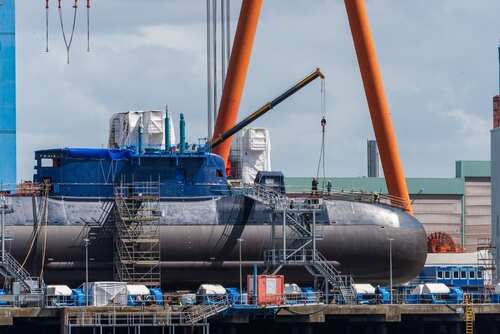
Construction of the Columbia-class ballistic missile submarines, designed to replace aging Ohio-class boomers, has fallen dangerously behind schedule despite massive investment. The lead boat USS District of Columbia (SSBN-826) now sits 17-18 months late with delivery pushed to 2029-2030, though General Dynamics Electric Boat reported the vessel 60 percent complete as of October 2025. The Navy awarded a $2.3 billion contract in November 2025 for hulls SSBN-828 through SSBN-832, while steel was cut for USS Wisconsin (SSBN-827). A 140,000-worker shortage across contractors and suppliers drives these delays, threatening the $348 billion lifecycle program that represents America’s sea-based nuclear deterrent backbone.
Shipyard Modernization Struggles Against Backlogs
The Navy’s Shipyard Infrastructure Optimization Program seeks to reverse decades of neglect at Norfolk, Portsmouth, Puget Sound, and Pearl Harbor shipyards, but improvements lag behind accumulating demands. Portsmouth Naval Shipyard received $8.6 million in upgrades during FY2025, while Puget Sound secured a $377 million contract in September 2025 for Dry Dock 4 modernization. These investments aim to reduce bottlenecks, yet maintenance backlogs persist as overlapping demands from new construction and repair work overwhelm capacity. The USS Boise sat sidelined for approximately 10 years before finally receiving a repair contract in 2024, more than seven years after the planned start date—a stark illustration of systemic dysfunction eroding fleet readiness.
Virginia-Class and SSN(X) Programs Face Compounding Problems
Delays in Columbia-class construction create cascading failures across other submarine programs as labor and resources spread thin. The Navy plans to build two Virginia-class attack submarines in 2026 while decommissioning two Los Angeles-class boats, but workforce shortages constrain production rates. Development of the next-generation SSN(X) attack submarine, funded at $622.8 million for research and development in the FY2026 budget, faces delays that analysts warn threaten America’s seapower advantage. Leonardo DRS, the sole supplier of Columbia-class electric-drive propulsion systems, opened a $120 million South Carolina facility in January 2026 to boost capacity, yet experts acknowledge short-term fixes remain impossible given the depth of industrial base erosion.
This crisis represents government mismanagement and decades of neglecting the defense industrial infrastructure that safeguards American security. While China rapidly modernizes its submarine force with new diesel and nuclear platforms, our shipyards struggle to maintain vessels already in service, let alone deliver new capabilities on schedule. The Navy launched BuildSubmarines recruiting initiatives through the BlueForge Alliance starting in 2022, but rebuilding a skilled workforce takes years—time the nation may not have as adversaries press their advantages. Limited government accountability and bloated bureaucracy allowed this deterioration, leaving the Trump administration to confront a crisis greater than any combat loss: the inability to field the undersea fleet America needs.
Sources:
The U.S. Navy’s New $348 Billion Columbia-Class Nuclear Missile Submarine is in Trouble
The U.S. Navy’s Next Big Crisis: Building and Repairing Nuclear Submarines Feels Impossible
China Diesel Powered Submarines
Congressional Research Service Navy Columbia Class Ballistic Missile Submarine Program
Department of the Navy FY 2026 Budget Highlights
Report to Congress Projects Delays in SSN(X) Development