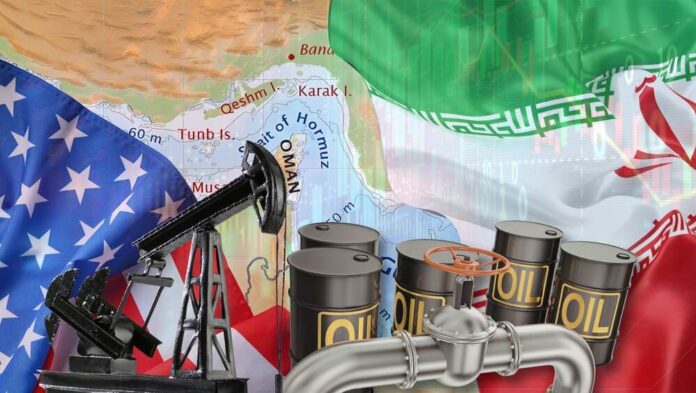
Americans are paying war-price gas again because the Strait of Hormuz turned into a choke point—and the White House is now openly threatening to hit Iran’s civilian power infrastructure to force it back open.
Quick Take
- Oil markets swung sharply after President Trump warned Iran it must reopen the Strait of Hormuz by Tuesday or face U.S. strikes on power plants and bridges.
- The war entered its sixth week after the U.S. and Israel began bombing Iran in late February, followed by Iran’s effective closure of the Strait.
- Roughly one-fifth of global oil and liquefied natural gas flows through Hormuz, making the closure an immediate driver of higher U.S. fuel and grocery costs.
- Reports of 45-day ceasefire talks are colliding with escalating rhetoric, leaving markets and households stuck in uncertainty.
Trump’s Hormuz Ultimatum Collides With Sixth-Week War Reality
President Trump’s latest ultimatum put the economic stakes of the Iran conflict into a 48-hour window: reopen the Strait of Hormuz by Tuesday, or the U.S. will consider striking Iran’s power plants and bridges. The warning landed as the war entered its sixth week, after U.S. and Israeli strikes that began in late February and Iran’s retaliation by restricting traffic through Hormuz, a corridor central to global energy trade.
For many Trump voters, the timing is jarring because “no new wars” was a core promise—and now the administration owns every downstream consequence, from fuel prices to risk of further escalation. The available reporting also leaves major gaps: details of what a strike plan would entail, what rules of engagement would govern it, and what congressional or legal posture would shape it are not fully described in the provided research.
Oil Prices Whipsaw as Traders Price Both Missiles and Negotiations
Markets reacted in real time to the threat and the possibility of diplomacy. Brent crude jumped about 2.6% before reversing to trade slightly lower around $108.62 a barrel. U.S. benchmark WTI also swung, falling about 1.6% to roughly $109.59 after earlier rising as high as $115.48. This kind of intraday volatility signals a market trying to price two futures at once: a wider war or a negotiated pause.
Reports of ceasefire negotiations—described as a 45-day framework involving the U.S., Iran, and international mediators—complicate the picture. If talks are real and productive, they can reduce the risk premium embedded in oil. If rhetoric escalates faster than diplomacy, energy traders tend to buy protection, shipping costs rise, and consumers feel it. The research also indicates early signs of some ship traffic returning, but it does not quantify volumes or confirm how durable the reopening is.
Why Hormuz Matters to Your Wallet and the Cost of Living
The Strait of Hormuz is not a distant abstraction; it is a critical passageway for about one-fifth of the world’s oil and liquefied natural gas. When that flow is threatened, the cost shows up quickly in U.S. gasoline, airline fares, and goods moved by truck. The research notes U.S. gasoline topping $4 per gallon for the first time since 2022, while jet fuel climbed to about $195 at the end of March, pushing airlines to raise fares or cut routes.
Higher fuel is also a tax on everything families buy. The research ties rising grocery costs to supply-chain disruptions, which is consistent with the way diesel, packaging, refrigeration, and distribution ripple through prices. Conservatives who have spent years fighting inflation driven by overspending and mismanagement are now confronting a second engine of higher costs: war-risk premiums and disrupted energy logistics—costs that can hit even when domestic production is strong.
MAGA’s Split Screen: Standing With Allies vs. Avoiding Endless Wars
The most politically sensitive piece for the Trump coalition is the growing tension between supporting Israel and resisting open-ended U.S. involvement. The research establishes that the U.S. and Israel began bombing Iran in late February and that Iran responded by closing Hormuz. It does not provide polling, but it does show why grassroots frustration is building: the policy debate is no longer theoretical when families see higher fuel, higher travel costs, and broader inflation pressure.
That split also raises constitutional and accountability questions conservatives routinely ask, especially after decades of “forever war” habits in Washington. The research does not specify congressional authorization, operational scope, or objectives beyond reopening Hormuz and potential infrastructure strikes. Absent clearer limits, skepticism will grow—because Americans have watched limited actions turn into long commitments before, often with unclear end states and heavy costs borne at home.
What to Watch Next: Tuesday Deadline, Ceasefire Window, and “New Normal” Risk
The immediate trigger is the Tuesday deadline tied to Trump’s ultimatum. In parallel, analysts cited in the research argue markets may adapt to a “new kinetic equilibrium,” where ongoing conflict becomes background noise rather than a shock—similar to how markets behaved during COVID-19 and the Ukraine war. That may help traders, but it is cold comfort for households paying higher prices while Washington normalizes another long conflict cycle.
The next concrete signals are straightforward: whether Hormuz shipping reliably resumes, whether the reported 45-day ceasefire talks produce verifiable terms, and whether the administration narrows or expands its military aims. The research does not provide those specifics yet, so readers should treat predictions with caution. What is clear is that energy costs and war decisions are now directly linked—and this White House, not the previous one, will be judged on results.
Sources:
Oil Prices Swing As Trump Threatens to Strike Iran’s Power Plants
Oil prices rise as US-Israeli war with Iran continues to disrupt supply