
When a student leader tells angry demonstrators that, without police and stewarding, her guests would be “cooked” by the crowd, she is not inventing a threat; she is naming a security reality that has become routine around high‑stakes debates on Islam at the Oxford Union.
Key Points
- The debate “This House Believes the West Is Right to Be Suspicious of Islam,” featuring Tommy Robinson at the Oxford Union, went ahead under an unusually heavy policing and security operation across central Oxford.
- Oxford Union president Arwa Elrayess, a Muslim student of Palestinian heritage, used striking language about critics being “cooked” without security, reflecting the volatile atmosphere rather than calling for harm.
- Local authorities and university groups, including the Oxford University Islamic Society, had already warned that hosting Robinson posed specific risks to public order and Muslim students’ safety.
- The episode sits in a longer pattern in which controversial speakers on Islam trigger large protests, security clampdowns, and arguments over whether such events represent principled free speech or dangerous platforming.
The Debate That Turned Oxford City Centre Into a Security Zone
The starting point for understanding Arwa Elrayess’s remark is the scale of the operation built around a single evening’s debate. The Oxford Union invited Tommy Robinson, the far‑right activist whose record includes founding the English Defence League and repeated campaigns targeting Muslims, to speak on the motion “This House Believes the West Is Right to Be Suspicious of Islam.” Well before anyone took to the podium, the invitation had already transformed the centre of Oxford.
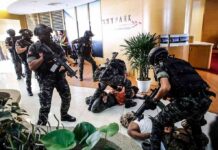
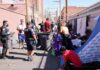
Thames Valley Police confirmed a significant policing operation across the city centre, with St Michael’s Street—the narrow lane where the Union sits—closed to vehicles and pedestrians for much of the evening. BBC reporting quoted Oxford City Council leader Susan Brown warning that “extensive police resources and road closures” would be required and that the Union should pay for the “large‑scale security operation” attached to the event. Pubs and shops in the vicinity shut early amid warnings of unrest. Hundreds of protesters assembled, chanting against fascism and racism and demanding “no platform” for Robinson, while his supporters framed the gathering as a test of free speech in a university that has historically welcomed controversial speakers.
In other words, the Robinson debate did not unfold against a neutral backdrop; it unfolded in a city centre temporarily rearranged around risk management. That matters for how one hears a student president’s blunt assessment of what would happen if the security cordon vanished.
Arwa Elrayess: A Polarizing President in a Polarizing Moment
Arwa Hanin Elrayess is not a generic student functionary. She is the first Palestinian, first Arab woman, and first Algerian to serve as president of the Oxford Union, elected in Trinity Term 2026 with a clear margin over her rivals. She has used her platform to argue that liberal democracy has been “weaponised by the West as a tool of domination” in the Global South, and to insist that pro‑Palestinian voices in British institutions face disproportionate scrutiny. Those views have ensured that, even before the Robinson debate, she was a magnet for attention.
Much of that scrutiny has focused on earlier WhatsApp comments in which she described the Hamas‑led 7 October 2023 attack on Israel as “proportional” and suggested that “any resistance group will inevitably be deemed a ‘terrorist’ organization by the West until they achieve their liberation, by which time they will be lauded as heroes.” These remarks prompted calls for her resignation and coverage in national and international outlets; Elrayess has responded that the quotes were torn from context and used as part of a broader “vilification of Palestinians.” Whatever one makes of that dispute, the practical effect was clear: by the time she invited Robinson, she was already under a microscope.
That matters when assessing whether her “cooked” comment was a threat, a gaffe, or a realistic description of the temperature in the room. She was speaking as a president whose own security and legitimacy were contested, in a chamber packed with cameras, protesters outside, and police controlling the doors. The line has to be heard against that whole backdrop, not as a free‑floating taunt.
What She Said and Why It Resonated
The remark itself appears in a widely shared clip from the Robinson debate, amplified on social media: as she introduces the event and acknowledges the presence of extensive security, Elrayess tells the room that without it, critics of Islam—or more specifically, Robinson and those aligned with his position—would be “cooked” by the mob. The wording is intentionally vivid, even flippant. But its underlying claim is straightforward: the intensity of feeling around Islam, immigration, and far‑right activism has reached a point where physical safety cannot be assumed in the absence of structured protection.
That is not speculation. The Oxford University Islamic Society issued a formal statement before the debate warning that inviting Robinson “posed a direct threat to Muslim students’ safety,” and arguing that platforms given to figures whose reputations rest on targeting minorities “are not without consequence.” Faith leaders and local campaigners signed open letters describing the event as “untimely and divisive” and explicitly raising fears about public safety. Police previously cancelled a Robinson appearance at the Union in 2013 on security grounds, with the institution acknowledging that it could not afford the necessary protection.
Set against this record, Elrayess’s language reads less as incitement and more as a blunt acknowledgement of what the police already assumed: given Robinson’s history and the anger he attracts, any event featuring him would, without security, risk spiralling beyond peaceful protest. Her choice of the word “cooked” is provocative, but the substance of her warning aligns with official assessments rather than contradicting them.
Security, Free Speech, and the Oxford Union’s Long History of Controversy
The Robinson debate and Elrayess’s framing sit inside a longer story about the Oxford Union and the politics of free speech. For decades the Union has invited polarizing figures—from revolutionary leaders to hard‑right activists—and justified those invitations in the name of robust, open debate. Robinson himself has appeared in Union motions on Islam before; Mehdi Hasan’s 2013 speech arguing that “Islam is a peaceful religion” became a viral counterpoint to those invitations, and his broader message urged students not to “fuel the arguments of the phobes” by abandoning engagement.
What has changed over the last decade is the security footprint. When far‑right or anti‑Muslim figures are invited, universities now routinely confront the need for road closures, ticket screening, and liaison with counter‑terrorism units. The Robinson debate saw pubs closing early, streets cordoned off, and police presence strong enough that some attendees felt they were being “screened” simply to enter the Union building. Council leaders have publicly questioned whether the Union is adequately factoring these costs into its programming, describing its invitations as “provocation and a willingness to endanger public safety in order to obtain publicity and fill seats.”
In that climate, short remarks about safety—especially coming from a Muslim president—are unusually charged. For those who already view the Union’s invitation policy as reckless, Elrayess’s warning simply confirms the risk: she is saying out loud what critics and police reports imply, that anger around Islam and far‑right activism can spill into violence. For those who see the protests as attempts to shut down lawful speech, however, the same sentence can be reframed as proof of bias: a president allegedly crowing that her opponents would be ripped apart by the crowd if the authorities were not there to protect them.
How the Debate Itself Played Out
Inside the chamber, the actual argument on Islam was more structured than the soundbite suggests. The motion—“This House Believes the West Is Right to Be Suspicious of Islam”—pitted Robinson and his allies against Elrayess and other Muslim and pro‑Islam speakers. According to detailed coverage, Elrayess used her speech to challenge Robinson’s selective reading of Qur’anic verses, pointing out that when he quoted a passage apparently calling for violence against unbelievers, he omitted the preceding verse exempting those who maintained a peace treaty with Muslims.
Her closing remarks tied free speech to her faith, insisting that “free speech and debate is not something I do despite being a Muslim, it is something I do because of it.” When votes were counted, the motion was defeated: 41 in favour, 57 against, a relatively narrow margin but enough to deliver what many Muslim commentators described as a symbolic rebuke to Robinson’s thesis. Gaza‑born students and British Muslims online celebrated Elrayess’s performance as a “dismantling” of Robinson’s argument rather than as an exercise in institutional hospitality to his views.
Seen from that vantage point, the “cooked” remark functions as a kind of grim aside about the price of that victory: the debate only happened at all because police and stewards were willing to create a controlled environment for two worldviews that, outside such spaces, tend to meet through street protests and online abuse rather than through formal motions and votes.
The motion before the Oxford Union was, "This House believes the West is right to be suspicious of Islam".
It was defeated, 57 votes to 41. In other words, "no", the West is not right to be suspicious of Islam.
In opposition to the motion, Oxford Union President Arwa Elrayess,… https://t.co/aZLHuYtpmE pic.twitter.com/9kmUY6XgH0
— HIS, PHD (@PropagandaBuff) August 1, 2026
Why This Episode Matters Beyond Oxford
What happened in Oxford is a local instance of a global tension. Across Europe and North America, institutions that pride themselves on hosting difficult conversations are discovering that, when the subject is Islam and the invited speaker is known for inflammatory rhetoric, the cost of “difficult conversation” now includes riot‑policing budgets, reputational campaigns against student leaders, and contested narratives about who is being protected from whom.
Elrayess’s remark crystallises that tension in one unsettling image. To Robinson’s supporters, it can be clipped and replayed as evidence that Muslim student leaders relish the threat of mob violence against critics of Islam. To her defenders, it is simply honest: a reminder that without the shield of formal debate rules and police in the street, people like Robinson and his Muslim opponents would meet each other in far less structured—and far less safe—ways.
The evidence supports the latter reading. The city council’s language, Islamic society warnings, past cancellations on security grounds, and the very fact of road closures and early pub shutdowns all point to a risk that was real enough to shape official behaviour. Elrayess did not conjure that risk; she named it, in a phrase whose sharpness ensures it will be argued about long after the votes on the motion are forgotten.
Sources:
twitchy.com, cherwell.org, bbc.com, middleeasteye.net, speakola.com, news.sky.com, 5pillarsuk.com, en.wikipedia.org, youtube.com, instagram.com, islamchannel.tv, reddit.com