
When a violent crime intersects with a novelty technology, clear facts matter most: Austin police say a costumed 20-year-old stabbed two people at a neighborhood coffee shop, fled in a pickup, and during that flight struck an unoccupied robotaxi before being arrested miles away—the kind of compressed chain of events that can distort public memory unless we anchor it to what’s documented.
At a Glance
- Police report two stabbing victims at The Buzz Mill in southeast Austin just before 9 p.m. on October 28, 2026; both were hospitalized and later reported stable.
- Officers identified the suspect as 20-year-old Shankar Temple Grace and charged him with two counts of aggravated assault with a deadly weapon.
- Investigators say the suspect fled in a pickup, later abandoned the vehicle, and was arrested on a walking trail near Rosewood and Chestnut, roughly three miles from the scene.
- During the flight, the pickup reportedly struck an unoccupied autonomous vehicle, described by outlets as a robotaxi.
What Police Say Happened: Sequence, Location, and Injuries
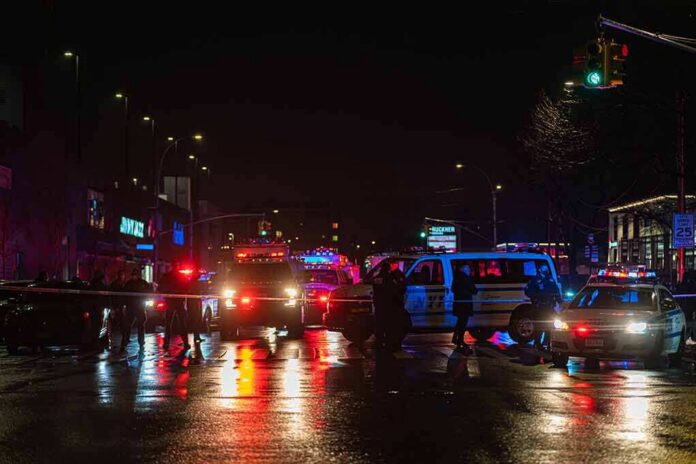
According to Austin police statements reported by multiple local outlets, officers responded at approximately 8:54 p.m. to The Buzz Mill, 1505 Town Creek Drive, where they found two people with stab wounds. Early injury assessments classified one victim as having life-threatening wounds and the other as non-life-threatening; both were transported for treatment and were later reported in stable condition as the night progressed. The venue—a well-known 24-hour coffee shop and bar near the Riverside corridor—regularly draws evening crowds; that context helps explain both the speed of the police response and the volume of public attention the case received.
Police identified the suspect as 20-year-old Shankar Temple Grace. He was arrested and booked into the Travis County Jail on two counts of aggravated assault with a deadly weapon, a felony charge that in Texas hinges on the alleged use of a deadly instrument, not on the ultimate medical outcome for the victims. These accounts are consistent across independent local reporting that attributes the information to the Austin Police Department.
Flight From the Scene and the Reported Robotaxi Collision
Investigators describe a flight-and-arrest arc that links the coffee shop to a separate crash and, later, to an on-foot pursuit. The suspect allegedly left the scene in a pickup truck, struck an unoccupied autonomous vehicle referred to as a robotaxi, and eventually ran from the vehicle before officers found him on a walking trail near Rosewood and Chestnut avenues—an East Austin location roughly three miles from the initial scene, a distance consistent with a short urban drive and subsequent foot chase. Multiple outlets reported the autonomous vehicle element and, in some accounts, described it as a Tesla-style robotaxi; what’s common across those accounts is the police assertion that the AV was unoccupied at impact.
Crashes involving automated systems generate particular public interest because they sit at the edge of consumer technology, traffic safety, and liability. It is routine in such cases for investigators to seek data recorded by the vehicle’s onboard systems and, where applicable, by the operating company’s backend; federal standing orders already require certain crash reports for vehicles equipped with advanced driver-assistance or automated driving systems, precisely because electronic data often clarify circumstances and timing. That broader framework explains why even a minor, no-injury contact with an autonomous vehicle can become a focal point of coverage.
The Charges and How Texas Law Frames Them
Two counts of aggravated assault with a deadly weapon track the core facts alleged by police: an assault causing bodily injury, coupled with the use of an instrument legally deemed capable of causing death or serious bodily injury. In Texas, “deadly weapon” is a legal term of art that encompasses knives as well as other instruments when used or exhibited in a manner capable of inflicting severe harm. Prosecutors typically do not need to wait for surgical reports to file such charges if officers observe wounds consistent with a stabbing and recover corroborating evidence or witness accounts; the medical classification—life-threatening versus non-life-threatening—often shapes bond and charging posture but does not define the offense.
From a criminal-process standpoint, the case then advances through an initial appearance, potential indictment by a Travis County grand jury, and pretrial discovery. That path is standard in assault cases that originate with a rapid-response scene, quick suspect identification, and custody within hours. The reported booking of Grace into the county jail is consistent with that timeline and with the swift conversion of scene-level facts into formal charges.
Why This Story Traveled: Costumes, Violence, and Novel Tech
The unusually vivid elements—Halloween makeup described as “zombie,” a stabbing at a familiar third place, a chase ending on a neighborhood trail, and a robotaxi in the middle—are exactly the characteristics that push a local crime story into wider circulation. News selection research has long shown that unexpectedness, violence, and strangeness predict whether a crime event is amplified beyond the metro brief; this episode checks each box and adds a nascent technology whose every misstep attracts disproportionate attention. That lens does not diminish the seriousness of the alleged assaults; rather, it helps readers understand why this incident crossed the threshold from local blotter to national pickup.
The autonomous-vehicle thread adds a second reason the story resonated. Regulators and researchers have built special reporting channels for crashes involving advanced driver-assistance and automated systems, precisely because reliable telemetry can exist independent of human recollection. The National Highway Traffic Safety Administration’s standing general order on crash reporting reflects that premise: when software participates in control, data trails matter, and public agencies seek them to accelerate analysis and pattern detection. Even when a robotaxi is merely a bystander struck while parked or unoccupied, its presence invites questions about automation’s integration into ordinary city life.
Minutes before a free comedy show, a man in zombie makeup turned an Austin coffee shop into a crime scene, police say.
Shankar Temple Grace, 20, is accused of stabbing two people at Buzz Mill Coffee on Wednesday night, then speeding off in a pickup and slamming into an empty…
— TechPulse Daily (@DailyTechpulse) October 29, 2026
Geography and Plausibility: Mapping the Movements
The locations cited in reporting—The Buzz Mill on Town Creek Drive, the East Austin trail at Rosewood and Chestnut—form a plausible route under light evening traffic: a short drive east-northeast across the river-adjacent arterials, then a turn into residential streets and mixed-use corridors that offer opportunities to abandon a vehicle and continue on foot. For readers who know the city, that geography helps reconcile the timing: an incident just before 9 p.m., a brief vehicular flight with a low-speed collision, and an arrest within a window consistent with patrol saturation during a busy evening in a dense area.
What To Watch Next
As felony assault cases move forward, the record typically accretes: charging documents, supplemental reports, and, in due course, evidence disclosures to counsel. On the transportation side, any crash documentation—police reports, photos, and, if available, autonomous-vehicle telemetry—clarifies vehicle status and contact dynamics. Those materials, when available through public channels or court filings, often become the durable reference points that replace early summaries in public memory. For now, the backbone of the case is consistent across multiple outlets: two people were stabbed at The Buzz Mill; both survived after hospital care; police named and arrested a 20-year-old suspect; and a robotaxi was struck during the suspect’s reported flight from the scene.
Sources:
foxnews.com, whmi.com, iheart.com, kfoxtv.com, kxan.com, statesman.com, fox4news.com, meridian.news, academic.oup.com, tandfonline.com