American football’s awkward, decade-long experiment in exporting itself to Europe finally produced its cleanest success story yet: a Detroit wide receiver whose mother was born in Leverkusen walked into Allianz Arena in lederhosen, spoke more German than English to the assembled press, and then torched the New England Patriots for two touchdowns in a 35-10 Lions win.
Key Points
- The Detroit Lions beat the New England Patriots 35-10 at Allianz Arena in Munich in a Week 10 NFL regular-season game.
- Lions receiver Amon-Ra St. Brown, whose mother is German, caught two touchdown passes and framed the win as “a dream come true”.
- St. Brown arrived in lederhosen, ran onto the field waving a German flag, and conducted much of his press availability in fluent German.
- The game extended the NFL’s five-city, sellout-only track record in Germany since 2022, a run the league credits with tens of millions of euros in local economic impact.
- The “homecoming” storyline is journalistic framing layered atop verified biographical and on-field facts, not an official league designation — a distinction worth understanding, not doubting.
What Happened on the Field
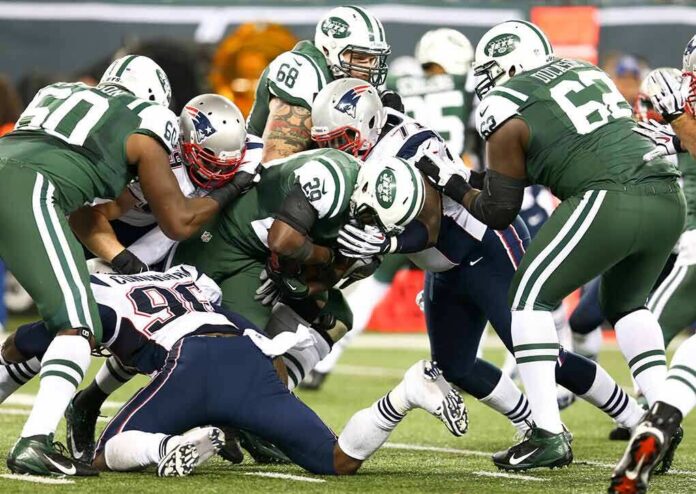
The box score is unambiguous. Detroit beat New England 35-10 in Munich, a result that stretched the Lions’ winning streak and tightened their grip atop the NFC North. St. Brown finished with two touchdown receptions, including a 56-yard strike that broadcasters on the league’s own highlight package dubbed his turn as “the German football king.” Running back Jahmyr Gibbs added a monster rushing day, while Detroit’s defense harassed Patriots quarterback Drake Maye into an eventual benching for Tommy DeVito. New England’s offense, already carrying the league’s worst turnover differential into the trip, never found its footing against a Lions defense that had allowed no rushing touchdowns during its streak.
None of this required Munich to happen. The Lions have been the better team for weeks, and the scoreline reflects roster quality, not geography. What made the afternoon unusual was everything wrapped around it.
The Player at the Center of the Story
St. Brown’s German identity is not a marketing invention grafted onto the game after the fact. His mother was born and raised in Leverkusen, and he and his brothers spent considerable stretches of their childhood in Germany; he has spoken publicly, and repeatedly in German, about that upbringing. At his Munich press conference, attended by more than 100 local journalists, he conducted roughly three-quarters of the session in German — a detail that distinguishes this from the usual NFL international-series photo opportunity, where American players learn a handful of phrases for the cameras. The Detroit Lions organization has since taken to calling him, officially, a “football ambassador to Germany,” a label the team itself coined rather than one imposed by the league.
The visuals matched the substance. St. Brown arrived at the stadium in traditional Bavarian lederhosen and later ran out of the tunnel carrying a German flag before his first touchdown catch. His parents appeared alongside him at the Lions’ fan festival, where he drew sustained applause from a crowd that had traveled — in some cases thousands of miles — specifically to see him play in his mother’s home country. Whether one calls this a “homecoming” is a matter of framing rather than fact; the underlying biography and the on-field performance are not in dispute, and the emotional register of the day is corroborated across independent outlets, from wire-service photography to team-produced features to postgame quotes in which St. Brown called the trip one he would “never forget.”
Why the NFL Keeps Returning to Germany
Munich’s game was not a novelty booking. It was the fifth NFL game staged in Germany since 2022, spread across Munich, Berlin, and Frankfurt, and every single one has sold out. The league’s own accounting credited its inaugural 2022 Munich game with roughly $77.5 million in economic impact for the host city, and a subsequent Berlin game produced an independently commissioned estimate of €74.3 million once direct, indirect, and induced spending were tallied. Frankfurt’s 2023 games were credited locally with nearly €110 million in regional economic value. These figures come from event-impact studies tied to the league or host cities rather than fully independent audits, and they should be read as evidence of a genuine commercial phenomenon rather than as precise public-benefit accounting.
The commercial logic behind the push is straightforward. Germany is the European Union’s largest economy, and NFL executives have been explicit that the country’s existing affinity for American football — built over years of streaming growth, merchandise sales, and television ratings — made it the obvious next market after the league’s long-running London experiment. Ticket demand abroad has grown 35 percent year over year by one industry measure, with Germany named alongside the UK, Australia, and Mexico as an emerging hotbed. The Lions’ own business staff said more than 22,000 fans registered for a two-day Munich fan festival built around the game, and the team reported that a fifth of its new membership growth is now coming from Europe.
What This Means Going Forward
St. Brown’s afternoon in Munich works as a case study in how the NFL wants its international expansion to look: a result decisive enough to be entertaining, a storyline personal enough to be unforgettable, and a commercial apparatus — ticket sales, fan festivals, membership growth — humming quietly underneath both. The league, the team, and the player all have obvious incentives to emphasize the emotional resonance of the trip, and reporters covering a blowout win with a two-touchdown homecoming narrative had little reason to dwell on logistics or attendance mechanics instead. That does not make the underlying facts suspect; it simply means the celebratory framing deserves to be understood as framing. The game happened, the score is final, and St. Brown’s connection to Germany is real and well documented. The rest is the NFL doing what it has done successfully in Germany for four straight years: turning a football game into an argument for playing more of them there.
Amon-Ra St. Brown ran out of the tunnel in Munich waving the German flag.
Then took a short pass 56 yards to the house in the 1st quarter.
Most guys visit mom's homeland and come back with a beer stein.
He came back with a touchdown and Joe Davis calling him "The German… pic.twitter.com/DYXkePylDv
— Throckmorton (@Throckmorton777) November 15, 2026
Sources:
mediaite.com, nytimes.com, patriots.com, columbusohioherald.com, apnews.com, openresearch.okstate.edu, en.eintracht.de, sportico.com, en.as.com, sportsbusinessjournal.com, nfl.com, espn.co.uk