A $220 million DHS “border deterrence” ad blitz is colliding with a basic conservative demand: if government is going to spend big, it must be transparent—and free of insider dealing.
Story Snapshot
- DHS awarded contracts totaling about $220 million for an immigration-deterrence media campaign that relied on an emergency justification to move quickly.
- Reporting describes undisclosed links between a subcontractor and Noem’s inner circle, raising questions about favoritism and disclosure.
- Safe America Media, the biggest recipient, was reportedly formed only days before the deal, intensifying scrutiny about capacity and vetting.
- At a March 2026 Senate hearing, Noem denied steering contracts and DHS defended the campaign as effective, citing self-deportation claims.
- Key factual disputes remain unresolved, and the developing story is now centered on oversight, process, and accountability for taxpayer spending.
How a border messaging push turned into a contracting controversy
Department of Homeland Security leadership under Secretary Kristi Noem backed a major advertising campaign aimed at deterring illegal immigration, with total contract spending reported at roughly $220 million across fiscal year 2025-2026. The campaign included high-profile footage of Noem, including an October 2, 2025 shoot at Mount Rushmore during a government shutdown. Reporting describes the spending as a sharp increase over prior DHS ad budgets and says the contracting process used an emergency rationale to accelerate awards.
DHS defended the campaign publicly as an operational tool tied to enforcement priorities, while critics focused on whether normal guardrails were followed. The core issue for voters who prioritize limited government is not whether the border should be secured—many agree it must be—but whether Washington can be trusted to spend hundreds of millions without the appearance of “friends-and-family” favoritism. The more aggressively the federal government spends, the higher the burden to show clean procedures.
What the reporting says about who benefited and why it matters
Investigative reporting identified Safe America Media, a Delaware LLC, as the primary recipient at $143 million, with another firm, People Who Think, receiving $77 million. The same reporting says Safe America Media was created only days before the deal and ties its listed address to a GOP operative’s home, details that have fueled questions about transparency and vetting. Those facts alone do not prove wrongdoing, but they intensify the need for documentation.
The reporting also describes a subcontracting role for Strategy Group, a Republican consulting firm, saying it was paid $226,137 tied to the production work—five shoots, 45 videos, and six radio ads—yet was not clearly disclosed on public contract documentation. Strategy Group is led by Joe Yoho, the husband of DHS spokesperson Tricia McLaughlin, and reporting describes additional overlap with Noem’s network, including prior ties involving aides. In federal procurement, even the appearance of inside access can erode public trust fast.
Noem’s Senate testimony and DHS claims about results
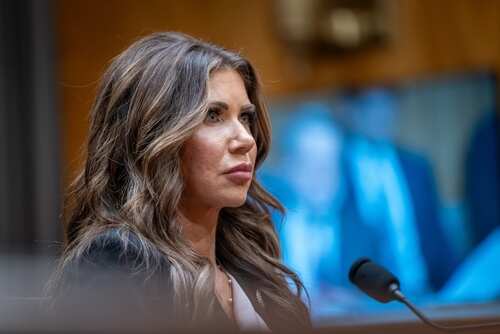
At a March 2026 Senate hearing, Noem denied that the work was a no-bid giveaway and described a process she said involved competition between two vendors. Noem also said she was not involved in contracting decisions, while DHS officials argued that career staff managed the procurement. In the same public defense, DHS leadership claimed the campaign contributed to “2.2 million self-deportations” and asserted that it saved taxpayers billions—claims that, based on the provided research, largely come from DHS statements rather than independent audits.
Where the facts are solid—and where the story is still murky
The documented, least-disputed facts are the scale of the spending reported at about $220 million, the campaign’s purpose as immigration deterrence messaging, and the use of dramatic Noem-centered creative, including the Mount Rushmore filming date. The most contested claims involve influence and intent: Noem and DHS deny improper involvement, while the reporting emphasizes personal connections and opaque disclosures. Until inspectors general, courts, or congressional investigators publish findings, the allegations remain unproven.
Why this fight matters to conservatives focused on limited government
Conservatives can support tougher border policy and still demand strict discipline in federal contracting. An emergency justification may be legal, but it should not become a blank check that makes competitive bidding optional, especially for nine-figure deals. If DHS wants the public’s confidence, it needs clear, accessible paperwork showing who did what work, why vendors were selected, and how performance was measured. Without that, even successful border messaging risks being overshadowed by process questions.
For now, the “civil war” framing is more political than proven by the underlying documentation in the provided research. The stronger, evidence-based takeaway is simpler: Congress is applying pressure, DHS is defending a costly campaign as effective, and watchdog reporting is pointing to relationships and disclosure gaps that demand a real oversight response. If the administration wants to keep the focus on border enforcement, it will have to meet the moment with transparency that matches the size of the spending.
Sources:
Kristi Noem-Tied Firm Secretly Got Piece of $220 Million DHS Ad Campaign
ICymi: Rep. Neguse’s consequential questioning of Kristi Noem on $200M taxpayer-funded