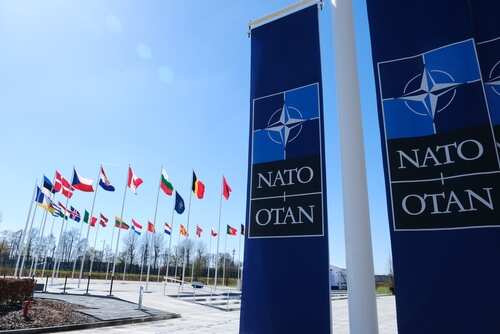
A new policy threatens to undermine NATO’s foundation, sparking a potential geopolitical crisis.
Story Highlights
- President Trump asserts NATO’s value hinges on U.S. involvement.
- Trump’s push for Greenland raises alarms among NATO allies.
- Denmark warns U.S. actions could dissolve NATO.
- U.S. threats undermine NATO’s Article 5 credibility.
Trump’s Greenland Ambition Raises NATO Concerns
In a move that has stirred international debate, President Trump has reiterated his stance that NATO’s existence heavily relies on U.S. participation. This assertion comes alongside his renewed interest in acquiring Greenland, a strategic move that he argues is vital for U.S. national security. Trump has not ruled out the use of force, raising significant concerns among NATO members, particularly Denmark, which views such threats as a potential existential crisis for the alliance.
Denmark’s Prime Minister, Mette Frederiksen, has warned that the U.S.’s aggressive stance on Greenland could lead to the “end of NATO,” a sentiment echoed by several European leaders. This situation has put NATO’s foundational Article 5 in jeopardy, as any U.S. military action against Denmark would contradict the alliance’s principle of collective defense. The Trump administration’s aggressive approach has not only strained U.S.-Danish relations but also tested the unity and trust within NATO.
🧊 TRUMP PUTS GREENLAND ON THE TABLE — AND NATO IS HOLDING ITS BREATH
Donald Trump is no longer hinting.
He is explicitly targeting Greenland — and this time, the White House has openly said:👉 The US military is an option.
That single sentence is why Europe stopped laughing.… pic.twitter.com/FZ8VyXO5wh
— Mansa Tesla (@MansaTesla) January 8, 2026
The Strategic Importance of Greenland
Greenland’s strategic value lies in its geographic location and resources, making it a focal point for great-power rivalry in the Arctic. The U.S. has maintained long-standing interests in Greenland, hosting key military installations like Thule Air Base. Trump argues that controlling Greenland is essential to counter Chinese and Russian activities in the Arctic, a region increasingly viewed as a strategic frontier. However, Denmark, while open to increased U.S. military presence, rejects any sovereignty changes, creating a diplomatic impasse.
NATO Secretary-General Mark Rutte faces a challenging scenario, as the alliance’s leading member contemplates annexing another member’s territory. This unprecedented situation threatens the cohesion and credibility of NATO, with European allies expressing concerns over U.S. unpredictability. The potential fracturing of NATO would benefit adversaries like Russia and China, who may exploit a divided alliance to advance their geopolitical ambitions.
Potential Implications for NATO and Global Security
The implications of Trump’s Greenland ambitions extend beyond immediate diplomatic tensions. In the short term, European states are considering contingency plans for defense without U.S. support, questioning the unconditional reliability of Article 5. In the long term, the threat of U.S. annexation of Greenland could lead to a reevaluation of strategic alliances, with European nations potentially pursuing greater autonomy in defense matters.
Globally, a weakened NATO could shift the geopolitical balance, reducing the West’s ability to coordinate responses to threats and weakening its military posture. The U.S. risks losing valuable diplomatic influence in Europe and access to key military bases, while Russia and China stand to gain from a fractured alliance. As negotiations continue, the world watches closely, aware of the profound consequences that could arise from this geopolitical chess game.
Sources:
Trump affirms US will always be there for NATO while expressing doubts about the alliance
Trump’s quest for Greenland could be NATO’s darkest hour
US intentions towards Greenland threaten NATO’s future; European countries are not helpless