
Late-cycle presidential travel is not about persuasion so much as choreography: when a sitting president drops into competitive states on the final weekend, he is lending logistics, media oxygen, and perceived momentum to down-ballot allies—an effect that hinges on staging and sequencing as much as on the speech itself.
At a Glance
- President Trump reinstated a Nov. 1, 2026 in-person rally in Dubuque, Iowa after an initial cancellation, aligning the stop with a same-day Kansas event.
- The Dubuque appearance was structured to boost named Republicans—including Ashley Hinson and the party’s congressional slate—before Election Day.
- The Kansas stop was separately scheduled with detailed public logistics at Salina Regional Airport, underscoring a two-state late-weekend push.
- These visits fit the long-standing pattern of presidents using endgame rallies to mobilize supporters rather than to deliver policy forums.
What Happened: Two Stops, One Weekend, Clear Electoral Purpose
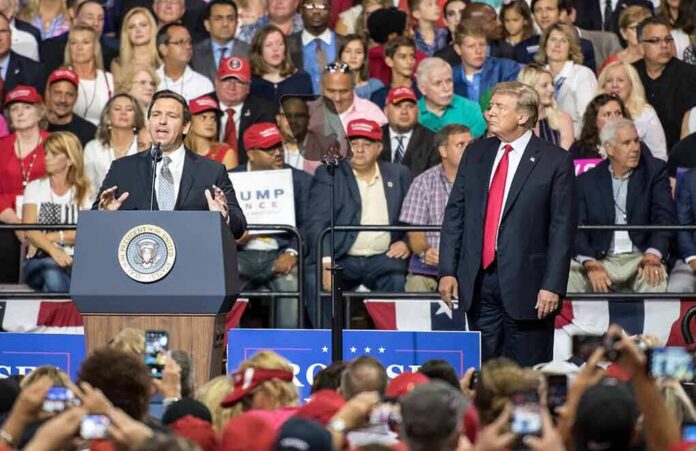
On the final Sunday before the midterms, President Trump executed a twin rally itinerary in the Midwest—an afternoon event at Dubuque’s Five Flags Center and an evening appearance set for Salina Regional Airport in Kansas—after briefly canceling and then restoring the Iowa stop. Local outlets in Iowa documented the whiplash: an announced cancellation and tele-rally pivot, followed by confirmation that the in-person Dubuque event was back on, with doors and timing reconfirmed for Nov. 1 at the Five Flags complex. Coverage linked the Iowa stagecraft directly to a slate of Republican beneficiaries, naming Senate contender Ashley Hinson and the state’s congressional candidates as focal points of the effort.
In Kansas, television reporting specified Hangar 509 at the Salina Regional Airport, with doors opening midafternoon, the rally window in early evening, and the president’s remarks slated for later that night; the stop was described as Trump’s second Kansas campaign visit of the cycle. National and regional outlets framed both events as classic late-calendar mobilization on the final weekend before voting—activity aimed at turnout, message unification, and earned media in two reliably red but competitive-state environments.
How These Operations Work: Staging, Surrogates, and Transfer of Attention
Presidential rally mechanics are well practiced. Local and state candidates stack the program to localize stakes and harvest press attention from a national figure; the White House and party committees synchronize venue, timing, and market reach to maximize television and digital pickup in target media zones. Iowa’s Dubuque venue, a familiar Upper Midwest stop, provided a contained indoor set with clear camera lines and credentialed press space—ideal for packaging candidate cameos alongside the headliner. Airport hangars, ubiquitous in modern campaigning, offer scalable capacity, overflow flexibility, direct presidential access, and aerial visuals that communicate size and energy without postproduction spin; Salina’s Hangar 509 fits this established template.
In practical terms, “transfer of attention” is the coin of the realm. Down-ballot names get repeated by the president and flashed across chyrons; local press captures candidates in joint frames; and the itinerary itself becomes news. That is why public logistics—doors, set times, venue identifiers—matter: they are not mere wayfinding; they are signals to activists, local officials, and news desks coordinating coverage windows and volunteer surges.
Why Iowa and Kansas, and Why Then
Calendar placement matters. Final-weekend rallies are less about persuading late deciders than activating partisans—a well-observed asymmetry in modern campaigns. Research on presidential rally effects from 2008–2016 finds short-lived bumps in support and participation metrics concentrated among partisans and leaners, with limited spillover to unrelated candidates; that is consistent with the strategic logic here, especially in states where Republicans typically hold an advantage but still manage risk at the margins.
The Midwestern double—a daytime indoor venue in Iowa and an evening hangar event in Kansas—offered geographic adjacency without overextending travel cycles. It also let allied campaigns splice rally content into late TV and digital placements, exploiting the last news cycle with fresh footage and joint-appearance visuals. National desk descriptions of the weekend as part of Republicans’ fight to retain control in Congress captured the operational aim: turn out the base efficiently and frame the election in terms favorable to party narratives.
The Dubuque Reversal: Logistics, Not Strategy, Deciding the Headlines
The only hiccup was Iowa’s brief cancellation-then-restoration. Local reporting first flagged a conversion to a tele-rally—an increasingly common contingency in the digital era—before subsequent reports confirmed the president would in fact appear in person at the Five Flags Center. In practical campaign management, such reversals typically reflect airlift adjustments, venue throughput calculations, or security timing—not a shift in electoral thesis. Still, reversals create their own media arc; the quick reinstatement limited narrative drift and put the storyline back on the standard closing-argument footing.
In Dubuque, the beneficiary list was explicit. Hinson’s presence on programs and party guidance naming the state’s congressional slate underscored the rally’s design: concentrate presidential brand capital where it is most convertible into volunteer energy, small-dollar fundraising, and Election Day turnout operations. That specificity—naming candidates and tying them to a president’s closing pass—has more tactical value than a policy lecture; it focuses local press and simplifies volunteer asks at precisely the moment campaigns are pulling 72-hour GOTV levers.
Rallies as Mobilization Tools: What the Evidence Supports
For readers accustomed to treating rallies as poll-moving spectacles, the more durable lesson is narrower and more practical. Scholarly work on presidential campaign rallies suggests transient opinion effects on the headliner—measured in days—not lasting structural shifts across the ballot. What rallies do reliably is feed the field program: they generate signups, validate local surrogates, and provide content for last-mile digital targeting that keeps supporters engaged through close of polls. That is why campaigns keep doing them even when polling averages barely twitch.
In this instance, the combination of a revived Iowa stop and a fully specified Kansas hangar event served exactly that function. The schedule projected activity and confidence; the venues fit known best practices; and the program architecture in Dubuque tied presidential attention to named candidates whose fortunes hinge more on turnout architecture than on a single rhetorical flourish.
WATCH: President Donald J. Trump delivers remarks at campaign rally in Dubuque, Iowa https://t.co/98Q1cYVg7L
— Paul White Gold Eagle (@PaulGoldEagle) November 2, 2026
What to Watch in Similar Endgame Weekends
Four practical indicators separate effective late-cycle rallies from performative travel. First, specificity of beneficiary naming on stage—if campaigns are spotlighted by name and race, the content is being operationalized. Second, logistical clarity—public, precise call times and venue identifiers make volunteer and media coordination possible, as seen in Salina’s detailed schedule. Third, adjacency and time-zone management—pairings like Iowa-to-Kansas minimize transit friction while maximizing camera-ready segments across markets. Fourth, integration with field—watch for immediate digital cutdowns and localized ads seeded from the rally footage; those signals show the event was stitched into the turnout plan rather than treated as a stand-alone show.
Sources:
youtube.com, kcrg.com, theolympian.com, cbs2iowa.com, kctv5.com, ktiv.com, desmoinesregister.com