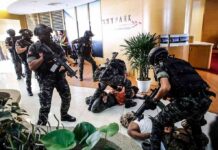
A gunman opening fire near the White House is now being turned into “proof” of a far‑left war on Trump before investigators have even told the public why he pulled the trigger.
Story Snapshot
- Secret Service agents shot and killed an armed man who fired near the White House while President Trump was inside, triggering a full lockdown.[2]
- Commentators like Jack Posobiec immediately framed the shooting as part of a wave of far‑left attacks on Trump and his supporters.
- Law enforcement have not publicly identified a motive, ideology, or group affiliation for the shooter.[2]
- The rush to label incidents as “left‑wing” or “right‑wing” violence is deepening distrust in institutions that already seem captured by unaccountable elites.[1][4]
What Actually Happened Outside the White House
Fox News and local Washington outlets report that an armed individual approached a Secret Service checkpoint near 17th Street and Pennsylvania Avenue, just outside the White House complex, and pulled a handgun from a bag before opening fire.[2] Secret Service officers returned fire, shooting the suspect, and at least one bystander was injured during the exchange.[2] Reporters on site were rushed into the press briefing room as the complex went into lockdown, and President Trump was inside the White House during the incident.[2]
Secret Service officials acknowledged reports of shots fired around the White House perimeter and said they were working with personnel on the ground to verify details and secure the scene.[2] The Federal Bureau of Investigation (FBI) responded to support the investigation, but early public statements focused strictly on security, not motive.[2] ABC7 and other local outlets described chaos on the north side of the complex, emphasizing the rapid lockdown and emergency response, while repeating that facts about why the shooter acted remained unclear.[2]
From One Shooting to a Story of “Far‑Left Attacks”
Even as law enforcement said the investigation was ongoing, political media rushed to turn the confrontation into a symbol of a larger ideological war.[1][2] Commentators such as Jack Posobiec used the Newsmax segment to argue that the White House shooting showed rising far‑left violence, linking the event to what they call an “assassination culture” against Trump and conservatives. That framing matches a broader pattern in which high‑profile incidents are folded into preexisting narratives about domestic enemies long before case files are public.[1][3]
Neutral analysis of the available reporting undercuts a confident link to left‑wing ideology. Coverage from Fox and local stations documents the suspect’s actions, the Secret Service response, and the resulting lockdown, but does not identify the shooter’s political views, affiliations, or social‑media trail.[2] One retired FBI agent quoted on television even stressed that anyone walking up to armed officers at the White House with a handgun was not making a realistic assassination attempt, casting doubt on claims of a sophisticated ideological operation.[2]
Why Motive Gaps Fuel Partisan Storytelling
Researchers who study political violence note that in today’s media environment, audiences demand meaning faster than investigators can supply hard evidence.[1][4] When agencies like the Secret Service and FBI release only minimal information, partisan commentators on both the right and left fill the vacuum with their own explanations, each pointing to a favorite villain: far‑left radicals, right‑wing extremists, or some shadowy “deep state.” That pattern has repeated around other high‑salience shootings, including attacks linked to events in Washington political circles.[1][3]
Legal and investigative constraints mean authorities often cannot reveal motive details, device forensics, or manifesto content until much later, if at all.[2][4] That delay leaves citizens who already distrust government with two unappealing options: accept vague official reassurances or adopt whichever media narrative best matches their anger. For conservatives, this often means seeing every attack near Trump as proof of left‑wing hatred; for liberals, it can mean seeing every crackdown as a step toward authoritarianism.[1][4]
The Bigger Question: Is Left‑Wing Political Violence Actually Rising?
A recent analysis of left‑wing terrorism and political violence in the United States argues that 2025 was on pace to be the most violent year for the left in decades, based on tracked incidents and plots.[4] That finding supports the idea that far‑left violence is a real concern, not a pure media invention. At the same time, the authors warn that cherry‑picking incidents and ignoring context can distort public understanding and turn complex patterns into simplistic talking points.[4]
The White House shooting is a textbook case of that tension. The facts we have support treating it as a serious security breach and a potential act of political violence.[2] The facts we do not have—verified ideology, organizational ties, or a clear manifesto—mean it cannot honestly be held up yet as definitive proof of a far‑left campaign. For Americans on both sides who feel the system lies or spins for its own survival, that gray area is exactly where mistrust grows.[1][4]
How Citizens Can Respond When Institutions and Media Clash
People who feel squeezed by inflation, broken immigration policy, and a political class that always seems to protect itself first have good reason to scrutinize official stories. But responsible skepticism means demanding evidence, not simply choosing whichever partisan narrative feels most satisfying. In cases like this shooting, that means watching for court documents, investigative reports, and forensic findings that can confirm or refute ideological claims rather than letting television clips decide the story on day one.[2][4]
Both major parties benefit when citizens are scared of one another and desperate for protection from “the other side.” Incidents near the White House will always be politicized, especially under a polarizing president. Yet if Americans across the spectrum want to push back against a government and media culture that seems more focused on power than truth, insisting on clear facts before ideological labels is a small but meaningful step toward reclaiming some control over the narrative.[1][3][4]
Sources:
[1] YouTube – What the “Political Violence” Framing is Hiding
[2] YouTube – WHCD Shooting: ‘Left-Wing Cult,’ White House Blames …
[3] YouTube – White House Correspondents’ Dinner shooting suspect …
[4] Web – What we know about the suspect in shooting at White House …