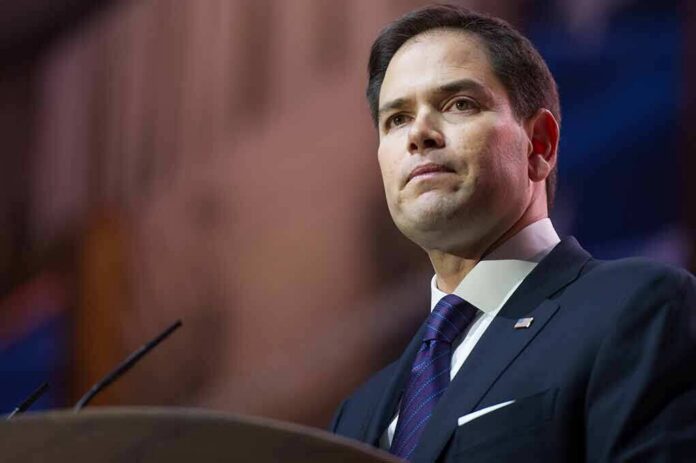
When Marco Rubio warns that left-wing terrorism has “surpassed” far-right violence, he is seizing on a narrow statistical moment and turning it into a sweeping narrative—one that mixes real data, genuine concern, and a heavy dose of politics.
Key Points
- CSIS data do show that, in early 2025, recorded left-wing attacks outnumbered far-right attacks for the first time in three decades—but from a very low baseline.
- Rubio built a global campaign around those numbers, arguing far-left political terrorism is a resurgent, transnational threat on par with past waves of leftist violence.
- Independent analysts and fact-checkers broadly agree left-wing incidents have increased, yet emphasize they remain far fewer, and generally less deadly, than historical right-wing and jihadist violence.
- The choice to focus a “political violence” summit almost exclusively on the far left, and to embed the issue in election messaging, has turned a legitimate security question into a contested political project.
How Rubio’s Case Is Built: The Data and the Directive
Rubio’s argument rests heavily on one core empirical claim: that in the first half of 2025, left-wing terrorist plots and attacks in the United States outnumbered those from the violent far right for the first time in more than 30 years. The underlying analysis comes from the Center for Strategic and International Studies (CSIS), which examined roughly three decades of incidents and concluded that, between January 1 and July 4, 2025, five far-left plots and attacks were recorded compared to a single far-right incident. This “reversal” is genuine in the narrow sense that the counts flip for that period. But it occurs against a backdrop in which right-wing violence has dominated the landscape for decades. CSIS’s own numbers show an average of 0.6 left-wing incidents annually from 1994 through 2000 versus 20.6 on the right, and four per year on the left versus 22.7 on the right between 2016 and 2024. The 2025 pattern, in other words, reflects a combination of a modest uptick on the left and a steep drop on the right, not a wholesale replacement of one threat by another.
Rubio nonetheless treats this moment as a pivot point. In his summit speeches and interviews, he cites 2025 as “the left’s most violent year in more than three decades,” pointing to a reported 400 percent increase in far-left plots and attacks over the previous year. He pairs those figures with historical context: between 1970 and 1980, he notes, roughly 93 percent of terrorist attacks in the West were attributed to far-left extremists, pointing to groups like Italy’s Red Brigades, Germany’s Red Army Faction, Greece’s 17 November, and U.S. organizations such as the Weather Underground and the Black Liberation Army. The implication is clear—history has seen the far left dominate terrorism before, and the current data show the first signs of a return.
Policy, in his framing, must follow. Rubio points to National Security Presidential Memorandum No. 7 (NSPM‑7), a directive issued by President Trump, as the legal backbone of a new approach. In his remarks, he describes NSPM‑7 as formally recognizing left-wing violence as “political terrorism” and ordering agencies to disrupt, defund, debank, arrest, and prosecute those involved. Subsequent actions he touts include the November designation of four European far-left or “antifa” groups as foreign terrorist organizations and the launch of a Rewards for Justice program offering up to $10 million for information on their financing. On paper, this marks a significant shift: left-wing actors, once treated largely through criminal law, are explicitly folded into the national security terrorism architecture.
The Summit in Washington: Political Terrorism, Narrowly Defined
Rubio’s most visible move to operationalize this threat framing was the State Department’s “Ministerial on Resurgence of Political Violence,” a summit that drew representatives from more than 60 countries. In public statements and the summit’s program, the event is described as addressing “political terrorism” or “political violence” writ large. In practice, the agenda focuses almost exclusively on far-left actors—particularly loose networks associated with “Antifa” and other anti-fascist or radical left movements.
Rubio’s speeches at the summit weave the 2025 CSIS numbers into a broader narrative. He recounts specific incidents abroad: a 72-year-old woman in Greece killed by a firebomb amid local political tensions, an 83-year-old woman in Berlin who died during a blackout allegedly caused by sabotage, and a 23-year-old in Lyon beaten to death by militants described as far-left. He presents these as emblematic of a resurgent, transnational far-left threat, coordinated through encrypted communications, shared safe houses, and funding streams that allegedly intersect with hostile foreign states, including Iranian proxies and Cuba’s intelligence services. The rhetoric is stark: far-left terrorism is cast as a civilizational threat driven by hatred of Western institutions, not as marginal street violence.
Senior officials echo this tone. Stephen Miller, a key administration figure on the issue, frames NSPM‑7 as the first directive to unify the U.S. security apparatus against left-wing political terrorism, and he cites eye-catching figures—such as an 8,000 percent increase in violent assaults against ICE officers—to argue the threat is systemic rather than episodic. This statistic has not been independently validated in public-facing FBI or DHS datasets, and no official breakdown has been published to show underlying counts or methodology. Still, it plays an important rhetorical role: it signals that what might be seen as isolated clashes around immigration policy are being reinterpreted as organized political terror.
What the Broader Evidence Actually Shows
When one steps back from the summit stage and looks at the wider body of research, a more nuanced picture emerges. CSIS is explicit, in the same analysis Rubio cites, that left-wing violence has “risen from very low levels and remains much lower than historical levels of violence carried out by right-wing and jihadist attackers.” A companion CSIS brief on ideological trends likewise emphasizes that, although far-left incidents have increased in the last decade, they remain far fewer than right-wing and Islamist attacks in both number and lethality. A peer‑reviewed comparison of worldwide political violence finds that, relative to right-wing and Islamist groups, left-wing attacks tend to be less deadly.
Independent analysts have pushed directly on the “historic reversal” narrative. A detailed critique published at Just Security points out that the alarm over 2025’s left-wing violence rests on just five recorded plots and attacks over nearly seven months, extrapolated into projections about a “most violent year in more than three decades.” The author notes that even if that pace continued to 10 incidents by year’s end, the absolute number would still be small compared to recent peaks in right-wing terrorism. Fact-checkers at outlets like PolitiFact and OPB reach similar judgments in the context of political claims about left-wing violence: they confirm that left-wing incidents did outnumber right-wing ones in early 2025, but rate sweeping assertions about the left eclipsing the right overall as “mostly false,” because they disregard the much higher and more sustained levels of right-wing violence over the preceding three decades.
These critiques do not deny that a real uptick has occurred. They accept the CSIS finding that left-wing plots and attacks have risen and that law enforcement must take them seriously. Their objection is to how that uptick is framed. Highlighting a short-term crossing of lines on a chart as proof that “the left” has become the primary terrorist threat, while ignoring long-term trends and absolute numbers, distorts public understanding of risk. It also risks redirecting attention and resources away from threats that remain quantitatively larger in favor of those that better fit the political moment.
Politics, Perception, and the Charge of Ideological Bias
Because Rubio’s campaign against left-wing terrorism unfolds in a heavily polarized environment, the security debate is quickly entangled with partisan suspicion. Mainstream outlets including NPR and the Washington Post describe the summit and associated initiatives as a “marquee issue for Republicans heading into the midterm elections,” tying the focus on left-wing violence directly to Trump‑era electoral strategy. Civil rights groups and some Democratic lawmakers argue, in letters and public statements, that concentrating federal counterterrorism on left-wing actors risks weaponizing the national security apparatus against domestic opposition rather than following an apolitical, data‑driven threat assessment.
International reaction is mixed. The Guardian reports European allies privately questioning the scale and definition of the far-left threat being advanced, particularly around the label “Antifa,” which in Europe often denotes a broad anti-fascist milieu rather than a discrete terror organization. Yet Rubio publicly insists that other governments are “proactively reaching out” to collaborate, and he points to Treasury’s pledges to target suspected financial networks as evidence of growing consensus. Leaked internal documents, cited by Raw Story and others, suggest that within the U.S. government, “political terrorism” is, in some contexts, operationally defined as “far-left terrorism,” reinforcing critics’ claims that the rubric itself has been ideologically narrowed.
Media coverage reflects this divide. Conservative outlets hail Rubio’s speeches as long‑overdue recognition of a serious blind spot, applauding the willingness to name far-left actors as terrorists and to treat attacks on immigration infrastructure or conservative figures as political violence, not spontaneous protest. Progressive and civil libertarian commentators, by contrast, warn that NSPM‑7’s broad language—encompassing “organized doxing campaigns,” rioting, trespass, and “civil disorder” under the terrorism umbrella—could chill protected speech and blur the line between violence and contentious politics.
Mechanism and Consequence: What This Shift Does Inside the System
From a counterterrorism practitioner’s standpoint, the mechanism of this shift matters as much as its rhetoric. When a category such as “far-left political terrorism” is formally recognized in a presidential memorandum, designated in State Department lists, and embedded in summit communiqués, it changes how agencies collect intelligence, prioritize investigations, and allocate resources. Behavior that might once have been handled primarily as criminal protest or civil unrest—attacks on property during demonstrations, organized harassment of officials, or violent clashes around immigration enforcement—can be reframed as potential terrorism, triggering different surveillance authorities, interagency coordination, and international information sharing.
In some cases, that broader toolset may be appropriate; a small number of left-wing actors do appear to have planned and executed attacks that meet standard terrorism criteria—ideologically motivated violence against noncombatants to influence government policy. The CSIS dataset includes plots and attacks directed at government and law enforcement targets around immigration, and the authors note the growing role of anti-government extremism in far-left incidents. At the same time, lumping a wide spectrum of confrontational, even unlawful, political activity into the terrorism box risks overreach. The more expansive NSPM‑7’s operational definition becomes, the more easily it can be used not only to disrupt violent networks but also to surveil, deter, or criminalize dissent.
The long-term consequence is a kind of ideological pendulum in threat assessment. For most of the post‑Cold War period, jihadist and far-right violence dominated U.S. terrorism discourse and resource allocation. A short-term statistical anomaly in 2025 now underwrites a campaign to reframe the far left as the emergent primary threat. If that narrative is not tethered carefully to the full data record, it risks repeating an old pattern: policy chasing headlines and momentary numbers rather than sustained trends, with each swing leaving parts of the landscape underexamined.
How to Read Claims About “Surpassing” Terror Threats
For an informed reader, the lesson in this debate is not that left-wing terrorism is imaginary, nor that Rubio’s concerns can be dismissed outright. Left-wing plots and attacks have meaningfully increased from a low baseline, they have produced real casualties at home and abroad, and they deserve serious investigative attention. What the evidence does not support is the leap from “more left-wing incidents than usual, and more than the right in a six‑month window” to “the left has become the dominant terrorist threat,” especially when measured against decades of far-right and jihadist violence.
Whenever a public figure asserts that one ideological threat has “surpassed” another, it is worth asking four questions. What is the time window being used? Are absolute numbers small or large? How do those numbers compare to long‑term trends? And how might political incentives be shaping which threats are highlighted and which are backgrounded? In Rubio’s case, the answers point to a real uptick, a very small absolute count, a long history of right‑wing dominance in the data, and a clear alignment with electoral strategy. That combination does not make his security agenda illegitimate. But it does mean that discerning citizens should separate three things: the facts about violence, the judgments about risk, and the politics that determine which risks move to the front of the stage.
Rubio Puts Political Terrorism on Notice
Getting into the US is going to be harder for far-left terrorists and the members of Mexican drug cartels.
Secretary of State Marco Rubio announced new visa restrictions during a summit he hosted for diplomats…
— Liberty Nation (@libertynation) July 18, 2026
Sources:
townhall.com, astrid-online.it, youtube.com, facebook.com, npr.org, reuters.com, singjupost.com, thehill.com, x.com, instagram.com, theguardian.com, latimes.com, csis.org, justsecurity.org, pmc.ncbi.nlm.nih.gov