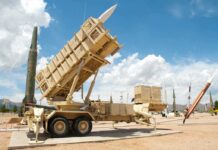
The Marine Corps’ interest in General Atomics’ Bullseye matters because it shows how the service is trying to turn long-range precision strike from a specialist capability into something it can disperse, move, and reload in the Indo-Pacific at speed.
Intro Header
- The FY2027 NDAA markup includes $40 million for Bullseye integration and demonstration through Marine Corps technology prototyping activities.
- Bullseye is pitched as a 300-kilometer cruise missile optimized for maritime strike, with ground and sea launch options.
- The concept is built around rapid deployment: a containerized “Bullseye in a Box” loadout, plus integration work for the M142 HIMARS.
- The strategic logic is explicit: the missile is being framed as a tool for deterring Chinese anti-access and area-denial systems in the Indo-Pacific.
What the Marine Corps Is Trying to Buy
The core story is not that the Marine Corps has fielded a finished new missile; it is that Congress is now being asked to fund the integration and demonstration of a weapon designed to fit the Corps’ emerging expeditionary strike model. Naval News reports that the Senate Armed Services Committee markup for the FY2027 NDAA includes $40 million for Bullseye through Marine Corps technology demonstration and prototyping activities, and that the service is also working on integration with the M142 High Mobility Rocket Artillery System.
That detail matters because it places Bullseye in the familiar but often misunderstood middle ground between concept and fielded capability. In defense procurement, “integration and demonstration” usually means the military is still proving that a weapon can be carried, launched, networked, and sustained in the environments it cares about. It is an important step, but it is not the same thing as broad operational adoption. The reporting available here supports the view that Bullseye is being treated as a serious candidate for Marine Corps use, not as a fully mature, universally deployed system.
Why Bullseye Fits the Marine Corps’ Indo-Pacific Problem
Bullseye’s appeal comes from geography and targeting logic. General Atomics says the missile is a long-range, precision-guided strike weapon with a range greater than 300 kilometers, and Naval News describes it as a General Atomics-built cruise missile derived from Rafael’s Ice Breaker. In practical terms, that means a relatively compact standoff missile that can be launched from multiple platforms and still reach ships, fortified positions, and island targets without exposing the launching force to immediate retaliation.
That is exactly the sort of capability the Marine Corps has been chasing as it rebuilds its role in littoral warfare. The service’s Expeditionary Advanced Base Operations concept depends on small, dispersed units that can move quickly, survive long enough to shoot, and then displace before an adversary can locate and strike them. A missile that can be transported in standard logistics, mounted on a HIMARS launcher, and fired from a containerized package fits that logic with unusual neatness.
The “Bullseye in a Box” idea is the clearest signal of that design philosophy. According to the reporting, each container can hold four missiles and can be moved with ordinary logistics before being put on a launcher. That is not just an engineering flourish; it is a doctrinal statement. The weapon is being designed less as a precious, bespoke asset than as a distributed munition that can be pre-positioned, rapidly emplaced, and used to create surprise mass in a theater where the enemy’s sensors and missiles are supposed to dominate the open battlespace.
The Strategic Logic Is Anti-Access, Not Showpiece Weaponry
Bullseye is being marketed for a very specific operational problem: penetrating anti-access and area-denial systems. Naval News says General Atomics has advertised the missile as a counter to the kind of networked defenses China fields, including PLA bases on artificial islands in the South China Sea. That claim is not a neutral technical specification; it is the missile’s reason for being. The whole point is to give Marine forces a survivable way to threaten ships, logistics nodes, and hardened shore sites from beyond the most dangerous defensive rings.
General Atomics’ own description reinforces that logic. The company says Bullseye is engineered for high-value targets and can support air, sea, and ground launch, while its published specifications list a range of more than 300 kilometers. Other reporting describes it as modular and intended for maritime strike first, with additional mission sets such as anti-ship, anti-surface, electronic warfare, and decoy roles. In other words, the program is being sold as a family of effects, not a single-purpose round.
This is also why the Indo-Pacific frame is so central. A missile like Bullseye does not have to be the longest-ranged or most exquisite weapon in the inventory to matter; it has to be good enough, cheap enough, and numerous enough to complicate a rival’s planning. That is the logic behind much of modern precision strike: create enough survivable launch points that the enemy cannot focus on a handful of predictable batteries. Bullseye is being presented as a tool for that kind of distributed lethality.
USMC Eyes General Atomics’ Bullseye Cruise Missile to Counter China
American lawmakers want to fund a U.S. Marine Corps test of General Atomics’ Bullseye cruise missile in the 2027 National Defense Authorization Act.
By @AaronMatthew_L https://t.co/nPCjZWXtWh— Naval News (@navalnewscom) July 13, 2026
What Is Known, and What Is Still Not Proven
The available record is strong on ambition and thinner on validation. There are public claims about a 300-kilometer range, maritime optimization, modular payloads, and compatibility with multiple launch platforms, including HIMARS and containerized deployment. But there are no public Marine Corps test results in the material provided here, no independently published performance data from service trials, and no clear evidence yet of an operational unit fielding Bullseye in routine service. The distinction matters because a demonstration missile and a combat-ready missile are not interchangeable categories.
There is also a broader pattern at work. Defense firms routinely package new weapons around live threats, then seek congressional money while the military decides whether the capability fills a real gap. That is not unusual; it is how American procurement often moves. But it does mean Bullseye should be understood as part of a larger competition over which long-range strike concepts will define the Marine Corps’ future, and which industrial partners will benefit from that decision. The open question is not whether the missile concept is relevant. It is whether the Corps can prove that it is reliable, affordable, and useful enough to justify scale.
Why This Program Deserves Attention Beyond the Funding Line
Bullseye is important because it sits at the intersection of doctrine, geography, and industrial strategy. The doctrine says the Marine Corps wants to fight as a distributed expeditionary force. The geography says the Indo-Pacific rewards long-range strike from dispersed positions. The industrial strategy says the Pentagon keeps looking for weapons that are cheaper to produce and easier to mass than the exquisite systems that dominate headlines. Bullseye is built to satisfy all three demands at once.
That does not guarantee success. Programs win when prototypes become fieldable systems, when logistics remain manageable, and when the unit economics make sense under wartime pressure. But the fact that Bullseye is already being written into NDAA funding and described as a candidate for Marine Corps integration tells you enough to place it in the serious category. It is not a speculative concept floating on power-point vapor; it is a live effort to arm Marines with a missile shaped for the central problem of modern Pacific deterrence.
Sources:
navalnews.com, usagovpolicy.com, congress.gov, youtube.com