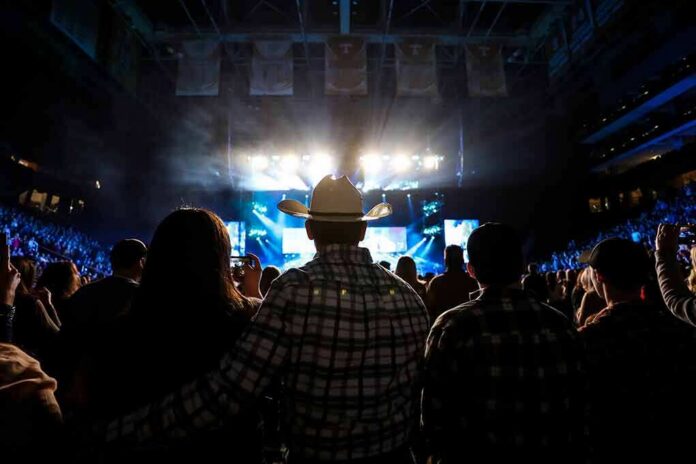
A fleeting gesture can clarify a performer’s ethics more than a press release: at Gorillaz’s U.S. tour opener in Orlando, Damon Albarn raised a Palestinian flag and told the arena to take a side—an unambiguous plea against neutrality delivered from the stage.
The Short Version
- At the Kia Center in Orlando, Albarn lifted a Palestinian flag handed up from the crowd and urged fans: “Don’t forget this. Ever. Stand your position. Don’t ever be neutral.”
- Local and international outlets reported the moment consistently and in near real time, citing video clips circulating on social platforms.
- Orlando coverage framed the line as a call not to “turn a blind eye,” underscoring Albarn’s appeal to moral engagement rather than party politics.
- The act landed inside a broader industry debate over artists’ pro-Palestinian speech, including the Macklemore–Ed Sheeran tour controversy days earlier.
What Happened On Stage—and Why It Registered
During Gorillaz’s tour kickoff in Orlando, Damon Albarn accepted a Palestinian flag from the audience, held it overhead, and addressed the arena with a compact admonition: do not be neutral. Multiple outlets recorded the same core phrasing—“Don’t forget this. Ever. Stand your position. Don’t ever be neutral”—and located the moment squarely within the set that night. The detail that matters here is not novelty but clarity: Albarn used a universally legible symbol and a plainspoken line to collapse hedging, locating the performance in the moral weather of the present rather than the safe timelessness of hits.
The local press captured the tone accurately. Orlando Weekly emphasized the call to resist indifference—“not turn a blind eye to what’s happening in today’s world”—which matches the cadence longtime observers associate with Albarn’s stagecraft: brief, pointed, and more civic than partisan. The arena setting matters; concert speech is not a town hall, but the music stage has always functioned as a public square with a PA system, where symbols compress arguments for audiences who did not come for a seminar yet leave with a thesis.
How Artists Use Symbols in Performance
Within live music, a flag is a semiotic amplifier. It communicates alignment faster than exposition and travels well through the fog of a stadium mix. Artists deploy such symbols to set a moral key for the rest of the night—less a policy plank than a stance. Albarn’s line—“stand your position”—functions as metacommentary on spectatorship itself. In effect, he was asking the room to move from audience to witness. That distinction is old in protest culture but continually relearned: participation is not only singing along; it is choosing a moral frame through which to hear the next song.
Because the gesture was embedded in a performance, not an interview, its power derived from juxtaposition: a familiar catalog scored against an unfamiliar insistence. The message’s architecture was succinct—symbol first, injunction second—which is exactly how a touring artist ensures the meaning survives low-fidelity phone video and secondhand summaries. That is why reports from disparate outlets aligned on the same two elements: the flag and the refusal of neutrality.
The Immediate Context: A Wider Industry Argument
The Orlando moment did not happen in a vacuum. In the days around the show, debate over pro-Palestinian speech by musicians was already active, most visibly after Macklemore was dropped from the U.S. leg of Ed Sheeran’s tour following his “free Palestine” remarks at MetLife Stadium. That dispute reframed a tour as a referendum on political expression, and it primed audiences and editors alike to read artists’ stage remarks through that lens. Coverage of Albarn’s comment explicitly connected the dots: another marquee act making a visible statement in a climate where silence and speech both carry costs.
Zooming out further, the past two years have seen coordinated pro-Palestinian initiatives across the music world, including the Together for Palestine concert at London’s OVO Arena Wembley with a large, cross-disciplinary lineup—a sign that advocacy has become a structural, not episodic, presence in parts of the industry. Albarn has performed within that orbit, which makes the Orlando appeal less an outlier than a continuation of a through-line.
What Albarn Said—and What He Didn’t
The phrasing matters. “Don’t ever be neutral” is an ethical prompt, not a policy menu. He did not outline legislation, call for a boycott, or name specific actors from the stage as reported; instead, he insisted on the act of choosing a side in the face of suffering—reporting pairs the line with “atrocities in Gaza,” which squarely locates the referent even as the words themselves remain general. For an arena address, that is a feature, not a bug: the more generalized the imperative, the more room it leaves for individual conscience to supply detail while still signaling solidarity.
Interpretation across outlets landed consistently on support for Palestine. That is an accurate reading given the symbol and the timing. Local framing as a call against indifference adds texture without contradiction. Taken together, the record supports a straightforward conclusion: Albarn integrated a pro-Palestinian gesture into the set and used it to tell the audience that disengagement is not a defensible position.
Macklemore didn't get dropped from Ed Sheeran's tour for having an opinion. He hijacked someone else's concert — keffiyeh, Gaza war footage on the screens, a genocide-accusation song, "Free Palestine" chants — turning an opening slot into a protest nobody signed up for. Robert… pic.twitter.com/xgrkRvxw7I
— From the Frontline (@From_Frontline) September 19, 2026
Why This Matters for Live Music—and for Audiences
Large-scale tours are among the last truly mass cultural rituals; tens of thousands of people cohere in a room designed for volume, and what is said from that stage echoes beyond it via phones and feeds. In that environment, a moment like Orlando accomplishes three things at once. First, it places the artist within an identifiable moral coalition, which clarifies expectations for future appearances and collaborations. Second, it signals to promoters and peers that the bounds of acceptable stage speech remain contested but navigable. Third, it reminds audiences that the entertainment contract has always contained an expressive clause: you paid for music; you also got the artist’s conscience.
Sources:
facebook.com, twaslnews1.twaslnews.com, complex.com, uk.news.yahoo.com, ground.news, perthnow.com.au, gbnews.com, us.headtopics.com