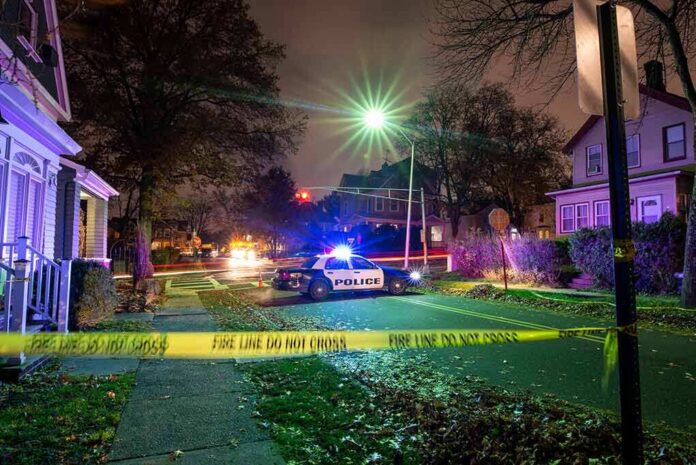
When a homicide suspect dials dispatch to confess, is found beside a dead parent with a bloodied knife nearby, and repeats the admission to first responders, the core facts of the case solidify fast; what remains contested later is rarely what happened, but which legal theory those facts ultimately support.
At a Glance
- Police say Alexander Harrington, 50, called dispatch to report he killed his 77-year-old mother inside their Delray Beach home.
- Deputies found the victim with multiple stab wounds in the living room; a knife was recovered near her body.
- Harrington was detained outside without incident, allegedly reiterated “I killed my mom,” and was charged with first-degree premeditated murder.
- Multiple outlets report consistent core details; he is held without bond while the case proceeds in court.
The established facts: a rapid confession, a scene consistent with stabbing, and an immediate arrest
On a Friday afternoon in west Delray Beach, Florida, law enforcement received a call that shaped the ensuing investigation from the start: a man identifying himself as Alexander Harrington told dispatch he had killed his mother. Deputies who arrived at the gated Monterey Lake neighborhood found 77-year-old Susan Baratto deceased in the living room with multiple stab wounds. A black-handled knife lay nearby, and Harrington, 50, was detained outside the home without incident. He was booked into the Palm Beach County Jail and charged with first-degree premeditated murder, with a judge ordering him held without bond. These core facts appear across independent reports drawing on the arrest paperwork and first-appearance proceedings.
Accounts derived from the probable cause affidavit say Harrington repeated the admission to paramedics—“I killed my mom”—and, after receiving Miranda warnings, acknowledged stabbing her and calling police. Reporters also noted he had a cut on his arm, a detail consistent with recent physical involvement, though the public summaries offer no forensic elaboration beyond that observation. What the arrest record does not provide is a motive; outlets explicitly state the affidavit offers no explanation for why the killing occurred.
How cases like this move from arrest to theory: premeditation versus proof of killing
Homicide investigations often contain two evidentiary layers that the public conflates. The first is proof that a killing occurred and that the suspect committed it—what lawyers call the corpus delicti (the fact of the crime) and identity. A prompt self-incriminating call, physical evidence consistent with a stabbing, and contemporaneous statements to responders readily support that layer. The second is the theory of the murder charged. In Florida and elsewhere, first-degree premeditated murder requires evidence that the defendant formed the intent to kill after reflection—not in a purely instantaneous outburst. Prosecutors can, and often do, rely on circumstantial evidence to establish premeditation: weapon choice and use, wound pattern, prior relationship and interactions, actions before and after the killing, and statements that reveal planning or resolve. Courts have repeatedly held that premeditation may be inferred from such circumstances when the evidence, taken together, supports it beyond a reasonable doubt.
In the Harrington matter, the charging decision signals that prosecutors believe the facts will eventually support premeditation; the public summaries, however, properly stop short of previewing that proof. This is common early in a major case: the public narrative rests on undisputed mechanics—confession, stabbing, recovery of a knife, immediate arrest—while the trial theory matures through discovery, expert analysis, and witness testimony. Multiple outlets note the absence of a stated motive in the initial affidavit, a gap that does not bar a first-degree charge but that typically prompts further investigative work and litigation over the defendant’s mental state, any prior threats, and the sequence and nature of the wounds.
What multiple outlets agree on—and why that convergence matters
Convergence across independent local and national outlets is not proof by itself, but it does reduce the likelihood that a single misread document is driving the story. In this case, the Palm Beach Post, Sun Sentinel, WPBF, CBS12, PEOPLE, and WFLA align on the essentials: the 2 p.m.-hour call from Harrington reporting he killed his mother, the discovery of Baratto with multiple stab wounds, the knife at the scene, the detention of Harrington outside the residence, and a no-bond first-degree murder charge. That consistency—especially when tied to the same arrest affidavit and first-appearance proceeding—creates a reliable factual backbone for understanding what happened, even as the legal theory is tested in court.
There is some inconsistency in secondary reporting of the victim’s surname (Baratto versus Barreto); where it appears, it is best understood as a copy error rather than a competing account of the event. The shared facts about location—the 5100 block of Monterey Lane in the Monterey Lake community off South Military Trail—also repeat across reports, providing geospatial specificity that further anchors the narrative.
The role and limits of a confession in homicide prosecutions
Confessions—especially unsolicited, primary admissions to authorities—are weighty evidence. But American courts police both admissibility and sufficiency. Unless a confession is the product of coercive police conduct, it is generally admissible; Colorado v. Connelly is the canonical articulation of that threshold. Mental illness alone, absent police overreaching, does not render a confession involuntary under the Due Process Clause. Separately, the State still must prove each element of the charged offense beyond a reasonable doubt. In premeditated murder prosecutions, that means the confession to the killing does not, by itself, automatically satisfy premeditation; prosecutors typically supplement with circumstantial proof capable of supporting deliberation and reflection, as Florida appellate decisions repeatedly recognize.
Practically, that is why cases that seem “open and shut” on who did what can still produce serious litigation over what was intended and when. The defense may probe the timing and content of statements, the suspect’s psychiatric history, and forensic findings such as wound number and placement to challenge the inference of planning. The State, for its part, may point to weapon retrieval, the manner and duration of the attack, post-offense conduct, or pre-incident communications to argue deliberation.
Why this case drew outsized attention—and how to read it responsibly
The facts are tragic on their own; the media hook is sharper because Harrington presented himself publicly as a “life coach” or “intuitive healer” and reportedly posted a social video about forgiveness shortly before the killing. Those details travel quickly online and can distort what matters in court: not the irony of branding, but the evidence of intent. The better frame is the sober one: a matricide case with a prompt confession, corroborated scene evidence, and a first-degree charge now moving into a phase where premeditation and mental state are litigated using records, forensics, and witness testimony. While Harrington is presumed innocent until proven guilty, the record reported so far establishes, with unusual clarity, what investigators encountered and why prosecutors charged it the way they did.
Sources:
nypost.com, palmbeachpost.com, wpbf.com, cbs12.com, sun-sentinel.com, newsbreak.com, midmichigannow.com, casemine.com, leb.fbi.gov