When police face a moving knife threat in a dense crowd, seconds — and distance — determine whether anyone else gets hurt; in Times Square, officers confronted exactly that scenario and followed a sequence of commands, less-lethal attempts, and then gunfire that multiple outlets report as consistent with training and policy.
The Short Version
- A woman fatally stabbed one person and wounded another in Times Square before confronting officers while holding two knives, according to police.
- Officers engaged her for roughly four minutes, issuing repeated commands to drop the weapons and deploying Tasers that did not stop her.
- Police say she advanced and threatened to kill them; two officers then fired, killing her.
- City leadership publicly said the officers acted “by the book” in a crowded, high-risk environment.
What happened in Times Square: sequence and stakes
The core facts are straightforward and broadly uncontested across reporting: a woman later identified as Pamela Cisneros stabbed two people near 7th Avenue and West 40–42nd Streets, killing a Bank of America vice president and injuring a 68-year-old visitor, in what police described as random, unprovoked attacks. Officers encountered Cisneros holding two knives; for approximately four minutes they tried to end the confrontation without gunfire, repeatedly ordering her to drop the weapons. When verbal commands failed, officers fired Tasers. The stun attempts did not incapacitate her, and, according to Police Commissioner Jessica Tisch, she advanced and issued explicit death threats — “I will kill you” — before two officers discharged their service weapons, fatally striking her.
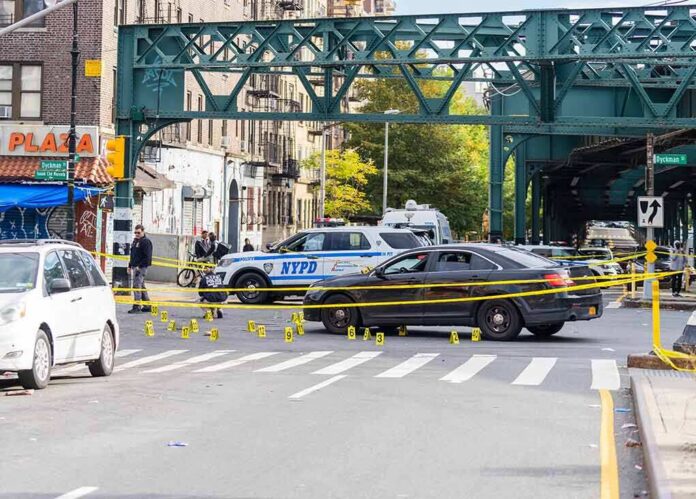
The location matters as much as the sequence. This unfolded in one of the most crowded public spaces in the country, with tourists, office workers, and families within immediate range — the kind of setting where an edged-weapon assailant can cover short distances quickly and where stray movement can turn a contained standoff into a mass-casualty risk. Tisch called it an “extraordinarily dangerous situation,” a characterization echoed by multiple outlets describing bystanders nearby as officers worked through the force options available to them.
Why officers progressed from voice commands to Tasers to gunfire
Modern patrol training in large U.S. departments emphasizes a progression: create distance and cover, issue clear commands, seek compliance, and, when feasible, use less-lethal tools before escalating to deadly force when an imminent threat persists. New York reporting describes that pattern in this case: sustained verbal commands, then at least one Taser deployment that failed to stop Cisneros despite probes delivering a shock, and finally gunfire as she closed distance while still armed with knives. A single unsuccessful Taser activation can fail for prosaic reasons — poor probe spread, heavy clothing, or movement breaking electrical contact — but the practical point for line officers is simple: if a subject remains mobile with lethal weapons in hand in a dense environment, the window for repeated less-lethal cycles narrows quickly.
Commissioner Tisch said the officers “did exactly what they’re trained to do,” and described their decision to fire as appropriate to the immediacy of the threat. That framing appears consistently in multiple outlets’ accounts of the same timeline, adding institutional clarity to the on-scene actions. It also aligns with a familiar pattern in urban officer-involved shootings that involve edged weapons: commands; failed less-lethal; advance by the armed subject; lethal force to stop the movement before it reaches officers or surrounding civilians.
Crowd geometry and edged-weapon dynamics
Edged-weapon encounters are shaped by physics more than rhetoric. A person holding knives can bridge short gaps faster than an officer can backpedal, draw additional tools, or attempt hands-on restraint without unacceptable risk. In a setting like Times Square, where egress paths narrow and sightlines are compromised by vehicles, kiosks, and pedestrian flow, the tactical choices compress: contain if possible, keep barriers between the threat and the crowd, and prevent further victims. Reporting indicates the officers had “countless innocent people around them” as they managed the contact, which raises the cost of any tactic that requires closing to grappling range or allowing the subject to maneuver toward new victims. In such geometry, failed Tasers followed by forward movement with weapons in hand is the canonical trigger for firearm resort in policy and practice.
A family member’s pain will naturally raise the question, why didn’t officers just “grab her” — but grabbing a person actively wielding knives is close-quarters combat with lethal stakes, not a restraint technique. Patrol officers are neither equipped with cut-resistant suits nor trained to sacrifice limbs in hopes of a clean arm control; they are trained to stop an imminent deadly threat to themselves and others. Where cover, time, and distance allow, officers do attempt containment and negotiation; the reporting here depicts a moving, knife-armed assailant in a high-density area after two civilians were already stabbed, one fatally.
What the record establishes — and how we know it
Several specific assertions carry particular weight because they recur across outlets and are attributed to named officials. The four-minute engagement before shots is credited to Commissioner Jessica Tisch and appears in The New York Times’ contemporaneous reporting, anchoring the duration of the pre-shooting contact. Tisch is also quoted relaying Cisneros’s alleged threats — “I’m not dropping anything. I would rather kill both of you” and “I will kill you” — during the confrontation, a detail reported by CBS New York among others. Independent outlets including ABC7NY, CNN, and The Guardian each reported that Tasers were deployed and ineffective, corroborating the force-progression narrative from multiple directions.
Two additional elements are well-supported. First, the stabbings were described by police as random and unprovoked, a characterization repeated by local and national outlets; second, body-worn cameras captured the confrontation. The first establishes why officers treated the threat as ongoing and not contained to a domestic or targeted dispute; the second explains the confidence with which the department spoke about specific quotes and movements soon after the incident. New York has formalized a policy to release critical-incident body-camera footage within 30 days, providing an expected window for public viewing of the underlying material when feasible.
The broader pattern: critical incidents, cameras, and public understanding
This case sits squarely within a familiar national pattern: initial accounts emphasize commands to disarm, failed less-lethal attempts, and imminent threat in a crowded setting; subsequent release of video and investigative files allows the public to validate — or challenge — the chronology. Jurisdictions vary in how quickly footage becomes public, but New York’s stated 30-day release practice for critical incidents has aimed to narrow the gap between official narrative and primary evidence. Other jurisdictions set different clocks, from Los Angeles’s 45-day policy to states that require court orders before release; these choices shape how quickly communities move from argument to shared facts.
In the absence of synchronized release regimes nationwide, the best practice for readers is to weigh specific, attributable claims most heavily: statements by identified officials; concrete time intervals; the presence or absence of less-lethal attempts; and the geometry of the scene. On those measures, the Times Square case presents a consistent picture across multiple independent reports: a fatal stabbing, a surviving victim, a knife-armed subject refusing orders and threatening to kill officers, a failed Taser deployment, and a final advance that precipitated gunfire in a densely populated corridor.
The human cost — and why clarity matters
Two families suffered irreparable loss and trauma in minutes: the family of the Bank of America vice president who never made it home from work, and the family of Cisneros grappling with the incomprehensibility of her actions and death. Public safety and accountability both demand precision about what happened; that is why departments outfit officers with cameras and why city leadership brief the public early when a threat unfolds in the open. Here, the officers’ actions track with the training script for stopping a moving, knife-armed assailant in a crowd after lethal violence has already occurred. The details that give that conclusion weight — the four-minute engagement, the documented commands, the failed Tasers, the advance with knives, and the explicit threats — are the backbone on which sound judgment rests.
Sources:
fox5ny.com, nytimes.com, cbsnews.com, abc7ny.com, nypost.com, foxnews.com, marca.com, nbcnewyork.com, propublica.org