

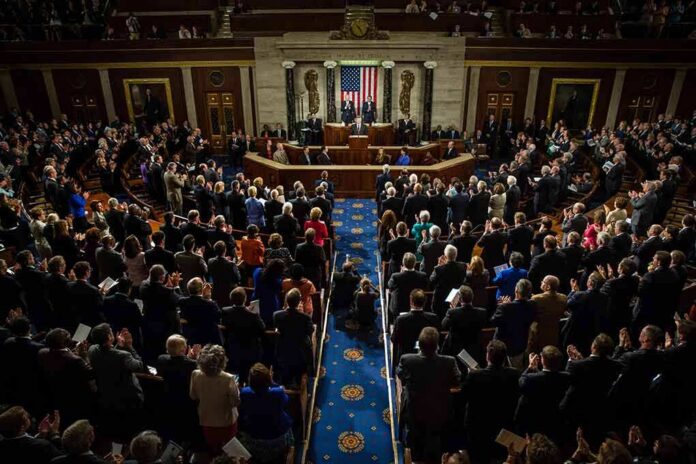
Expanding the House of Representatives is the most direct statutory lever the country has to make presidential outcomes more population-sensitive and to repair frayed representation in the “people’s House” — but it is not a silver bullet for Electoral College inversions, and getting the details right matters as much as the seat count.
At a Glance
- Congress — not the Constitution — fixes the House at 435; changing it needs only a statute, not an amendment.
- More House seats make Electoral College weights track population more closely, lowering inversion risk but not eliminating it.
- An expansion around 800 members would improve representation; much larger chambers further cut Electoral College disparities, with diminishing returns.
- Gerrymandering rules and public legitimacy are the practical guardrails; expansion without redistricting reform risks compounding today’s distortions.
What changing House size actually does
House size is set by ordinary law. Congress locked the chamber at 435 in the Permanent Apportionment Act era; the Constitution never fixed that number. Adjusting it requires the familiar legislative process — not a constitutional amendment — because Article I and the Fourteenth Amendment prescribe apportionment by population but leave the chamber’s size to statute. That statutory choice ripples into presidential elections. Each state’s Electoral College weight equals its House seats plus two Senators; as the House grows, the Senate’s fixed two-per-state bonus shrinks as a share of each state’s total, making electoral weights more population-proportional. This is the core mechanism reformers are trying to activate.
That’s why proposals to “uncap” the House are framed as an Electoral College repair as well as a legislative one. Chuck Todd captured the intuition bluntly: grow the House toward roughly 800 and you reduce the odds that the Electoral College diverges from the national popular vote while restoring closer constituent-to-representative ratios. On the first point — aligning presidential outcomes with population — the direction is right. On the second — representation inside the House — the case is even clearer: today’s districts routinely exceed 750,000 people; adding seats lowers that ratio and makes retail representation more feasible.
How we got locked at 435 — and what it’s cost
For most of American history, the House expanded as the population did. That practice stopped a century ago, and the fixed chamber has been asked to represent a nation more than three times larger than when 435 became the norm. Nonpartisan analysts and reform commissions have argued that this drift has democratic costs: oversized districts, strained constituent service, and outlier status among peer democracies on chamber-to-population ratios. The Congressional Research Service situates the legal baseline cleanly: House size is a statutory variable; apportionment still guarantees each state one seat and uses a priority method to allocate the rest after each census.
Because Electoral College weights are the sum of House and Senate allotments, the 435 cap also amplifies the small-state bonus in presidential contests. Enlarge the House and you dilute that bonus. The arithmetic is simple; the politics are not.
What the evidence says about inversions and “how big is big enough”
Quantitative work over the last decade reaches a consistent conclusion: enlarging the House reduces the probability of a candidate winning the Electoral College while losing the national popular vote, but does not abolish it. A comprehensive study of presidential “inversions” across 1836–2016 found that even very large houses push probabilities down but leave a nontrivial chance — on the order of ten percent in razor-thin national contests — because state-level winner‑take‑all rules still convert narrow margins into full slates of electors.
Modelers also converge on scale: going from 435 to something like 584 or 800 improves the mapping between people and power, yet the reduction in Electoral College disparity is incremental. Push higher — 1,000, 2,000, even 5,000 seats — and the small‑state bias continues to fall, with diminishing returns governed by state winner‑take‑all allocation and the constitutional two‑senator constant. In short, expansion helps; outsized expansion helps more; neither by itself fixes the structural source of inversions when states award electors winner‑take‑all.
Representation gains inside the House are the surest benefit
If the Electoral College effects are probabilistic and partial, the representational gains in the lower chamber are concrete. More seats mean fewer constituents per member, more accessible offices, and more granular districting that can better reflect regional interests. Crucially, researchers who modeled expansions across multiple apportionments found no consistent, durable partisan advantage in the House or Electoral College from changing the seat count itself; population shifts drive the results more than party engineering. That weakens the standard “power grab” critique and reframes expansion as institutional maintenance rather than a partisan tactic.
The tradeoff is administrative and political complexity: every added seat requires new districts. Without guardrails, that creates new canvases for gerrymandering. Reformers who back expansion therefore tend to pair it with districting constraints — independent commissions, compactness and community‑of‑interest standards, or even multi‑member districts with proportional rules — to ensure that more seats translate to more voice rather than more cartography games.
Why winner‑take‑all rules still dominate the Electoral College story
House size changes the denominator of Electoral College math; state award rules shape how votes become electors. As long as most states allocate electors winner‑take‑all, very narrow state victories can swing large electoral slates, preserving a residual inversion risk even in a very large House. The inversion study’s thought experiments show this clearly: scale the House up dramatically and you still observe outsized effects from hairline state margins because the allocation rule, not just apportionment, is doing the heavy lifting. That’s why analysts who care primarily about eliminating inversions often prioritize reforms to state assignment of electors — for example, proportional or district-based plans — or interstate compacts, with House expansion as a complementary but insufficient step.
Public legitimacy and the politics of changing Congress
Even the best-designed reform falters without consent. Surveys show Americans are, at best, ambivalent about enlarging the House: a majority prefer to keep 435; fewer than a third endorse more seats. That skepticism isn’t irrational — people experience Congress through performance, not seating charts — but it does mean any expansion case must anchor itself in outcomes citizens will feel: faster constituent service, better oversight, and a presidential tally that more reliably reflects where people live. Advocates who promise “we’ll never see a split again” oversell; those who argue “we can’t improve the system without an amendment” undersell what Congress can do tomorrow.
Practical path: what would a responsible expansion look like?
First, pick a defensible population ratio rather than a round number. A threshold like one representative per 500,000 to 600,000 would add seats methodically as the country grows, preventing another century-long freeze. Second, pair expansion with anti-gerrymandering rules — ideally independent redistricting and, where practicable, multi‑member districts with proportional allocation — to convert more seats into more voice, not more line-drawing. Third, be candid about Electoral College effects: expansion will reduce small‑state over‑weight and lower inversion odds; eliminating inversions requires changes to state allocation or a national popular vote regime. Finally, stage implementation to allow states to redraw maps after a census cycle and to stand up the administrative capacity new members require.
Bottom line
Right-sizing the House is the rare reform that is both legally straightforward and civically meaningful. It won’t conjure a perfectly majoritarian presidency, but it will bend presidential math toward population while delivering surer gains inside the chamber Americans interact with most. Treat expansion as institutional upkeep, not partisan gamesmanship; couple it with redistricting safeguards; and be honest about what it can and cannot fix. Do that, and an 800‑member House is not a radical idea — it is a return to first principles by statutory means.
Sources:
twitchy.com, congress.gov, x.com, dailykos.com, paulschiffberman.substack.com, blumenauer.house.gov, delawareonline.com