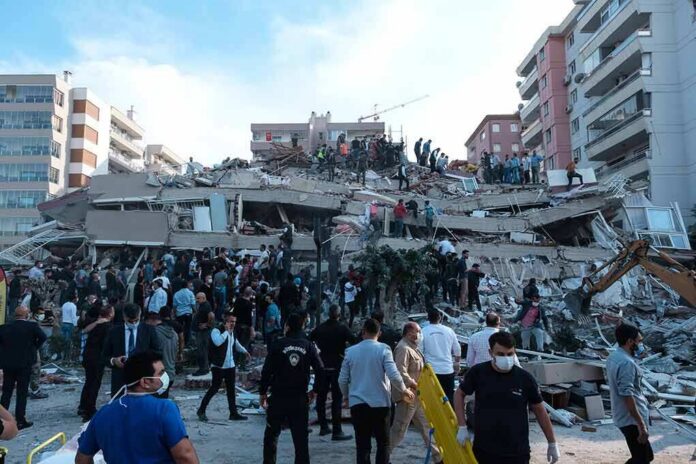
The most sobering truth about Russia’s missile and drone campaign against Ukraine is not any single death toll, but the way repeated, large-scale strikes have turned civilian vulnerability into a standing condition of daily life.
At a Glance
- Russian forces now rely heavily on ballistic missiles and drones to hit Ukrainian cities far from the front line, causing steeply rising civilian casualties.
- Individual attacks routinely kill between half a dozen and several dozen civilians; numbers are provisional at first and often revised as rescue operations continue.
- Ukraine’s air defenses intercept large portions of incoming salvos, but cannot reliably stop modern ballistic missiles, which drive much of the recent surge in deaths and injuries.
- Official casualty figures from Ukrainian authorities and UN monitors show 2026 as one of the deadliest years for civilians since the full-scale invasion began.
From singular tragedy to systemic pattern
When headlines report that “Russia hits Ukraine with ballistic missiles and drones, killing at least nine,” they describe one episode in a much larger, entrenched pattern of aerial warfare. On any given night, Russian forces can launch a combination of ballistic missiles, cruise missiles, and attack drones toward Ukrainian cities. Depending on the particular salvo, that attack may kill six people, nine, 18, or more than 20; taken together, these events form a continuous campaign rather than isolated shocks.
This pattern is evident in the range of recent incidents. One Associated Press report describes Russian attacks that killed six people, including a child, and wounded 29, as missiles and drones hit the northeastern Sumy region, Odesa, and Kyiv. Another evening’s barrage, documented by the BBC, involved more than 700 drones and missiles in successive waves and left at least 18 civilians dead across Odesa, Dnipro, and Kyiv. Separate strikes have killed 13, 22, or 27 civilians in single overnight assaults, according to BBC and ABC reporting. The headline figure changes; the mechanism and intent do not.
How Russia’s missile–drone campaign actually works
Militarily, Russia’s current approach relies on massed, long-range firepower to overwhelm Ukrainian air defenses and inflict damage on energy infrastructure, industrial sites, and—inevitably—residential areas and civic buildings. Ukrainian and international monitors describe salvos involving dozens of missiles and hundreds of drones in a single night. In one documented attack, Ukraine’s air force reported that Russian forces unleashed 73 missiles and 656 drones across the country. Another large-scale operation against Kyiv alone involved 55 ballistic and cruise missiles and 549 drones, much of which Ukrainian defenses intercepted.
Ballistic missiles are central to this strategy. Unlike cruise missiles or many drones, ballistic missiles travel at extremely high speeds along a largely predictable trajectory, but are far more difficult to shoot down, especially when launched in large numbers. Ukrainian officials and Western analysts have acknowledged that while Ukraine can intercept a high percentage of cruise missiles and drones, its systems struggle with modern ballistic missiles such as the Iskander-M and newer designs. A recent report highlighted an overnight barrage in which Ukraine intercepted 55 missiles and 265 drones, yet the missiles that penetrated still killed at least 10 civilians.
Drones play a complementary role. Russia deploys cheap, expendable attack drones—often in swarms—to saturate radar and air-defense batteries, forcing Ukraine to expend valuable interceptor missiles and attention on relatively low-cost threats. Some of these drones carry warheads capable of destroying small buildings or vehicles; others primarily serve to occupy defenses so that ballistic missiles can arrive with a better chance of reaching their targets. This mix of weapons is visible in casualty reports that mention glide bombs, ballistic missiles, cruise missiles, and drones hitting the same cities within hours.
How casualty numbers are produced—and why they move
One of the recurring frustrations for readers trying to track this war is the shifting nature of casualty figures. In active conflict zones, initial numbers almost always come from local authorities and emergency services under intense pressure, often while search-and-rescue operations are still underway. Ukrainian regional heads, the State Emergency Service, and the Air Force are the primary sources for early tallies, and news agencies rely on their updates.
Consider a single strike sequence. In Sumy, Ukrainian officials reported that two aerial glide bombs hit a crowded area, killing four people, including a child, and wounding 17. A similar incident described by Al Jazeera—likely another attack within the same campaign—reported five people killed and 30 injured when glide bombs struck the northern city. Elsewhere, regional authorities in Dnipropetrovsk and Odesa have reported deaths ranging from two to six, with dozens wounded, after missiles or drones hit civilian infrastructure. These numbers are not contradictions so much as snapshots taken at different moments, wrapped around different events.
The same dynamic scales to national tallies. UN monitors documented 1,396 civilians killed and 7,978 wounded in Ukraine in the first six months of 2026 alone, attributing the sharp rise primarily to long-range ballistic missiles and drones hitting densely populated urban areas. A separate analysis found that civilian casualties linked to aerial attacks reached 6,719 in a recent three-year span, a 53% increase over the comparable period, as Russia’s use of drones and missiles intensified. Early reports of “at least nine killed” in one city are building blocks in this larger, evolving ledger of harm.
Why ballistic missiles and drones are driving a new phase of civilian harm
Although Russia has targeted civilians since the outset of its full-scale invasion, the composition and intensity of recent attacks mark a distinct escalation. The UN Human Rights Monitoring Mission and independent think-tank trackers point to a surge in long-range strike systems and a corresponding jump in civilian casualties far from front lines. According to one dataset, Russian forces fired 5,681 drones and missiles in the month of June 2026 alone—the highest monthly total since the war began—most of them against urban targets.
This shift matters for two reasons. First, ballistic missiles and drones reduce the link between battlefield dynamics and civilian risk. A city’s exposure is no longer tied only to how close it sits to the front; Kyiv, Dnipro, Lviv, and Odesa have all suffered lethal barrages despite being well behind the main ground fighting. Second, the scale of these attacks allows Russia to pursue strategic objectives—disrupting energy systems, undermining industrial capacity, pressuring the population—while accepting, and arguably exploiting, high levels of collateral civilian death.
The record of Russian attacks on civilians since 2022 underscores this pattern. Documented strikes have repeatedly hit apartment blocks, shopping centers, hospitals, and schools, often with ballistic missiles whose accuracy is sufficient to raise serious questions about target selection. Events like the missile that killed 11 people, including children, in Dobropillia, or the large-scale August 2025 attack that launched nearly 600 drones and more than 30 missiles at Kyiv, killing 23, sit on the same continuum as today’s “at least nine dead” reports.
Comparing one night’s toll to the broader civilian burden
When a single overnight attack kills nine civilians in one region and injures dozens more, it is both a discrete tragedy and statistically unremarkable within the current phase of the war. Individual strikes have produced fatalities around that magnitude on a regular basis: eight killed and dozens wounded in one barrage; 10 killed in another; 13, 18, or 22 in others, depending on the particular mix of targets and weapons. The emotional impact on survivors and families is unique; the military pattern is not.
This normalization is dangerous. As the numbers accumulate, there is a risk that each new incident is mentally filed as “another missile attack” rather than weighed as an expansion of the long-term civilian toll. UN and Ukrainian tallies suggest that, by mid-2026, total civilian deaths from these attacks likely number between 15,000 (the UN-confirmed figure) and roughly 40,000 when broader estimates are included. In that context, “at least nine killed” is not a small number; it is another entry in a ledger that keeps growing faster than diplomatic or military solutions can contain it.
Information, attribution, and the absence of meaningful dispute
In many conflicts, a key question after a deadly strike is “who did it?” In this case, mainstream reporting presents no meaningful counter-claim on attribution. Across outlets—AP, BBC, ABC, Al Jazeera, Ukrainian independent media—these attacks are consistently described as Russian missile and drone strikes, with weapon types and trajectories that match known Russian systems and launch profiles. Russian authorities, for their part, often respond not by denying their operations, but by highlighting Ukrainian strikes on Russian territory or occupied areas in parallel, framing the exchange as reciprocal escalation.
The genuine complexities lie elsewhere: in separating one night’s assault from another amid overlapping news cycles, in tracking which civilian deaths map to which salvo, and in reconciling evolving casualty numbers across sources. But the core facts—that Russia is launching large-scale ballistic missile and drone attacks against Ukrainian cities, and that these attacks are killing civilians in significant numbers—are broadly uncontested in the available record.
🚨 BREAKING: At least 9 people have been killed and 28 others injured after Russia launched a fresh wave of missile and drone strikes on Kyiv, Ukraine.
Residential buildings were damaged as emergency crews responded to multiple strike locations across the capital. Rescue… pic.twitter.com/tCo3RrgkhN— Toluwani Oyebade. (@ToluofGod_) August 1, 2026
What this means going forward
For Ukrainians living under this campaign, each warning siren and ballistic missile alert is an invitation to make the same choice: run for shelter or trust that air defenses will hold. As Russia continues to employ high-volume drone and missile salvos, Ukraine’s strategic priority remains obvious—secure more and better air-defense systems, particularly those optimized against ballistic threats. Ukrainian leaders have repeatedly tied appeals for Western assistance to nights when incoming weapons exceeded their capacity to intercept, with predictable consequences for civilians.
For outside observers, the imperative is different but no less urgent. Understanding that “at least nine killed” is not a standalone incident but a small piece of a sustained campaign clarifies what any eventual settlement must address. The problem is not merely where front lines are drawn; it is whether any agreement constrains Russia’s ability to continue firing ballistic missiles and drones at cities tens or hundreds of miles away. Without limits on those systems, every ceasefire risks becoming a pause between salvos rather than a genuine reprieve for civilians.
Sources:
youtube.com, apnews.com, bbc.com, abcnews.com, aljazeera.com, en.wikipedia.org, cnn.com